
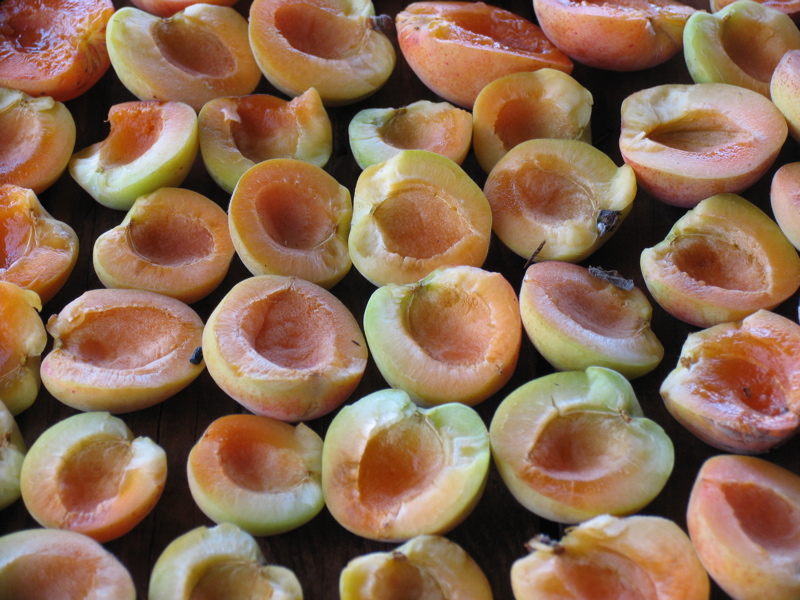
Apricot House (after Wang Wei)
We cut the finest apricot for roof beams
and braided fragrant grasses over them.
I wonder if clouds might form there
and rain upon this world?
The transliteration on Chinese-poems.com reads:
Fine apricot cut for roofbeam
Fragrant cogongrass tie for eaves
Not know ridgepole in cloud
Go make people among rain
Each adaptation poses its challenges, and this one was certainly no exception.
First I identified key words and determined how or whether to use them.
Apricot, roofbeam, cogongrass, eaves, ridgepole, cloud, people, rain.
Apricot was a given. It offered specificity, and feels lovely in the mouth. Roof beams, as well. Cogongrass didn’t make the cut. It is indeed used for thatched roofs in southeast Asia, but it felt clumsy; in this case, the specificity it lent detracted from my reading. And rather than use “thatched” I chose “braided” to imply the layered effect of thatching, and to imply movement, to mesh with and support the idea of clouds forming and drifting under the roof. “Not know” posed a question: did it mean ignorance or simply being unaware, or perhaps a state of wonderment? I first employed “unaware” but thought it took the poem in a different direction than Wang Wei intended (but who knows?). “Ridgepole” seemed unnecessary. So I chose to let the reader follow the unsaid – using “form there” to reinforce the impression already shaped by the roof beams and the grasses “over them.” I admit to some trepidation over the second couplet. It may still need work.

 O at the Edges
Uncertainty about expressing uncertainty — so very apt. For what it’s worth, I like your interpretation!
LikeLiked by 2 people
Thanks for being certain!
LikeLiked by 1 person
So much mystery and possibility in so few lines! I do love watching as you tease the meanings out of the translated poems.
LikeLiked by 1 person
These poems have endured for centuries. It’s amazing that they still speak to us.
LikeLike
I enjoyed this poem, also may I add, my mouth is watering for ripened apricots? smiles!
LikeLiked by 1 person
Thank you. Yum, apricots!
LikeLike
I look at your translation organically. The clouds, representing nature, are also entranced by the beauty of this apricot roof and thinks the roof is alive, ie. part of nature. Hence the cycle of rain, nourishing apricots and grasses continues, even with this man made house.
LikeLiked by 1 person
Thanks, Phil. I like your reading of it.
LikeLiked by 1 person
Reblogged this on Perth Words… exploring possibilities. and commented:
I find the translation of poetry fascinating.
LikeLiked by 1 person
Thanks for reblogging!
LikeLiked by 1 person
I admire your conscious taste for words.
LikeLiked by 1 person
Some taste better than others!
LikeLike
The original poem is “文杏栽為梁,香茅結為宇。不知棟里雲,去作人間雨。” It is really hard to translate into English, and I enjoy your translation.
BTW, do you know Chinese?
LikeLiked by 1 person
Thank you. Unfortunately I have no Chinese and am dependent upon the transliterations I find.
LikeLike
Bob, your adaptations continue to be a wonderment but not more so than your opening the mysteries of your process. It still seems like magic or witchcraft to me, but it’s nice witchcraft!
Ron
LikeLiked by 1 person
Thanks, Ron. In these short pieces, connotation and evocation are all important. But of course magic wands play a part, too…
LikeLike
Your interpretations of these beautiful classics create new classics.
LikeLiked by 2 people
Thanks very much!
LikeLike
Thanks for letting us into the kitchen of translation!
LikeLiked by 1 person
Next stop: living room!
LikeLike
I’ve always assumed you translate from mandarin, but for dome reason reading this post, I wondered – are you starting from the transliteration and adding your own flavour?
LikeLiked by 1 person
Alas, my ignorance forces me to start from the translilteration.
LikeLike
Either way, your poems are beautiful. Thanks for the insight into your process. You’re essentially getting prompt words to start and then like someone else said, you add your magic…
LikeLiked by 1 person
This is why I call them adaptations – I’m using someone else’s interpretations of the characters and applying my reading, my vision, to produce what I hope is something with a similar tone to the original.
LikeLiked by 1 person
I hadn’t really thought about the process of adaptation before, butI love the end product here.
LikeLiked by 1 person
Working on these adaptations has given me a deeper appreciation for the poets, and has certainly influenced my way of looking at poetry.
LikeLike
Oh, I love your process. And I particularly like this result. But I’m wondering if “world” is too encompassing for the author’s intent? But I can’t think of a better alternative. I think you have chosen well.
LikeLiked by 1 person
I pondered the same question and in the end felt that “world” fit better into my concept of Wang’s Buddhism. I didn’t like the word “people” in the transliteration, and “humanity” or some variant seemed out of place, and I wanted something encompassing. But again, I’m not convinced that I’m done with this one.
LikeLiked by 1 person
Perhaps it will come to you when you’re not thinking about it. Please let me know if you do. But the current version does provide the moment of illumination that is quite lovely.
LikeLiked by 1 person
This one is a bit different from the others. I love your variety. 🙂
LikeLiked by 1 person
I thought it might serve as a good companion piece to my poem, “Apricot Wood.” 🙂
LikeLiked by 1 person
I’ll check it out.
LikeLiked by 1 person
I think once again you’ve done a fine job here, and I congratulate you on it. God bless, and I’ll read you later.
LikeLiked by 1 person
Thanks very much.
LikeLike
Hello..
Pretty Good..
Follow me @
http://pimplehead.wordpress.com
LikeLike
Thank you.
LikeLike
Poetry is tough to translate, so much is often lost. No real equivalencies from one language to another. It takes a poet to translate another poet. Nice work!
LikeLiked by 1 person
Retaining the poetic feel is perhaps the most challenging (and rewarding) aspect.
LikeLiked by 1 person
Maybe I’m predisposed to reading things a certain way….but….this has to be one of the most sensual interpretations of Woman. You couldn’t have picked a better photograph! 🙂
LikeLiked by 1 person
I like that interpretation (and your predisposition) but must confess that it had never occurred to me. 🙂
LikeLike
Well, until now, I guess 😀
LikeLiked by 1 person
You have a point!
LikeLike
Just found this one. It is exquisite!
LikeLiked by 1 person
I’m so pleased you found it!
LikeLike