
The Lovely Wife and her boon companion Apollonia, the 5-lb terror of Texas, are in the country, shooting arrows, fixing weed whackers, burning wood and sipping Chianti with the neighbor, leaving me bereft, alone but for Jackboy, the loyal cattle dog, and forced to fend, alas, for myself. So after a vigorous cardiac rehab session I repaired to my favorite bar, er, grocery store, and while meandering with a “mazy motion” like Kubla Khan’s sacred river through the aisles laden with organic produce, wondrous cheeses, craft beers and dubious dietary supplements, what did I spy but a comely little top round bison roast! I’d never before prepared said roast, but throwing caution to the wind is of course part and parcel to fending for oneself, and it was a breezy day. And while resting at the bar, er beverage sampling station, and sampling the wares (a local German-style pilz), I pondered the piece of meat and eavesdropped among my fellow samplers – talk of shopping conquests, welding, 14th century navigation and hoppy beer. But what to do with the roast? Certainly not an ordinary potato and carrot concoction. Chili? Nah, just had it. Grilled? Are you kidding? And then I overheard the word, the one way, the truth: carnitas, which instantly transported me through various savory stretches of the world and multiple cuisines, initiating salivary gland overload, but leading, in the end, to what I hoped would become a culinary delight, or at least an edible dinner.
I knew that I should braise the meat, as this particular cut of bison was very lean (hell, bison is very lean), but it was late and I was famished. So I did what any bright, hungry, middle-aged sojourner of the kitchen would do: put it off. But thinking it might be nice to enhance the depth of flavor, I threw together a few dry ingredients (salt, sugar, 5-spice powder, ground pepper), sprinkled the mixture on the roast, and set it in the refrigerator to cure overnight.
[To assuage my hunger I fried some leftover rice with ham, green onion, jalapenos, carrots and peas. Tweren’t bad.]
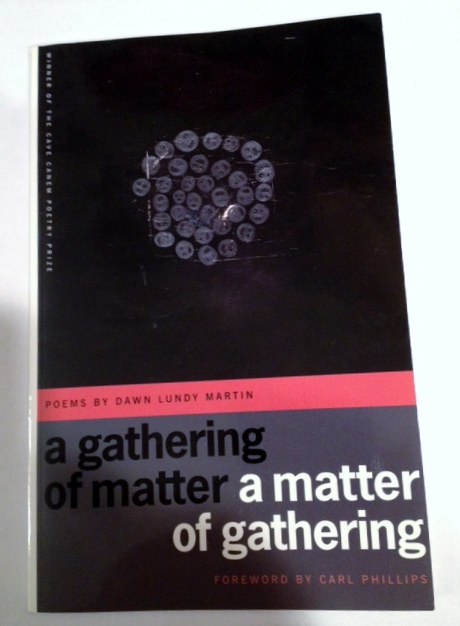
And the next day, after taking The Lovely Wife’s dobro to the repair shop, reading Dawn Lundy Martin’s A Gathering of Matter a Matter of Gathering (amazing poet, incredible poetry) at Hopfield’s gastropub while enjoying the Pascal Burger (medium rare with camembert, cornichons and carmelized onions) and frites accompanied by a delightful tulip of Birra del Borgo’s American Pale Ale,and following this with a productive and pleasant writing session in the poetry shack, I commenced preparing dinner…

…which began with opening a bottle of Parducci Small Lot Blend Pinot, and pondering Dawn Lundy Martin’s book. The collection opens with “Last Days,” a poem of death and grief and what lies before, between and after, consisting of questions and replies. But such questions. Such replies! She begins the poem:
What is the relation between Figure A and Figure B?
This is what the father has become.
And ends it:
How is the pain endured?
A stem of grass imagined when it is not raining.
All those things called intentions. The private / treasures one keeps safe.
The depths, the deliberation, the complexities of language and image brought forth in the replies, astound (confound?) me. So much to consider. And what lies between the opening and ending serves to build, layer by layer, the emotional foundation, adding texture and nuance, providing power in detail and, yes, simplicity. Wonderfully complex and beautifully done. But back to the pinot (light, spicy, woody aroma (cedar?), and balanced, though unlike Martin’s work, not complex, but hey, it was only $11), and cooking:
First I inventoried my supplies, starting with veggies: three slightly withered carrots, one whole onion, garlic, three jalapenos, a small knob of ginger, one red pepper, four green onions, half of a small red cabbage, and a poblano pepper that had seen better days. Next, the braising liquid. Hmm. Which primary liquid? Pinot? No, I wanted to drink it and wasn’t willing to share with the bison. Sherry? Nah, use it too often. Chicken broth? Water? Surely you jest. And then I spotted a partially full (empty? was I truly feeling optimistic?) bottle of sake, resting amiably next to its close friend, Ms. Soy Sauce. Braising liquid, check.
I peeled and fine-diced the carrots, sliced the jalapenos lengthwise into thin strips, diced the red pepper and onion, salvaged what I was able of the poblano (about half had gone mushy) and diced that, and minced three cloves of garlic and the knob of ginger, reserving half of the ginger for later use.
Then I patted the roast dry with a paper towel removing the excess moisture drawn out by the rub, after which I seared it in a little oil in a Dutch oven. After judging the roast suitably crusty, I removed it and added the carrots, onion and peppers, sauteed them until softened, added the garlic and ginger, two tablespoons of soy sauce and the rest of the bottle of sake, perhaps three quarters of a cup. I brought this up to a roil, turned down the heat, let it simmer for a few minutes, and then covered and placed the Dutch oven into the oven, where it remained for two and-a-half hours, simmering gently at 350 degrees.
While the roast braised, I shredded the remnants of the red cabbage, sliced the green onions, prepared a dressing consisting of rice vinegar, sesame oil, hoisin sauce, hot mustard, minced garlic and the reserved ginger, and tossed it all together, resulting in an in-your-face but nevertheless tasty slaw.
And after the allotted time, I removed the bison from the oven and shredded it with a fork – yes, it was that tender – placed a bit of it in taco shells (hey, these are MY carnitas, not your mama’s), topped the meat with some of the cooked veggies, dolloped a bit of creme fraiche on that (I’d found a partial container in the fridge, only a month past the “sell by” date), covered that with the slaw, and took a bite. My. Goodness. Wow. More. Want more. All in all, I must proclaim that the Asian-Inspired Bison Carnitas with Hoisin Slaw was a success. I give it two thumbs up, and a few assorted toes.
But I’m still pondering Dawn Lundy Martin, and have turned to her latest (I think) book, Discipline, which looks to be every bit as intriguing as A Gathering of Matter a Matter of Gathering.





 O at the Edges