Wherein the Book Implies Source

book

Wherein the Book Implies Source 

And words form the vessel by which we traverse centuries, the river
stitched across the valley’s floor, easing access.

Accession by choice. Inorganic memory.

Vellum conveys its origin: of a calf.

How like an entrance it appears, a doorway to a lighted space.
Closed, it resembles a block of beech wood.

To serve as conveyance, to impart without reciprocity.

Framing the conversation in space, immediacy fades.

The average calfskin may provide three and a half sheets of writing material.
Confined by spatial limitation, we consider scale in terms of the absolute.

The antithesis of scroll; random entry; codex.

A quaternion equalled four folded sheets, or eight leaves: sixteen sides.

Reader and read: each endures the other’s role.
Pippins prevented tearing during the drying and scraping process.

Text first, then illumination.

Once opened, the memory palace diminished.

* * *
This originally appeared in April 2014 as part of Boston Review’s National Poetry Month Celebration, and is included in The Circumference of Other, my offering in the Silver Birch Press chapbook collection, IDES, published in 2015.

ides front cover 92915

ECLECTICA MAGAZINE’S 20th Anniversary Best Poetry Anthology is Now Available

eclectica

I’m delighted to have a poem included in this stunning 180-page anthology published by one of the earliest online magazines. It is available for purchase here at CreateSpace and also at Amazon. If you order it through CreateSpace, Eclectica will receive a larger share of the royalties. And while you’re there, check out their Speculative, Nonfiction and Fiction anniversary editions as well. Only $12!

My included poem, “Memorial Day,” was written in 2001 or 2002, but languished in a folder for more than a dozen years before I sent it to Eclectica, where it subsequently appeared in the July/August 2014 issue. You never know what’ll happen to/with your poems, but I certainly never expected this. What an honor!

Fifty-Word Review: Greenhouses, Lighthouses by Tung-Hui Hu

Tung-Hui Hu’s Greenhouses, Lighthouses highlights lyrical precision in poems that bounce between such diverse launching points as photographic sequences, Euripedes, union slogans, woodcuts and even an historical seaman’s guide. His language placates and challenges, whispers, cajoles and insinuates, and overflows with layered possibilities and nuance. You must read his work.

This first appeared in January 2014.

photo(10)

Obsession: Books, or, Poetry Finds Me

photo 2

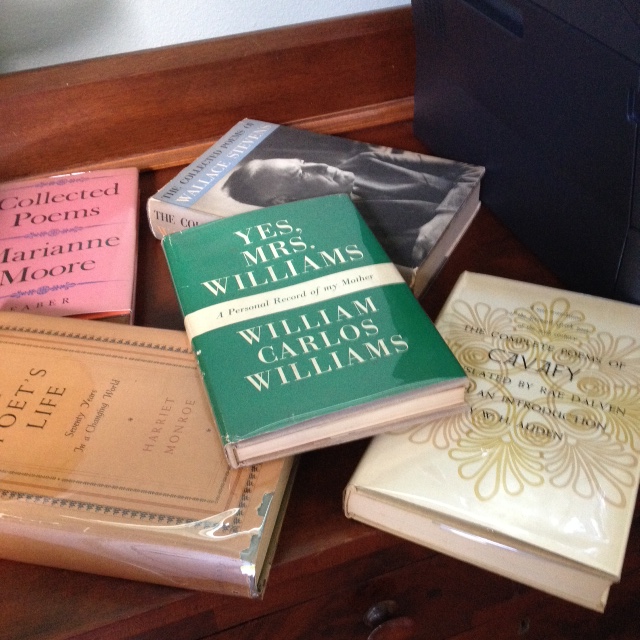
In another life books framed my days. I slept with them, dreamt about them, woke to their presence stacked by the bed and in various corners throughout the house, read them, handled them, discussed their merits with friends, co-workers, beer-drinking buddies, bartenders, customers, strangers, relatives, and even enemies. Traced my fingers slowly down their spines, identified some by odor alone, others by weight and feel. Bought, sold, cleaned, lent, skimmed, traded, gave, borrowed, collected, repaired, preserved, received. Traveled to acquire more, returned home to find still others languishing in never-opened, partially read or barely touched states. There were always too many. There were never enough.

The relationship began innocently. I’ve been an avid reader since the age of five, and over the years developed a knack for uncovering uncommon modern first editions. I’d walk into a thrift shop and spot a copy of William Kennedy’s first novel, The Ink Truck, snuggling up to Jane Fonda’s workout book, for a buck. Or at a small town antique store, something especially nice, perhaps a near-fine first edition of Cormac McCarthy’s Outer Dark, would leer at me from a dark shelf – $1.50. John Berryman’s Poems (New Directions, 1942) found me at a garage sale, for a quarter. Good Will yielded Pynchon’s Gravity’s Rainbow. There were others, of course. Many others.

I partnered with a few like-minded friends and opened a store, and when that didn’t work out, started my own home-based book business, which eventually expanded into a small brick-and-mortar shop, a true labor of love. And I mean labor. The forlorn space we rented was cheap and had housed for years a low-end, illicit massage parlor. Cleaning it out was, oh, shall we say interesting? I’ll never forget the furry massage table, the naked lady lamp or the various implements left behind after the joint was finally forced to close. But we hauled out the filthy carpeting, stripped and refinished the hardwood floors, fixed, painted and patched what we could, and hid what we couldn’t. It was exhausting, but well worth the toil.

My work schedule ran from Monday through Sunday, a minimum of eighty hours a week – in a seven-year period, I took off only two long weekends. It consumed me, but in the end I emerged mostly intact, a little more aware of my proclivities, of an unhealthy tendency to immerse myself wholly into an enthusiasm, to the detriment of family and friends. When we sold our store’s wares, I embraced the change; some dreams simply deplete you. But the itch remained.

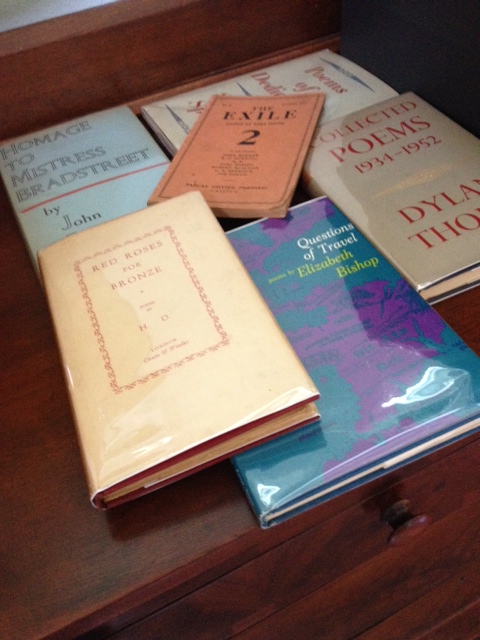
Just a few weeks ago I found myself perusing an accumulation of books in a storage facility across the street from a junk shop in Llano, Texas, a small county seat an hour’s drive west of my home on the outskirts of Austin. The shop’s owner had purchased an English professor’s estate, and judging by the collection, the professor had specialized in poetry. My first thought was “I want it all,” but reason set in (I could very well imagine my wife’s reaction were I to arrive home with a trailerful of books) so I glanced over the criticism, fiction, drama, essays and biographies, and concentrated on the poetry. In the end I walked away with thirty-one books, including H.D.’s Red Roses for Bronze (Chatto & Windus, 1931), Randall Jarrell’s Little Friend, Little Friend, Elizabeth Bishop’s Collected Poems and Questions of Travel, a brace of Berrymans – His Toy, His Dream, His Rest and Homage to Mistress Bradstreet – both the U.S. and U.K. first editions, which differ – and Love & Fame. A good haul, to say the least, but one that left me only partially satisfied and contemplating a return. But I remain resolute. So far.

As I said, the itch remains…

This first appeared in April 2015.

photo 1(1)

Which Poet, Which Beer (3)

beer

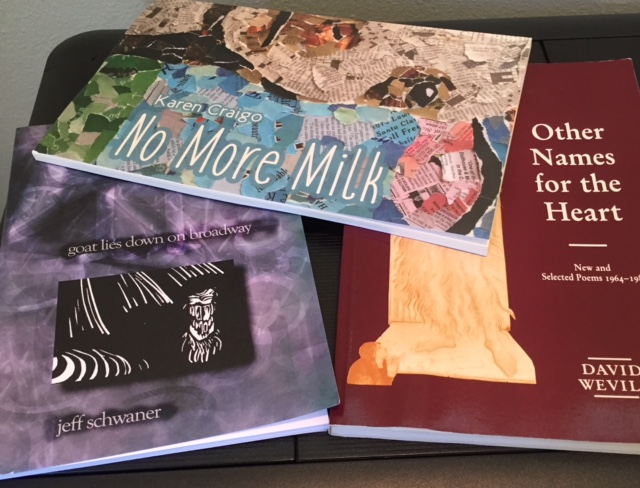
Nebraska Brewing Company’s Melange a Trois, a strong Belgian-Style Blonde ale, aged for six months in French Oak Chardonnay barrels, carries a good bit of the wine, with citrus and a hint of vanilla. A little musty, with an excellent frothy head, which, I believe, could describe me most mornings. But I digress. Deceptively strong (11+ ABV) with a pleasant bitterness. I would pair this with a plate of cured meat and David Wevill’s Other Names for the Heart: New and Selected Poems 1964-1984.

He writes in “Grace”:

… Sometimes lately

a bird you can’t identify has flitted close
and sung from the branches of his hands.

He leaves us touching ourselves.

Over the past thirty years, much of Wevill’s writing has left me with unrequited questions, with an itch to branch out, to learn more, to delve deeper into what makes us human.

But there are those days when introspection flies out the back door into the overgrown backyard, and all you want to do is sit back, watch the football game, relax, be entertained, escape. On those days I’ll break out a few cans of Austin Beerworks Pearl Snap, a German-style pilsner, moderately malty, straw-colored, with citrusy hops evident. A clean, palate-cleansing drink, good with nachos or chips, or hell, even with a Greek salad (heavy on the feta and olives, please). And if you’re like me and can’t devote yourself fully to the game, multitask – dip into Jeff Schwaner’s Goat Lies Down on Broadway, and absorb “Goat Reads the Signs”:

The sun rises like music
every morning. Wind goes
around the world and comes
back in a week or two. Goat
waits on top of a hill, judging…

As do we. Don’t stop there. Continue. Turn off the tube – one team will win, the other will lose. But Goat never wins. Goat never loses. Goat befriends Jerry Falwell. Goat eats Jerry’s tie. Goat ingests Sartre. Goat dies. “Goat is never dead.” A lively read, to say the least.

And speaking of lively, Independence Brewery’s Lupulust is a traditional Belgian-style tripel with a touch of modern hoppiness. It pours with a big head and spicy, floral notes, with a dry finish, reminding me of Karen Craigo’s No More Milk, in which she speaks of life – ordinary life – which, in her hands, becomes like that floral scented, big, hoppy beer. In “Scat with Mourning Dove” the narrator wakes “to syncopated song” and marvels at the bird’s jazz refrains from her place in bed with “a body warm against mine,” celebrating

how God made us, made jazz,
made an instrument of a dove.

Sip this book. Share it with friends. Take it to bed with a glass of warm milk. Savor it.

no-more-milk

August 18 Update to 2016 Tupelo Press 30/30 Challenge

image

Dear friends: Thanks to your generosity, with eleven days remaining, I’ve reached 83% of my revised goal of $1,000. With your help, I’ll pass that lofty mark before the end of the month. If you’re able and willing, I could use your assistance – as of today, 8 title sponsorships remain, and as many (or more) 3-word challenges are left. And quite frankly, if you provide a title or 3-words, my semi-fried brain won’t have to work as hard.

Remember: Tupelo Press is a nonprofit literary publisher. The funds support their publishing efforts. I signed up for this because I believe in the power of poetry, and I believe in Tupelo Press.

Here are a few incentives:

Name That Poem! For $10 donation, you provide a title, and I’ll write the poem during the marathon. Make the title as long or as interesting as you wish – consider this a dare! We began the month with “Nose-Picking Reese’s Hider.” How will the month end?

Use These Words, Poet! For an $11 donation, you can offer 3 words that I must use in a poem. Why only 3? Because I’m (a) chicken (pawk, pawk!), and (b) I hate relinquishing control of my poetry’s language. Yes, yes, I know. This says horrible things about my character. But look at it this way, you could combine the first two incentives to force me to use your title AND three words that I likely wouldn’t use otherwise, which is about as much control as I’m able to give up (shuddering). Be kind. Or not.

Isn’t Broadside a Military Term? Well, yeah, but in this case it’s also a printed poem. For a $15 donation, you’ll receive sometime in September a signed broadside (printed on 8.5 x 11 paper or card stock) of any of the poems I produce during the 30-30 marathon. Your choice.

Editors, Critique My Poem! I have only one of these remaining (unless we can convince an editor or two to contribute even more of their precious time). For a $20 donation, one of the participating editors, chosen at random, will critique your poem(s) (no more than three pages total, either one poem up to three pages long, a two-page poem plus a one-page poem, or three one-page poems). This is a wonderful (tax-deductible for U.S. participants) opportunity to have experienced lit mag editors examine your work and let you know what they think of it.

Participating editors include: Karen Craigo (whose recently released volume of poetry, No More Milk, is a must-read!), nonfiction editor of Mid-American Review and an editor of Gingko Tree Review; Jennifer Finstrom, poetry editor of Eclectica; Jeff Santosuosso, editor of Panoply; Anthony Frame, editor of Glass Poetry Press (which includes Glass: A Journal of Poetry) and poetry editor of Indianola Reviewand Matt Larrimore, Editor-in-Chief of Four Ties Lit Review.

Think Dink! A $30 donation will get you my 2015 chapbook If Your Matter Could Reform, Barton Smock’s Infant Cinema, Jamie Hunyor’s A New Sea, and Tim Kahl’s full length book, The String of Islands, thanks to the generosity of Dink Press founder and editor Kristopher Taylor!  A limited quantity is available, so order earlier rather than later.

If none of these incentives appeals to you, but you’d still like to help, I’m open to suggestions. Last year I sent signed poems to several donors, and even recorded a poem for another’s blog. Don’t limit yourself to the aforementioned incentives. Think big! Let’s have fun!

If you choose to sponsor me, please click on the links to my Tupelo Press 30/30 donation page, or after August 1, visit the 30/30 page, click on the donate button, and then my name. And please inform me of your donation and provide your contact info via email at robertokaji at yahoo dot com or through Facebook so that I may thank you and arrange or send your premium.

If you’ve seen through this blog or other outlets enough of my writing to last your remaining days, you might consider a $99 subscription to Tupelo’s regular subscription series (which I have done), which garners you nine books from one of the country’s top literary presses! If you choose this option, please indicate in the comments that you are subscribing to the 9 books for $99 option, specify “in honor of” and insert my name, “Robert Okaji,” to show your support for my efforts.

For more information on the 30/30 Project, and to read the daily poems, see: https://tupelopress.wordpress.com/3030-project/ I’ll likely post updates daily, but we’ll see. Things are going to be hectic. No matter what, I look forward to reading your comments. Thanks very much!

Many, many thanks to Karen Craigo, Jennifer Finstrom, Anthony Frame, Matt Larrimore, Jeff Santosuosso and Kristopher Taylor for their generous spirits and willingness to help out.

Update to August 2016 Tupelo Press 30/30 Challenge

image

In August I am participating in the Tupelo Press 30/30 challenge, a fundraiser for this outstanding nonprofit publisher. I have pledged to write 30 poems in 30 days, and hope that you might follow along and consider supporting poetry and literary publishers by making a donation. Every bit helps. To make this fun, and with hopes of enticing you, I’ve instituted a few incentives:

Name That Poem! For $10 donation, you provide a title, and I’ll write the poem during the marathon. As of July 30, only 20 titles remain – I have five in hand, with another five committed. Be imaginative. Make the title as long or as interesting as you wish – consider this a dare! We begin the month tomorrow with “Nose-Picking Reese’s Hider,” which was sponsored by a generous anonymous donor.

Use These Words, Poet! For an $11 donation, you can offer 3 words that I must use in a poem. Why only 3? Because I’m (a) chicken (pawk, pawk!), and (b) I hate relinquishing control of my poetry’s language. Yes, yes, I know. This says horrible things about my character. But look at it this way, you could combine the first two incentives to force me to use your title AND three words that I likely wouldn’t use otherwise, which is about as much control as I’m able to give up (shuddering). Be kind. Or not.

Isn’t Broadside a Military Term? Well, yeah, but in this case it’s also a printed poem. For a $15 donation, you’ll receive sometime in September a signed broadside (printed on 8.5 x 11 paper or card stock) of any of the poems I produce during the 30-30 marathon. Your choice.

Editors, Critique My Poem! For a $20 donation, one of the participating editors, chosen at random, will critique your poem(s) (no more than three pages total, either one poem up to three pages long, a two-page poem plus a one-page poem, or three one-page poems). This is a wonderful (tax-deductible for U.S. participants) opportunity to have experienced lit mag editors examine your work and let you know what they think of it.

Participating editors include: Karen Craigo (whose recently released volume of poetry, No More Milk, is a must-read!), nonfiction editor of Mid-American Review and an editor of Gingko Tree Review; Jennifer Finstrom, poetry editor of Eclectica; Jeff Santosuosso, editor of Panoply; Anthony Frame, editor of Glass Poetry Press (which includes Glass: A Journal of Poetry) and poetry editor of Indianola Reviewand Matt Larrimore, Editor in Chief of Four Ties Lit Review.

Think Dink! A $30 donation will get you my 2015 chapbook If Your Matter Could Reform, Barton Smock’s Infant Cinema, Jamie Hunyor’s A New Sea, and Tim Kahl’s full length book, The String of Islands, thanks to the generosity of Dink Press founder and editor Kristopher Taylor!  A limited quantity is available, so order earlier rather than later.

If none of these incentives appeals to you, but you’d still like to help, I’m open to suggestions. Last year I sent signed poems to several donors, and even recorded a poem for another’s blog. Don’t limit yourself to the aforementioned incentives. Think big! Let’s have fun!

If you choose to sponsor me, please click on the links to my Tupelo Press 30/30 donation page, or after August 1, visit the 30/30 page, click on the donate button, and then my name. And please inform me of your donation and provide your contact info via email at robertokaji at yahoo dot com or through Facebook so that I may thank you and arrange or send your premium.

If you’ve seen through this blog or other outlets enough of my writing to last your remaining days, you might consider a $99 subscription to Tupelo’s regular subscription series (which I have done), which garners you nine books from one of the country’s top literary presses! If you choose this option, please indicate in the comments that you are subscribing to the 9 books for $99 option, specify “in honor of” and insert my name, “Robert Okaji,” to show your support for my efforts.

For more information on the 30/30 Project, and to read the daily poems, see: https://tupelopress.wordpress.com/3030-project/ I’ll likely post updates daily, but we’ll see. Things are going to be hectic. No matter what, I look forward to reading your comments. Thanks very much!

Many, many thanks to Karen Craigo, Jennifer Finstrom, Anthony Frame, Matt Larrimore, Jeff Santosuosso and Kristopher Taylor for their generous spirits and willingness to help out.
August 2016 Tupelo Press 30/30 Challenge

image

In August I am participating in the Tupelo Press 30/30 challenge, a fundraiser for this outstanding nonprofit publisher. I have pledged to write 30 poems in 30 days, and to find sponsors to assist in this endeavor. If you have the time and inclination, please follow along and consider supporting poetry and literary publishers by making a donation. Every bit helps. To make this fun, and with hopes of enticing you, I’ve instituted a few incentives:

Name That Poem! For $10 donation, you provide a title, and I’ll write the poem during the marathon. Be imaginative. Make the title as long or as interesting as you wish – consider this a dare! But this incentive is limited to only thirty titles, and reduces by one every day of the marathon, so reserve your slot soon! Last year’s titles ranged from one word (“Stuck,” “Bent,” “Latitude,” “Katharsis”) to upwards of 80 (“Robert Okaji, Forced By This Title to Write a Poem in Third Person About Himself, Considers the Phenomena of Standing Waves, Dreams Involving Long-Lost Cats (Even If He Has Not Had Such a Dream Himself), And the Amazing Durability of Various Forms of Weakness, In a Meditation Which Following the Form of Certain Sung Dynasty Poets Also Happens to Be Written in a Way That Can Be Chanted to the Tune of a Popular Song of His Youth”), and also included such atrocities as “Calvin Coolidge: Live or Memorex,” “Your Armpits Smell Like Heaven,” and “Reduce Heat and Simmer Gently Without Cloud Cover, Till Sundown. Serves 2 – 7 Billion.” These last three were, of course, among my favorites to write.

Use These Words, Poet! For an $11 donation, you can offer 3 words that I must use in a poem. Why only 3? Because I’m (a) chicken (pawk, pawk!), and (b) I hate relinquishing control of my poetry’s language. Yes, yes, I know. This says horrible things about my character. But look at it this way, you could combine the first two incentives to force me to use your title AND three words that I likely wouldn’t use otherwise, which is about as much control as I’m able to give up (shuddering). Be kind. Or not.

Isn’t Broadside a Military Term? Well, yeah, but in this case it’s also a printed poem. For a $15 donation, you’ll receive sometime in September a signed broadside (printed on 8.5 x 11 paper or card stock) of any of the poems I produce during the 30-30 marathon. Your choice.

Editors, Critique My Poem! For a $20 donation, one of the participating editors, chosen at random, will critique your poem(s) (no more than three pages total, either one poem up to three pages long, a two-page poem plus a one-page poem, or three one-page poems). This is a wonderful (tax-deductible for U.S. participants) opportunity to have experienced lit mag editors examine your work and let you know what they think of it.

Participating editors include: Karen Craigo (whose recently released volume of poetry, No More Milk, is a must-read!), nonfiction editor of Mid-American Review and an associate editor of Gingko Tree Review; Jennifer Finstrom, poetry editor of Eclectica; Jeff Santosuosso, editor of Panoply; Anthony Frame, editor of Glass Poetry Press (which includes Glass: A Journal of Poetry) and poetry editor of Indianola Reviewand Matt Larrimore, Editor in Chief of Four Ties Lit Review.

Think Dink! Thanks to the generosity of Dink Press founder and editor Kristopher Taylor, $30 donation will get you the Dink Press Collection: 3 chapbooks, including my 2015 work If Your Matter Could Reform, Barton Smock’s Infant Cinema, one of the more interesting chapbooks I’ve read in the past year, Jamie Hunyor’s A New Sea, and Tim Kahl’s full length book, The String of Islands. A limited quantity is available, so order earlier rather than later.

If none of these incentives appeals to you, but you’d still like to help, I’m open to suggestions. Last year I sent signed poems to several donors, and even recorded a poem for another’s blog. Don’t limit yourself to the aforementioned incentives. Think big! Let’s have fun!

If you choose to sponsor me, please click on the links to my Tupelo Press 30/30 donation page, or after August 1, visit the 30/30 page, click on the donate button, and then my name. And please inform me of your donation and provide your contact info via email at robertokaji at yahoo dot com or through Facebook so that I may thank you and arrange or send your premium.

If you’ve seen through this blog or other outlets enough of my writing to last your remaining days, you might consider a $99 subscription to Tupelo’s regular subscription series (which I have done), which garners you nine books from one of the country’s top literary presses! This is not tax-deductible, but the quality of writing you receive with this discount is well worth it. If you choose this option, please indicate in the comments that you are subscribing to the 9 books for $99 option, specify “in honor of” and insert my name, “Robert Okaji,” to show your support for my efforts.

For more information on the 30/30 Project, and to read the daily poems, see: https://tupelopress.wordpress.com/3030-project/ I’ll likely post updates daily, but we’ll see. Things are going to be hectic. No matter what, I look forward to reading your comments. Thanks very much!

Many, many thanks to Karen Craigo, Jennifer Finstrom, Anthony Frame, Matt Larrimore, Jeff Santosuosso and Kristopher Taylor for their generous spirits and willingness to help out.

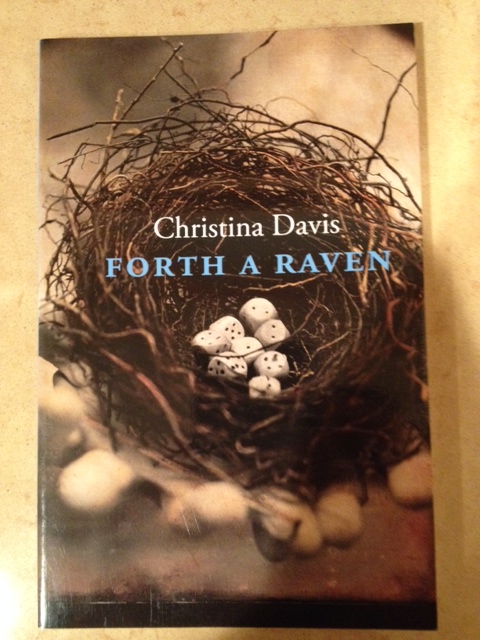
Fifty-Word Review: Forth a Raven, by Christina Davis

(Originally appeared in December 2013)

Christina Davis’s Forth a Raven offers stark, textured, intelligent and lyrical pieces in a stripped-down yet ultimately complex, reflective language. Encompassing the tension of different realms – the spiritual and the secular, the extraordinary and the mundane, her work, quite simply, astounds. Read this book. Seek out her work. It’s sublime.

photo(7)

Wherein the Book Implies Source

book

Wherein the Book Implies Source 

And words form the vessel by which we traverse centuries, the river
stitched across the valley’s floor, easing access.

Accession by choice. Inorganic memory.

Vellum conveys its origin: of a calf.

How like an entrance it appears, a doorway to a lighted space.
Closed, it resembles a block of beech wood.

To serve as conveyance, to impart without reciprocity.

Framing the conversation in space, immediacy fades.

The average calfskin may provide three and a half sheets of writing material.
Confined by spatial limitation, we consider scale in terms of the absolute.

The antithesis of scroll; random entry; codex.

A quaternion equalled four folded sheets, or eight leaves: sixteen sides.

Reader and read: each endures the other’s role.
Pippins prevented tearing during the drying and scraping process.

Text first, then illumination.

Once opened, the memory palace diminished.

This originally appeared in April 2014 as part of Boston Review’s National Poetry Month Celebration, and is included in The Circumference of Other, my offering in the Silver Birch Press chapbook collection, IDES, scheduled to be published on October 15.

ides front cover 92915