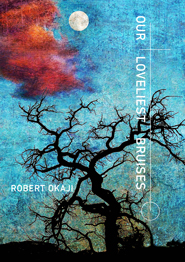
Our Loveliest Bruises is Now Available from 3: A Taos Press

Our Loveliest Bruises

I am thrilled to announce that my first full-length collection, Our Loveliest Bruises, is now available at 3: A Taos Press. Many thanks to publisher Andrea Watson for taking this book and seeing it through, and to Veronica Golos, whose wisdom and encouragement helped make a nebulous dream come true. I am also deeply grateful for the thoughtful and generous blurbs provided by Veronica, David Wevill, Anna Marie Sewell and Michael Simms. Thank you, thank you, thank you!

Celebration 3

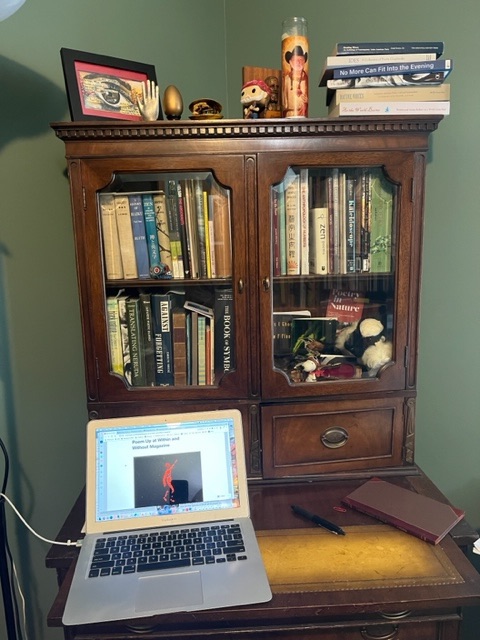
desk photo

3

I have always loved books, their smell and heft, bindings, illustrations, and of course, the stories within. But I don’t recall the title of the first book I personally checked out of the library. I was five-years old, in first grade. It was a Friday, the book was replete with color illustrations, and the story was, perhaps, about a little bear. So long ago. But I read and reread that book all weekend, and I felt (and still feel!) the awe and wonder, mystery and power of that glorious artifact.

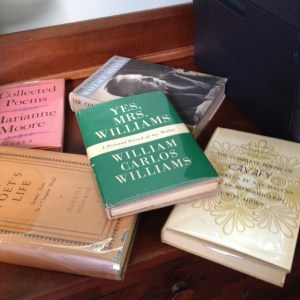
Nearly sixty years later, that awe has never diminished. The books behind my desk’s glass doors offer glimpses at rare beauty and yes, secrets. In front of me sits a U.S. first edition of Remy de Gourmont’s A Night in the Luxembourg (Boston, 1919), which may be an interesting relic in and of itself, but this particular volume bears the bookplate of Jun Fujita, historical figure, poet and photographer extraordinaire. Alongside it rests a much thumbed copy of The Book of Symbols, a source of great contemplation, insight and forehead slapping.

On the shelf above that a volume titled The Anthropology of Numbers, also a treasured resource, nestles just to the left of Kaleidoscope: Poems by American Negro Poets, a landmark 1967 anthology edited by Robert Hayden, the Consultant in Poetry to the Library of Congress from 1976 to 1978. Should your eyes wander down this shelf, you’ll also discover an inscribed copy of David Wevill’s Other Names for the Heart: New and Selected Poems 1964-1984, Maggie Nelson’s The Argonauts, and Kenkō’s Essays in Idleness, translated by Donald Keene.

Why are these books here? How have they come to be gathered in this house in Indiana, on these particular jumbled shelves? Who are the authors? What is their significance? Who knows them, feels them, understands them? What wisdoms have they endured?

Share with me your favorite books—from the volumes you’ve read time and again, to the ones you own simply because you were compelled to possess them, and those that have great significance to you, even if you’ve not read them and never will.

Obsession: Books, or, Poetry Finds Me

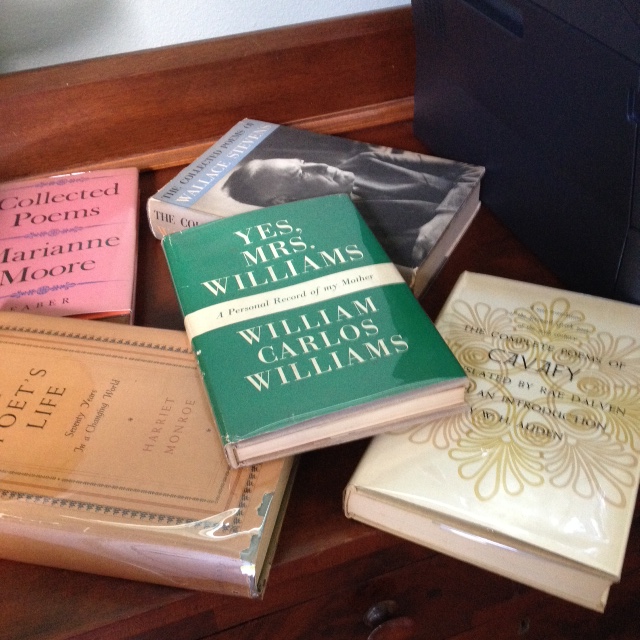
photo 2

In another life books framed my days. I slept with them, dreamt about them, woke to their presence stacked by the bed and in various corners throughout the house, read them, handled them, discussed their merits with friends, co-workers, beer-drinking buddies, bartenders, customers, strangers, relatives, and even enemies. Traced my fingers slowly down their spines, identified some by odor alone, others by weight and feel. Bought, sold, cleaned, lent, skimmed, traded, gave, borrowed, collected, repaired, preserved, received. Traveled to acquire more, returned home to find still others languishing in never-opened, partially read or barely touched states. There were always too many. There were never enough.

The relationship began innocently. I’ve been an avid reader since the age of five, and over the years developed a knack for uncovering uncommon modern first editions. I’d walk into a thrift shop and spot a copy of William Kennedy’s first novel, The Ink Truck, snuggling up to Jane Fonda’s workout book, for a buck. Or at a small town antique store, something especially nice, perhaps a near-fine first edition of Cormac McCarthy’s Outer Dark, would leer at me from a dark shelf – $1.50. John Berryman’s Poems (New Directions, 1942) found me at a garage sale, for a quarter. Good Will yielded Pynchon’s Gravity’s Rainbow. There were others, of course. Many others.

I partnered with a few like-minded friends and opened a store, and when that didn’t work out, started my own home-based book business, which eventually expanded into a small brick-and-mortar shop, a true labor of love. And I mean labor. The forlorn space we rented was cheap and had housed for years a low-end, illicit massage parlor. Cleaning it out was, oh, shall we say interesting? I’ll never forget the furry massage table, the naked lady lamp or the various implements left behind after the joint was finally forced to close. But we hauled out the filthy carpeting, stripped and refinished the hardwood floors, fixed, painted and patched what we could, and hid what we couldn’t. It was exhausting, but well worth the toil.

My work schedule ran from Monday through Sunday, a minimum of eighty hours a week – in a seven-year period, I took off only two long weekends. It consumed me, but in the end I emerged mostly intact, a little more aware of my proclivities, of an unhealthy tendency to immerse myself wholly into an enthusiasm, to the detriment of family and friends. When we sold our store’s wares, I embraced the change; some dreams simply deplete you. But the itch remained.

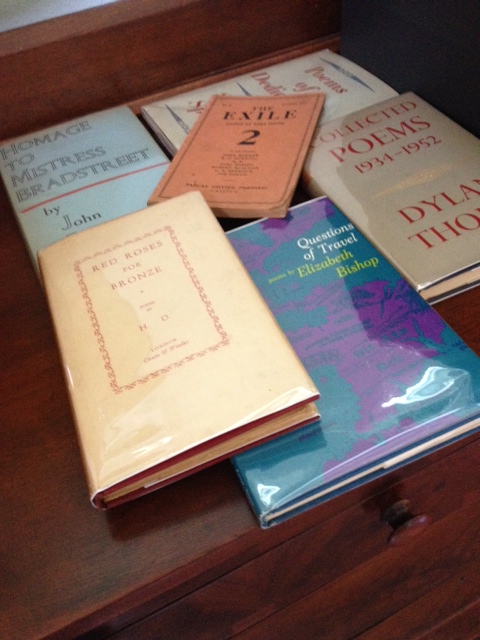
Just a few weeks ago I found myself perusing an accumulation of books in a storage facility across the street from a junk shop in Llano, Texas, a small county seat an hour’s drive west of my home on the outskirts of Austin. The shop’s owner had purchased an English professor’s estate, and judging by the collection, the professor had specialized in poetry. My first thought was “I want it all,” but reason set in (I could very well imagine my wife’s reaction were I to arrive home with a trailerful of books) so I glanced over the criticism, fiction, drama, essays and biographies, and concentrated on the poetry. In the end I walked away with thirty-one books, including H.D.’s Red Roses for Bronze (Chatto & Windus, 1931), Randall Jarrell’s Little Friend, Little Friend, Elizabeth Bishop’s Collected Poems and Questions of Travel, a brace of Berrymans – His Toy, His Dream, His Rest and Homage to Mistress Bradstreet – both the U.S. and U.K. first editions, which differ – and Love & Fame. A good haul, to say the least, but one that left me only partially satisfied and contemplating a return. But I remain resolute. So far.

As I said, the itch remains…

* * *

This first appeared here in April 2015, and yes, the itch is still there. The pandemic has prevented me from haunting used bookstores as I’d imagined I would. But someday…

photo 1(1)

Obsession: Books, or, Poetry Finds Me

photo 2

In another life books framed my days. I slept with them, dreamt about them, woke to their presence stacked by the bed and in various corners throughout the house, read them, handled them, discussed their merits with friends, co-workers, beer-drinking buddies, bartenders, customers, strangers, relatives, and even enemies. Traced my fingers slowly down their spines, identified some by odor alone, others by weight and feel. Bought, sold, cleaned, lent, skimmed, traded, gave, borrowed, collected, repaired, preserved, received. Traveled to acquire more, returned home to find still others languishing in never-opened, partially read or barely touched states. There were always too many. There were never enough.

The relationship began innocently. I’ve been an avid reader since the age of five, and over the years developed a knack for uncovering uncommon modern first editions. I’d walk into a thrift shop and spot a copy of William Kennedy’s first novel, The Ink Truck, snuggling up to Jane Fonda’s workout book, for a buck. Or at a small town antique store, something especially nice, perhaps a near-fine first edition of Cormac McCarthy’s Outer Dark, would leer at me from a dark shelf – $1.50. John Berryman’s Poems (New Directions, 1942) found me at a garage sale, for a quarter. Good Will yielded Pynchon’s Gravity’s Rainbow. There were others, of course. Many others.

I partnered with a few like-minded friends and opened a store, and when that didn’t work out, started my own home-based book business, which eventually expanded into a small brick-and-mortar shop, a true labor of love. And I mean labor. The forlorn space we rented was cheap and had housed for years a low-end, illicit massage parlor. Cleaning it out was, oh, shall we say interesting? I’ll never forget the furry massage table, the naked lady lamp or the various implements left behind after the joint was finally forced to close. But we hauled out the filthy carpeting, stripped and refinished the hardwood floors, fixed, painted and patched what we could, and hid what we couldn’t. It was exhausting, but well worth the toil.

My work schedule ran from Monday through Sunday, a minimum of eighty hours a week – in a seven-year period, I took off only two long weekends. It consumed me, but in the end I emerged mostly intact, a little more aware of my proclivities, of an unhealthy tendency to immerse myself wholly into an enthusiasm, to the detriment of family and friends. When we sold our store’s wares, I embraced the change; some dreams simply deplete you. But the itch remained.

Just a few weeks ago I found myself perusing an accumulation of books in a storage facility across the street from a junk shop in Llano, Texas, a small county seat an hour’s drive west of my home on the outskirts of Austin. The shop’s owner had purchased an English professor’s estate, and judging by the collection, the professor had specialized in poetry. My first thought was “I want it all,” but reason set in (I could very well imagine my wife’s reaction were I to arrive home with a trailerful of books) so I glanced over the criticism, fiction, drama, essays and biographies, and concentrated on the poetry. In the end I walked away with thirty-one books, including H.D.’s Red Roses for Bronze (Chatto & Windus, 1931), Randall Jarrell’s Little Friend, Little Friend, Elizabeth Bishop’s Collected Poems and Questions of Travel, a brace of Berrymans – His Toy, His Dream, His Rest and Homage to Mistress Bradstreet – both the U.S. and U.K. first editions, which differ – and Love & Fame. A good haul, to say the least, but one that left me only partially satisfied and contemplating a return. But I remain resolute. So far.

As I said, the itch remains…

* * *

This first appeared here in April 2015, and yes, the itch is still there. The pandemic has prevented me from haunting used bookstores as I’d imagined I would. But someday…

photo 1(1)

Obsession: Books, or, Poetry Finds Me

photo 2


In another life books framed my days. I slept with them, dreamt about them, woke to their presence stacked by the bed and in various corners throughout the house, read them, handled them, discussed their merits with friends, co-workers, beer-drinking buddies, bartenders, customers, strangers, relatives, and even enemies. Traced my fingers slowly down their spines, identified some by odor alone, others by weight and feel. Bought, sold, cleaned, lent, skimmed, traded, gave, borrowed, collected, repaired, preserved, received. Traveled to acquire more, returned home to find still others languishing in never-opened, partially read or barely touched states. There were always too many. There were never enough.

The relationship began innocently. I’ve been an avid reader since the age of five, and over the years developed a knack for uncovering uncommon modern first editions. I’d walk into a thrift shop and spot a copy of William Kennedy’s first novel, The Ink Truck, snuggling up to Jane Fonda’s workout book, for a buck. Or at a small town antique store, something especially nice, perhaps a near-fine first edition of Cormac McCarthy’s Outer Dark, would leer at me from a dark shelf – $1.50. John Berryman’s Poems (New Directions, 1942) found me at a garage sale, for a quarter. Good Will yielded Pynchon’s Gravity’s Rainbow. There were others, of course. Many others.

I partnered with a few like-minded friends and opened a store, and when that didn’t work out, started my own home-based book business, which eventually expanded into a small brick-and-mortar shop, a true labor of love. And I mean labor. The forlorn space we rented was cheap and had housed for years a low-end, illicit massage parlor. Cleaning it out was, oh, shall we say interesting? I’ll never forget the furry massage table, the naked lady lamp or the various implements left behind after the joint was finally forced to close. But we hauled out the filthy carpeting, stripped and refinished the hardwood floors, fixed, painted and patched what we could, and hid what we couldn’t. It was exhausting, but well worth the toil.

My work schedule ran from Monday through Sunday, a minimum of eighty hours a week – in a seven-year period, I took off only two long weekends. It consumed me, but in the end I emerged mostly intact, a little more aware of my proclivities, of an unhealthy tendency to immerse myself wholly into an enthusiasm, to the detriment of family and friends. When we sold our store’s wares, I embraced the change; some dreams simply deplete you. But the itch remained.

Just a few weeks ago I found myself perusing an accumulation of books in a storage facility across the street from a junk shop in Llano, Texas, a small county seat an hour’s drive west of my home on the outskirts of Austin. The shop’s owner had purchased an English professor’s estate, and judging by the collection, the professor had specialized in poetry. My first thought was “I want it all,” but reason set in (I could very well imagine my wife’s reaction were I to arrive home with a trailerful of books) so I glanced over the criticism, fiction, drama, essays and biographies, and concentrated on the poetry. In the end I walked away with thirty-one books, including H.D.’s Red Roses for Bronze (Chatto & Windus, 1931), Randall Jarrell’s Little Friend, Little Friend, Elizabeth Bishop’s Collected Poems and Questions of Travel, a brace of Berrymans – His Toy, His Dream, His Rest and Homage to Mistress Bradstreet – both the U.S. and U.K. first editions, which differ – and Love & Fame. A good haul, to say the least, but one that left me only partially satisfied and contemplating a return. But I remain resolute. So far.

As I said, the itch remains…


* * *

This first appeared here in April 2015, and yes, the itch is still there. Yesterday I walked into a wonderful bookshop (Black Dog Books) in Zionsville, Indiana, a few miles from my home in Indianapolis, and I felt instantly at home. Ah, the world of books! And yes, I returned home with a small stack of books.
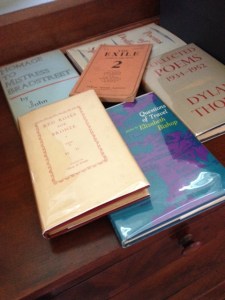
 

photo 1(1)

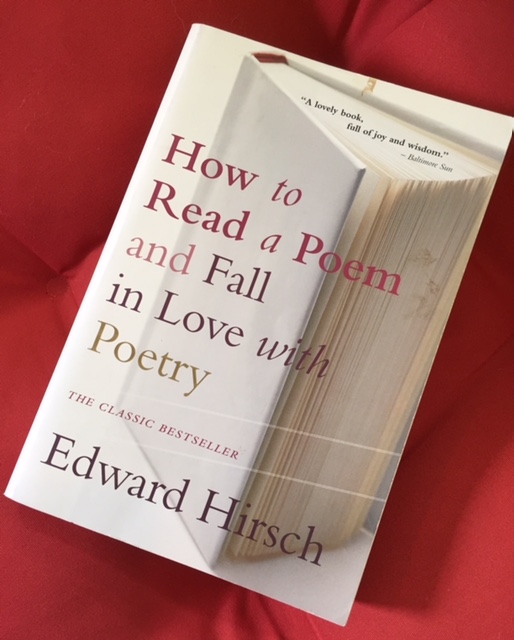
Edward Hirsch’s How to Read a Poem and Fall in Love with Poetry

In a nod to National Poetry Month, the Poetry Foundation has posted the first chapter of Edward Hirsch’s superb How to Read a Poem and Fall in Love with Poetry. One of my favorite all-time reads. If you haven’t read this book, dip into the first chapter now.

Obsession: Books, or, Poetry Finds Me

photo 2

In another life books framed my days. I slept with them, dreamt about them, woke to their presence stacked by the bed and in various corners throughout the house, read them, handled them, discussed their merits with friends, co-workers, beer-drinking buddies, bartenders, customers, strangers, relatives, and even enemies. Traced my fingers slowly down their spines, identified some by odor alone, others by weight and feel. Bought, sold, cleaned, lent, skimmed, traded, gave, borrowed, collected, repaired, preserved, received. Traveled to acquire more, returned home to find still others languishing in never-opened, partially read or barely touched states. There were always too many. There were never enough.

The relationship began innocently. I’ve been an avid reader since the age of five, and over the years developed a knack for uncovering uncommon modern first editions. I’d walk into a thrift shop and spot a copy of William Kennedy’s first novel, The Ink Truck, snuggling up to Jane Fonda’s workout book, for a buck. Or at a small town antique store, something especially nice, perhaps a near-fine first edition of Cormac McCarthy’s Outer Dark, would leer at me from a dark shelf – $1.50. John Berryman’s Poems (New Directions, 1942) found me at a garage sale, for a quarter. Good Will yielded Pynchon’s Gravity’s Rainbow. There were others, of course. Many others.

I partnered with a few like-minded friends and opened a store, and when that didn’t work out, started my own home-based book business, which eventually expanded into a small brick-and-mortar shop, a true labor of love. And I mean labor. The forlorn space we rented was cheap and had housed for years a low-end, illicit massage parlor. Cleaning it out was, oh, shall we say interesting? I’ll never forget the furry massage table, the naked lady lamp or the various implements left behind after the joint was finally forced to close. But we hauled out the filthy carpeting, stripped and refinished the hardwood floors, fixed, painted and patched what we could, and hid what we couldn’t. It was exhausting, but well worth the toil.

My work schedule ran from Monday through Sunday, a minimum of eighty hours a week – in a seven-year period, I took off only two long weekends. It consumed me, but in the end I emerged mostly intact, a little more aware of my proclivities, of an unhealthy tendency to immerse myself wholly into an enthusiasm, to the detriment of family and friends. When we sold our store’s wares, I embraced the change; some dreams simply deplete you. But the itch remained.

Just a few weeks ago I found myself perusing an accumulation of books in a storage facility across the street from a junk shop in Llano, Texas, a small county seat an hour’s drive west of my home on the outskirts of Austin. The shop’s owner had purchased an English professor’s estate, and judging by the collection, the professor had specialized in poetry. My first thought was “I want it all,” but reason set in (I could very well imagine my wife’s reaction were I to arrive home with a trailerful of books) so I glanced over the criticism, fiction, drama, essays and biographies, and concentrated on the poetry. In the end I walked away with thirty-one books, including H.D.’s Red Roses for Bronze (Chatto & Windus, 1931), Randall Jarrell’s Little Friend, Little Friend, Elizabeth Bishop’s Collected Poems and Questions of Travel, a brace of Berrymans – His Toy, His Dream, His Rest and Homage to Mistress Bradstreet – both the U.S. and U.K. first editions, which differ – and Love & Fame. A good haul, to say the least, but one that left me only partially satisfied and contemplating a return. But I remain resolute. So far.

As I said, the itch remains…

* * *

This first appeared in April 2015.

photo 1(1)

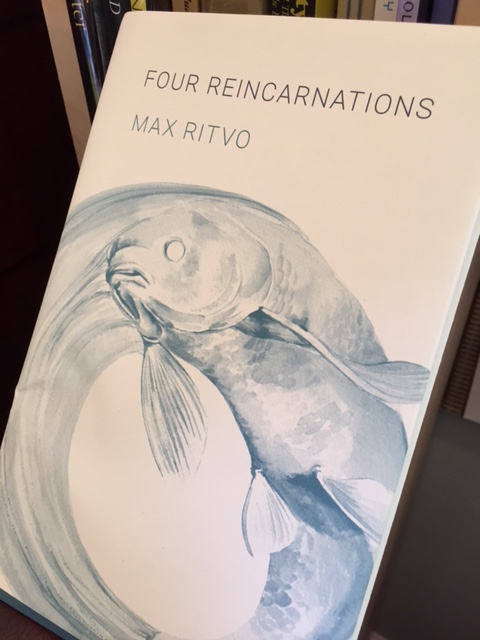
Max Ritvo

The world will see no more Max Ritvo poems, and for that, I grieve.

Read Helen Vendler’s review of his Four Reincarnations in Poetry. Better yet, read the book. It’ll make you ache.

Obsession: Books, or, Poetry Finds Me

photo 2

In another life books framed my days. I slept with them, dreamt about them, woke to their presence stacked by the bed and in various corners throughout the house, read them, handled them, discussed their merits with friends, co-workers, beer-drinking buddies, bartenders, customers, strangers, relatives, and even enemies. Traced my fingers slowly down their spines, identified some by odor alone, others by weight and feel. Bought, sold, cleaned, lent, skimmed, traded, gave, borrowed, collected, repaired, preserved, received. Traveled to acquire more, returned home to find still others languishing in never-opened, partially read or barely touched states. There were always too many. There were never enough.

The relationship began innocently. I’ve been an avid reader since the age of five, and over the years developed a knack for uncovering uncommon modern first editions. I’d walk into a thrift shop and spot a copy of William Kennedy’s first novel, The Ink Truck, snuggling up to Jane Fonda’s workout book, for a buck. Or at a small town antique store, something especially nice, perhaps a near-fine first edition of Cormac McCarthy’s Outer Dark, would leer at me from a dark shelf – $1.50. John Berryman’s Poems (New Directions, 1942) found me at a garage sale, for a quarter. Good Will yielded Pynchon’s Gravity’s Rainbow. There were others, of course. Many others.

I partnered with a few like-minded friends and opened a store, and when that didn’t work out, started my own home-based book business, which eventually expanded into a small brick-and-mortar shop, a true labor of love. And I mean labor. The forlorn space we rented was cheap and had housed for years a low-end, illicit massage parlor. Cleaning it out was, oh, shall we say interesting? I’ll never forget the furry massage table, the naked lady lamp or the various implements left behind after the joint was finally forced to close. But we hauled out the filthy carpeting, stripped and refinished the hardwood floors, fixed, painted and patched what we could, and hid what we couldn’t. It was exhausting, but well worth the toil.

My work schedule ran from Monday through Sunday, a minimum of eighty hours a week – in a seven-year period, I took off only two long weekends. It consumed me, but in the end I emerged mostly intact, a little more aware of my proclivities, of an unhealthy tendency to immerse myself wholly into an enthusiasm, to the detriment of family and friends. When we sold our store’s wares, I embraced the change; some dreams simply deplete you. But the itch remained.

Just a few weeks ago I found myself perusing an accumulation of books in a storage facility across the street from a junk shop in Llano, Texas, a small county seat an hour’s drive west of my home on the outskirts of Austin. The shop’s owner had purchased an English professor’s estate, and judging by the collection, the professor had specialized in poetry. My first thought was “I want it all,” but reason set in (I could very well imagine my wife’s reaction were I to arrive home with a trailerful of books) so I glanced over the criticism, fiction, drama, essays and biographies, and concentrated on the poetry. In the end I walked away with thirty-one books, including H.D.’s Red Roses for Bronze (Chatto & Windus, 1931), Randall Jarrell’s Little Friend, Little Friend, Elizabeth Bishop’s Collected Poems and Questions of Travel, a brace of Berrymans – His Toy, His Dream, His Rest and Homage to Mistress Bradstreet – both the U.S. and U.K. first editions, which differ – and Love & Fame. A good haul, to say the least, but one that left me only partially satisfied and contemplating a return. But I remain resolute. So far.

As I said, the itch remains…

This first appeared in April 2015.

photo 1(1)

Wherein the Book Implies Source

book

Wherein the Book Implies Source 

And words form the vessel by which we traverse centuries, the river
stitched across the valley’s floor, easing access.

Accession by choice. Inorganic memory.

Vellum conveys its origin: of a calf.

How like an entrance it appears, a doorway to a lighted space.
Closed, it resembles a block of beech wood.

To serve as conveyance, to impart without reciprocity.

Framing the conversation in space, immediacy fades.

The average calfskin may provide three and a half sheets of writing material.
Confined by spatial limitation, we consider scale in terms of the absolute.

The antithesis of scroll; random entry; codex.

A quaternion equalled four folded sheets, or eight leaves: sixteen sides.

Reader and read: each endures the other’s role.
Pippins prevented tearing during the drying and scraping process.

Text first, then illumination.

Once opened, the memory palace diminished.

This originally appeared in April 2014 as part of Boston Review’s National Poetry Month Celebration, and is included in The Circumference of Other, my offering in the Silver Birch Press chapbook collection, IDES, scheduled to be published on October 15.

ides front cover 92915