Self-Portrait with Orbit

planet231

Self-Portrait with Orbit

An arced path around a central point, bound to but held apart,
as in night’s returning grace, or standing waves.

In periapsis, you reach out as I slowly withdraw.

Gravity does not prevent departure but prolongs it.

The acceleration of a body is equal to the sum of the gravitational forces, divided by its mass. I rise from the chair but can’t escape.

Not circular but elliptical.

Where falling away and curving from never meet.

Realizing that I am neither focus nor center, I discover place
in symmetry, in flow and subtraction.

A cloud obscures the sun and you close your eyes.

I wither at the thought of scaling or relative size, or your departure.

In the simplest Klemperer rosette, four bodies cycle their dances,
heavy, light, heavy, light, in a rhombic configuration.

My arteries fill in opposition to desire.

Wanting you, I absolve weight and listen, accept my place.

“Self-Portrait with Orbit” is included in The Circumference of Other, my offering in the Silver Birch Press publication, IDES: A Collection of Poetry Chapbooks, available on Amazon.
old man grammo - upsidedown

Night Journey (after Tu Fu)

IMGP3335

First posted in March, 2014.

This is not a translation, but rather a version, my “take” on a famous Tu Fu poem. I claim no abilities in translation, neither speak nor read Chinese, and instead depend upon the skills of those who have ventured into these difficult reaches. This is where the poem carries me, a middle-aged Texas hill county dweller, in the Year of the Horse, 2014.

Night Journey (after Tu Fu)

Wind bends the grass along the road.
A lonely truck passes by.
Stars reach down to touch these hills
and the moon drifts behind.

No one will ever know my poems.
I am too old and ill to work.
Circling, floating, who am I
but a vulture looking down.

Here’s a literal translation of the piece (or so I believe), found on chinese-poems.com:

Nocturnal Reflections While Traveling

Gently grass soft wind shore
Tall mast alone night boat
Stars fall flat fields broad
Moon rises great river flows

Name not literary works mark
Official should old sick stop
Flutter flutter what place seem
Heaven earth one sand gull

My goal was to retain the mood, as I understand it, of the original, and to place it into my personal context. An interesting exercise.

Poet’s Pantry

file3911233869642

In my sliver of the world, poetry and cooking share many qualities. When I step into the kitchen, I often have only a vaporous notion of what’s for dinner. A hankering for roasted poblano peppers, the need to use a protein languishing in the refrigerator, the memory of an herbal breeze wafting down a terraced hill near Lago d’Averno, Hell’s entrance, according to Virgil, or even a single intriguing word, may spark what comes next. But the success of what follows depends upon the ingredients at hand, on how we’ve stocked the pantry. Good products beget better results. Let’s take my desire for roasted poblanos. What to do with them? Poking around, I uncover an opened package of goat cheese, a bit of grated grana padano and some creme fraiche, and I immediately think pasta! Looking further I spot arugula, a lemon, a handful of pecans, some cherry tomatoes. Dinner: Pappardelle with a roasted poblano and goat cheese sauce, garnished with toasted pecans, served with an arugula and cherry tomato salad dressed with a lemon vinaigrette. Simple, when you’ve stocked a solid base of quality components.

My writing employs a similar process. Anything – a vague sense of uneasiness, a particular word, the sunlight slanting through the unfortunate dove’s imprint on my window, articles or books I’ve read or perused on a myriad of subjects – may launch a poem. But what truly makes the poem, what bolsters, fills and completes, what ignites and catapults it arcing into the firmament are, of course, the pantry’s ingredients.

Everyone’s needs differ, and I wouldn’t presume to inflict my peculiar sensibilities on anyone, but if you cracked open my burgeoning poetry pantry’s door, you’d certainly unearth dictionaries and a thesaurus, fallen stars, books on etymology and language, curiosity, a guitar or mandolin, at least one window (sometimes partially open), conversations floating in the ether, various empty frames, wind, dog biscuits and dirty socks, a walking stick, sunlight and shadows, more books on such subjects as ancient navigation, the history of numbers, the periodic table, alchemy and olives. You might also spy reams of paper, unspoken words, coffee cups, a scorpion or two, scrawled notes on index cards, wandering musical notes, a pipe wrench, wood ear mushrooms and salvaged fragments of writing, failed ideas moldering in clumps on the floor, a few craft beers and empty wine bottles, a chain saw, and most important of all, a bucketful of patience.

(I cannot over-emphasize the bucket’s contents…)

This is just to say (no, I didn’t eat the plums) that the best equipped poets stock their pantries with the world and all its questions, with logic, with faith, persistence, emotion, science, art, romance and yes, patience. Line your kit with every tool you can grasp or imagine. Keep adding to it. Read deeply. Listen. Breathe. Listen again. Converse. Look outward. Further, past the trees, around the bend and beyond the horizon’s curve, where the unknown lurks. Look again. Don’t stop. Continue.

And if after all this you’re wondering what basks in my kitchen pantry:
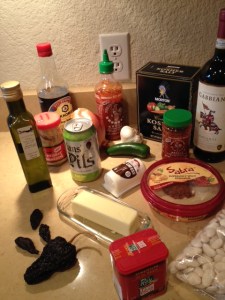
photo(13)

This was originally posted in January, 2014. I’m attending a conference and unable to tend the blog, so a few reposts are forthcoming over the next few days.

Morning Covers You

eye camera

Morning Covers You

1

We extract
light, bleeding
it out one

diamond-shaped
hole after
another.

Finger the results.
Remediation
in form

or placement
to best
advantage?

At night
loneliness cradles
our bones.

2

You arrange our bodies to greater effect,
presuming lesser horrors
to be less.

A list emerges.
Refuting one,
accepting another.

Choices fixed.
Ecstasies of failure
purged.

Morning covers you
like a blue
shroud, so pale.

So cold
and bitter.

This originally appeared in Boston Poetry Magazine in April, 2014.

diamond fence

Incongruities

image

Years ago, I worked in a library…

Incongruities

So little depends
upon

the half-Japanese
bookman

reading Italian
haiku

in the Texas
library.

Once again, my apologies to William Carlos Williams, whose poetry inspires and therefore often bears the brunt of my little diversions into whimsy.

image

December Moon (1999)

december moon

December Moon (1999)

If loneliness breathes,
then rain is its heart,

always falling to its lowest point
before receding. Water graces us

daily in all its forms – the slowest
drop, the line of ice on the wall,

your breath, so soft and even
in the cool night. But no one,

no thing, can fill the void of
departure. You exhale and turn

away, and the air, with its empty
arms, embraces the space

you’ve left. I feel this daily,
whenever we part. At forty-one

I’ve known you half my life
but have loved you even longer,

through the millennium’s demise
and all that preceded or follows.

The brightest moon for a century to come
is but a shadow in your light.

It’s hard to believe that I wrote this nearly sixteen years ago. Busy with books, work and life, I didn’t write much in the nineties. But this, the last poem of that decade, recently surfaced. The sentiments are as true today as they were then. I am a lucky man.

streetfog

Having Survived Myself I Lean Away

Survival

Having Survived Myself I Lean Away 

You know that
but not
why

the mockingbird mocks,
or how one note

marries others,
forming blissful

chords. And the skies
flaring each night

betraying your willful
ignorance,

while you paint
the words for love

in seven languages
you can’t
speak.

Where are you now,

whose bodies
have you denied,

wrapped in linen,
bagged or boxed,
arriving unseen?

Sagging, I observe your
counted victories, the
smirk claiming

exceptionalism
and destiny or
nobility of purpose,

as even your own shadow
recoils.

cemetery

Celan, 1970

image

Celan, 1970

From frame to door,
the obvious defers, denying

entry as if
an eye could reclaim

or separate

the fallen tear
and the river’s skin,

or return
those words to

thought, water to
stone, intent

to cold
reason,
now to before.

He stepped into release.

One of the most influential (and difficult) European poets of the 20th century, Paul Celan survived the horror of World War II but never escaped its shadow. A brief biography may be found here.

image

Window Open, Closed

black-curtains2

Window Open, Closed

We enter daylight in the shape
of praise, little words

billowing through wire mesh. Across
the highway a busboy questions time

and the concept of never, while
someone plucks leaves from the bay

tree and plans her day. Roger Bacon
longed to manipulate the inner essence

of inanimate objects, to harness their force,
and a lonely man swallows prescription drugs

deliberately, releasing their attributes over time.
My eyes redden from juniper pollen as the moon

spins invisibly above our roofs, tugging at the
clouds. I once traced in a building of music

the organ’s sound to the woman I longed
to attract. Now, the window prevents the passage

of solids, but waves penetrate. I spread my fingers
across the glass, but feel no vibrations. Distant

sirens announce a procession of cause and intent,
of carelessness and indecision. Somewhere a voice rises.

This originally appeared during Bonnie McClellan’s International Poetry Month celebration, and is included in The Circumference of Other, my offering in the Silver Birch Press chapbook collection, IDES, which is now available on Amazon. A recording of the poem may be found on Bonnie’s site.

ides front cover 92915

Calvin Coolidge — Live or Memorex?

image

This poem is dedicated to haiku master and good friend Ron Evans, who sponsored the title for the Tupelo Press 30/30 Project fundraiser I participated in during August. I firmly believe it is the worst title in the history of the Tupelo Press 30/30 Project! Ron is moving to Indiana, where he will, alas, no longer be able to find kolaches, breakfast tacos or Texas barbecue. I will of course send him lavishly photographed and detailed reviews of my adventures with these foods. Take care, Ron. We will miss you.

Calvin Coolidge — Live or Memorex?

They say the wind in Alvarado bypasses closed doors, slips through
book-laden walls and plate glass and into your dreams where it circles
and accumulates, whirling, whirling, steadily gaining force, gathering
loose pages and errant thoughts and memories too combustible to
burn, ignoring time’s compression and the gravity of dying suns, forever
counting, talking, thinking, looking up and out between the long nights.

unable to sleep           he opens a window          daring the wind

The 30th President of the United States breathes and writes at the junction
of an invisible house and a wheat field in Alvarado, in the guise of a
74-year old haiku poet. No longer the solemn ass, Cal laughs and speaks
and observes his two birthdays, recalling Harding’s scandals and Dorothy
Parker’s “How can they tell?” with equal relish. Sometimes he dresses
in tails and top hat, and speaks in 17-syllable phrases. Sometimes.

spitting out sake            in the shadow’s glare            death forestalled

Alvarado’s laureate is leaving it all behind – the presidency, the books,
the kolaches – catching the next breeze out of town, a silver-tongued
dust devil riding the word, spewing puns all the way to Indiana. But
buried in a waterproof box near Oswald’s grave, 314 cassette tapes
capable of shattering crystal carry his voice further than their unwound
lengths, whirring incessantly, celebrating life, praising the long wind.

standing in the sun          wisdom blows by          no questions today

alamo3