
Moths
Small moths stir
in the darkness.
I feel their
wings brush my
face, my hands,
remembering the cry
of something unseen.
It is windy
again this morning.


Moths
Small moths stir
in the darkness.
I feel their
wings brush my
face, my hands,
remembering the cry
of something unseen.
It is windy
again this morning.

Rice
Yesterday’s rain informs me I’m born of luck and blended
strands, of hope and words forged before a common tongue emerged.
Of my first two languages only one still breathes.
The other manifests in exile, in blurred images and hummed tunes.
Rice is my staple. I eat it without regarding its English etymology,
its transition from Sanskrit to Persian and Greek, to Latin, to French.
Flooding is not mandatory in cultivation, but requires less effort.
Rice contains arsenic, yet I crave its polished grains.
In my monolingual home we still call it gohan, literally cooked rice, or meal.
The kanji character, bei, also means America.
Representing a field, it symbolizes abundance, security, and fertility.
Three rice plants tied with a rope. Many. Life’s foundation.
To understand Japan, look to rice. To appreciate breadth, think gohan.
Humility exemplified: sake consists of rice, water and mold.
The words we shape predicate a communion of aesthetics.
Miscomprehension inhabits consequence.
* * *
This is one of five of my poems appearing in Heron Clan III, an anthology edited by Edward Lyons and Doug Stuber, and recently published by Katherine James Books, of Chapel Hill, NC. Containing 151 pages of poetry by more than 30 poets.
Available through Amazon: http://www.amazon.com/Poems-Heron-Clan-poetry-anthology/dp/0967385555/ref=sr_1_1?ie=UTF8&qid=1435606564&sr=8-1&keywords=heron+clan+iii


Natural Numbers
One is the instant,
part and parcel of the original.
Look, your open hand
contains all; close it,
and find infinity. God created
the natural numbers, patterns
within patterns within patterns,
shaping order. Look closely
and see wheels spinning
in sequence, drafting through
each other’s space and wind,
star matter, numbers
inside numbers, within others.
Two is the breathing, the in
and out, the pulsing, our tides
responding, a kiss, the moon’s demise
and rebirth. What rings truer
than not knowing? The cycle of
sunrise, noon and sunset gives us
Three, ever continuing, for who
defines beginnings? But what
of tomorrow? I have heard your
reply though no words were voiced,
following, as always, no matter the
result, the end. We are the
seasons. The continuum. The natural.
This is in response to a challenge issued by my friend Ron Evans, who asked me to produce a poem using three paragraphs from Dan Rockmore’s Stalking the Riemann Hypothesis: The Quest to Find the Hidden Law of Prime Natural Numbers. A few of the phrases were lifted verbatim from the selected paragraphs. This is just a draft, and the finished product may be quite different, but hey, it’s a beginning.


Ritual
Placing the dead is seldom arbitrary.
The Marquis de Sade’s grave in the forest at Malmaison
was planted with acorns so that he might be consumed by
trees, but my wife desires a shady plot in rural Texas,
where no one will claim her. In old Christian
graveyards the unclean were buried at the gospel side for
sinners. When her best friend died, she and his former lover
split a bottle of Johnny Walker Black and listened to Puccini.
The Nuer of Sudan place deformed dead babies by the river,
returning them to their true fathers, the hippos. After the fog
crushed Stevie Ray’s helicopter, I played Texas Flood on the juke
box and quit my job. In China, bones channel feng shui, becoming
part of the active landscape. Though she wanted her ashes to drift
in the Pacific, my mother’s body lies in a national cemetery in
San Antonio. On the northwest coast of Canada, the Kwakiutl
left their dead to the ravens, and my father has proposed
on numerous occasions that we shove a hambone up his ass
and let the dogs drag him off. I do not believe we’ll follow his
suggestion. In old England, suicides were often interred at
crossroads, impaled, to impede their restless wandering spirits.
The Torajans sometimes keep bodies wrapped in layers of absorbent
cloth in their homes for years. I’d like my incinerated, pulverized
remains released in the jet stream, if only to escape economy class for
once. Jellyroll Morton’s grave is in Section N, Lot 347, #4, in the northwest
quadrant of Calvary Cemetery, but some villagers bury stillborn
near a dwelling’s outer wall. Hugh Hefner is rumored to have acquired
the spot next to Marilyn Monroe. Placing the dead is never arbitrary.
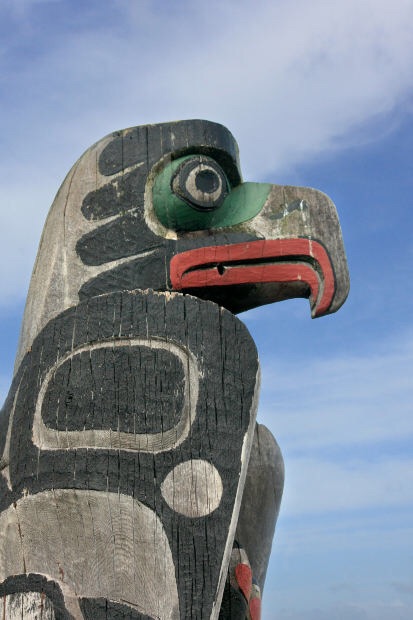
Originally published in Middle Gray in 2013, “Ritual” has just been reprinted in the anthology Heron Clan III.
For those who might be interested, a glimpse at the genesis of the poem is included in this interview conducted by Dariel Suarez, the editor of Middle Gray: http://www.themiddlegray.com/mgblog/2013/12/19/robert-okaji

Agave
It might deceive.
Or like a cruel
window, live its life
unopened,
offering a view
yet reserving the taste
for another’s
tongue, ignoring
even the wind.
The roots, as always, look down.
This first appeared in Ijagun Poetry Journal in December 2013, and is also included in my micro-chapbook, You Break What Falls, available for download from the Origami Poems Project: http://www.origamipoems.com/poets/236-robert-okaji

Two years with no word.
The stick you planted
sprouted leaves last spring,
restoring hope. We had long
thought it dead. Two leaves
and a bud. A note
scrawled on a dollar bill,
unsigned and smuggled out
by some kindly stranger.
This is not much.
We can do little
but watch the tree grow
while you count steps
and deny the walls of a room
that light never touches.

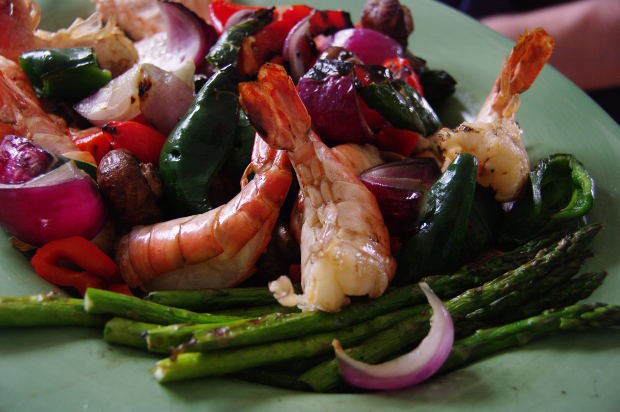
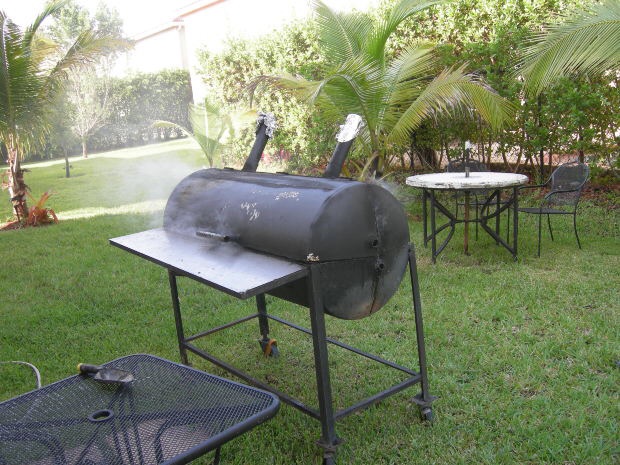
A History of Particles: Ash, Wood, Shrimp
Unsettled and predisposed
to flight, they
rise. Or, awaiting the process, receive
the glow as prelude to transformation, a
nocturnal exegesis inscribed in flame
and black swirls. Death in the air,
settling upon us. The bitterest
taste. But how to explain
the tongue’s sweet tremor? And the narrow
margins between the transition
from wood to smoke?
At 250 degrees
their pale shells redden,
become vessels of radiant
heat and its attenuated function,
moisture retained so as
to delay and heighten the
delectable flesh, once freed, become
virtue, become fate
sliding down the throat,
the course of deterioration hastened
and endured in perpetuity.

Life among the Prickly Pear
Rain’s twofold curse: not enough,
too much. Still, I take comfort
even among the thorns.
There is much to like here.
Its moonlight flowers.
Paddles fried with minced garlic.
Wren’s jubilant shriek.
The fruit’s red nectar.
After a long day I saw it rise
and walk two steps to the west,
uphill, our burdens shared
yet apart. I woke to distant
screech owls purring their desires
on separate slopes. Late spring,
storms on the way, a warning.
I close my eyes and the creek rises.

In This I Find You Again
If there is truth to be found
let someone find it. The yellow
rose rests in its jar. Day and
night it looks out through the glass
at the world of altered
lines, sensing, perhaps, beauty
through its failure to prevent
fading. Each morning I wake
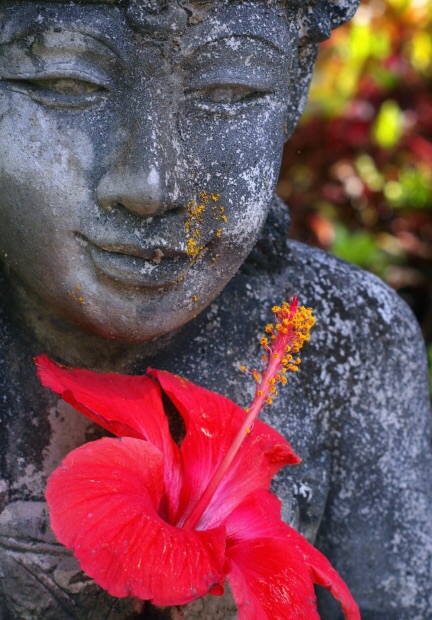
and think of you. The hibiscus
on our patio readies itself to blossom,
but pauses as if to prolong
the moment, waiting for a reason
to end its denial. Then it unfolds.
You are all I care to find.

Shadow’s Tale
If I call,
will you
reply?
Questions
left unwritten
shape
themselves
like words
we see
but don’t
read. Signs
fade then
reappear,
and the oaks
droop
in the still
heat.
No rain
again. If
you call,
will I
reply?


