Thinking of Language

words

Yesterday, while avoiding the big rig frenzy on the wet highway, I heard a fascinating talk on NPR’s TED Radio Hour, Phuc Tran’s “Does the Subjunctive Have a Dark Side.” The idea of how one’s language, one’s grammar, can shape or affect a culture, has never been made so apparent to me as in this well articulated piece.

End of the Road

photo


End of the Road (2002)

Neither expected nor sought, truth arrives.
One phrase, a minute turn of the

wrist, and the beginning reverses itself, becomes
vessel versus point, illuminating

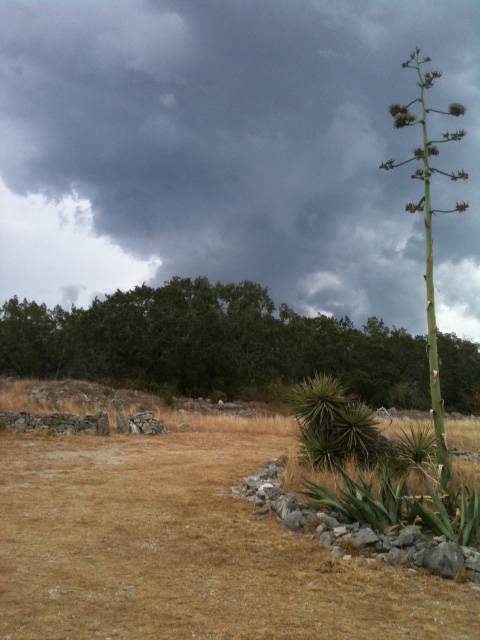
the reach: one sign, two paths. The agave.
How far we’ve come to affect this place.

Last season the flowers were gray and we knew nothing.
Even the stones quivered with laughter.

And then it rained. And the creeks rose, and the bedrock
appeared as if to say your efforts lack

substance. Look underfoot. There lies the truth.
Neither expected nor sought, it arrives.


“End of the Road” first appeared in April 2016.

eotr

Jackboy’s Lament

image

Jackboy’s Lament

We define ourselves in movement,
in the uncertain light and forms

shuddering by: fences, the nameless
wave, odors, dark water.

Look at the hills, their lines stretched taut like
smiles, or voices torn from the earth.

Or the creek below us – how its mouth never closes
yet nothing emerges but a shadow

on the wind. Two questions arise,
leaving only the abandoned to consider.

In our solitude, only my self is missing.


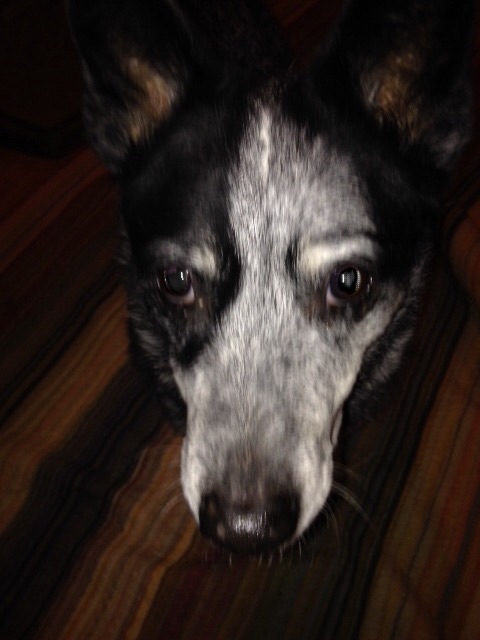
“Jackboy’s Lament” made its first appearance here in October 2015. I started the poem about a dozen years ago, after a drive through the Texas hill country with Jackboy the cattledog, who was quite the philosopher and humorist. This is what emerged after several conversations and much reflection over his circumstances (abused, abandoned, rescued). Jack didn’t talk much, but he thought. Oh, how he thought.

It has been nearly three years. We still miss him.

vultures

My poem “Gulf” is live at West Texas Literary Review

gulf

My poem “Gulf” has been published in West Texas Literary Review‘s inaugural issue.


I’ll Turn But Clouds Appear

spaghetti


I’ll Turn But Clouds Appear

You gather and disperse and nothing I do salves my hunger.
Where are you, if not here among the roots of dead flowers

or inches below the window’s opening
in the leaf-filtered light. Or spread across

the ceiling, caught in filaments of expelled
hope. Savoring motion, I look up and address the Dog Stars,

longing to catch your attention. But clouds muffle
my words, and instead I turn

to the fragrance of tomato and garlic and spice
wafting into the night. What could bring you back?

Not love. Not wine. Not solitude, nor the sound of my voice.
I spoon out the sauce, cautiously, and wait.

* * *

“I’ll Turn but Clouds Appear” first appeared in Bindlestiff.

treecloud

Still Hands (Cento)

image

Still Hands (Cento)

I let it burn, rooted as it is. Now
nothing else keeps my eyes

in the cloud – get close to a star,
and there you are, in the sun.

What about all the little stones,
sitting alone in the moonlight?

Silence complicates despair.
I have believed so long in the magic

of names and poems,
and I know that you would take

the still hands to dryness and
loose rocks, where the light

re-immerses itself. It’s not the story
I want. We cannot live on that.

* * *

Credits:
Sharon Wevill, Julia de Burgos, Francis Ponge, Mary Oliver,
Alberto de Lacerda, Robert Hass, HD, Jacques Dupin, Francesca Abbate, George Oppen.

“Still Hands” appeared in Issue Four of Long Exposure, in October 2016, and prior to that, on this blog in July 2015.

image

Hmong American Poets (Updated)

hmong

An update to the series. Read Khaty Xiong’s interview, and listen to/read “In Mother’s Garden.” Buy her books, or download (for free) this mini-digital chapbook, Ode to the Far Shore. A beautiful work!

The Academy of American Poets is offering a series, curated by 2016 Walt Whitman winner Mai Der Vang, featuring poems by and discussions with Hmong American poets.

Our country is enriched by its great diversity, yet we too often passively accept only what comes to us. Read these poets. Listen to their words. This is who they are. Who we are.

20th Century Protest Poetry

resist

I’ve just found, and followed, David Meeker’s impressive blog, 20th Century Protest Poetry: Poems That Make a Difference. Scrolling down the home page, you’ll find relevant poems, including Carolyn Forche’s “The Colonel,” Roethke’s “The Geranium,” and Nazim Hikmet’s “Letters from a Man in Solitary,” preceded by brief introductory essays. I wish I’d found this sooner, but will make up for lost time.


Glass with Memory

lamp


Glass with Memory

When I remember you
glass comes to mind,
but nothing so transparent
as an unclothed thought

or warmth trickling in
through the pipes or
under the haze of
the second night’s sheet,

no two alike except
in appearance, but under
the lamp’s unconscious glare
I find warmth spreading

across the hard surface,
telling me all is
not lost, that smoothness
persists beyond our reflection.

glass