Ritual

image

Ritual

Placing the dead is seldom arbitrary.
The Marquis de Sade’s grave in the forest at Malmaison
was planted with acorns so that he might be consumed by
trees, but my wife desires a shady plot in rural Texas,
where no one will claim her. In old Christian
graveyards the unclean were buried at the gospel side for
sinners. When her best friend died, she and his former lover
split a bottle of Johnny Walker Black and listened to Puccini.
The Nuer of Sudan place deformed dead babies by the river,
returning them to their true fathers, the hippos. After the fog
crushed Stevie Ray’s helicopter, I played Texas Flood on the juke
box and quit my job. In China, bones channel feng shui, becoming
part of the active landscape. Though she wanted her ashes to drift
in the Pacific, my mother’s body lies in a national cemetery in
San Antonio. On the northwest coast of Canada, the Kwakiutl
left their dead to the ravens, and my father has proposed
on numerous occasions that we shove a hambone up his ass
and let the dogs drag him off. I do not believe we’ll follow his
suggestion. In old England, suicides were often interred at
crossroads, impaled, to impede their restless wandering spirits.
The Torajans sometimes keep bodies wrapped in layers of absorbent
cloth in their homes for years. I’d like my incinerated, pulverized
remains released in the jet stream, if only to escape economy class for
once. Jellyroll Morton’s grave is in Section N, Lot 347, #4, in the northwest
quadrant of Calvary Cemetery, but some villagers bury stillborn
near a dwelling’s outer wall. Hugh Hefner is rumored to have acquired
the spot next to Marilyn Monroe. Placing the dead is never arbitrary.

Originally published in Middle Gray in 2013, “Ritual” was reprinted in the anthology Heron Clan III, and is included in The Circumference of Other, my offering in IDES: A Collection of Poetry Chapbooks. It also appeared here in July 2015 – the poem that refuses to die…

For those who might be interested, a glimpse at the genesis of the poem is included in this interview conducted by Dariel Suarez, the editor of Middle Gray: http://www.themiddlegray.com/mgblog/2013/12/19/robert-okaji
image

I Have Misplaced Entire Languages

ships

I Have Misplaced Entire Languages

Neither this tongue nor that still dwells in my house.
The hole of remembrance constricts, leaving behind only debris.

As a child I mixed three languages in family discourse.

Now only one is comprehensible, and I abuse it daily.

The woman in the blue dress stands alone on the pier, weeping.
A pidgin is a simplified language developed between groups with no

common tongue. Sounds form easily, but meanings struggle.

My father is shipped to Korea without warning.

Some words insert epenthetic consonants to separate vowels. Years
later we arrive in Italy and my mother starts receding.

A fourth language emerges.

This morning I asked, “Ame?” “Yes,” she said, “but just drizzling.”

Some families share no common language and must forge without.
We have used pain, pane and pan without reference to etymology.

Having abandoned the familiar, she chose another, never accepting the loss.

These forms we can’t articulate, these memories we have not traced.

* * *

This was originally published in April 2014 as part of Boston Review‘s National Poetry Month Celebration, and also appeared on this blog in July 2015.

bread

Refusal Charm

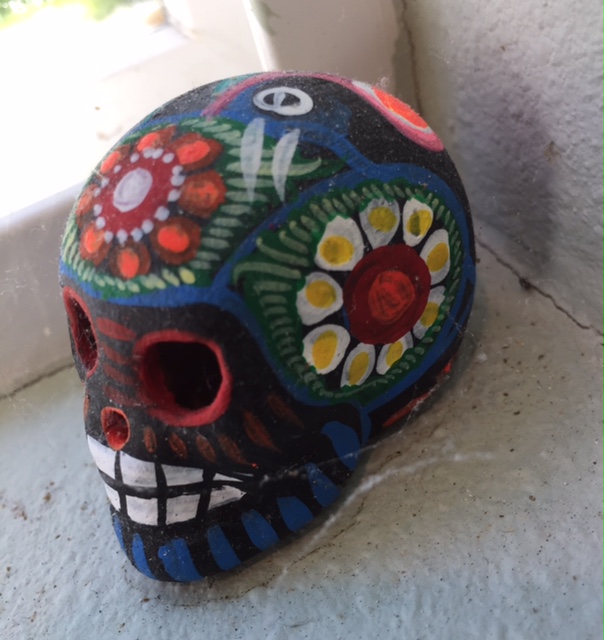
skull

Refusal Charm

Every rock a precept —
a fist in a garden of palms

a skull is a skull
she says

and I am        no iris

overnight the green beetles
have learned flight

now they lumber
into windows

bright asteroids        falling

I prefer other voices
in the lantana        or dirt

mounded in grids
asking        may I come out

no      it is late      too late

oh

In the Key of Your Hour

blueguitar


In the Key of Your Hour 

The words I sing are draped in silence,
wedged between notes yet flowing forward.

Stop-time presents the illusion of interrupted tempo and meter.

Perception informs our spirits.

The old guitar hangs on the wall and seldom speaks,
preferring instead to lightly hum when the wind blows just so.

The conceit of two right hands. A slamming door.

Music enters my room by subterfuge, but exits boldly.

If simultaneity is relative, how do we assign primacy
to an overtone? One voice, one whole.

We must respond to our bodies. In kind, with trust.

I ask you to listen without considering the requisite commitment.

The broken circle represents common time replete with imperfections,
linking the measurable to the internal well.

Gather what comes, no matter the source.

Mark time and repeat: harmonics, the quivering string. Breath.


“In the Key of Your Hour” appears in my chapbook-length work, The Circumference of Other, which is included in IDES: A Collection of Poetry Chapbooks, published by Silver Birch Press in 2015.

OLYMPUS DIGITAL CAMERA

My Poem “Between” Is Up On Clade Song

between

I thought I’d repost this as it was given short shrift during the 30/30 frenzy.

Many thanks to editors Joshua McKinney and Tim Kahl for including my poem “Between” in the current issue of Clade Song, one of my favorite poetry journals. A recording is also available for your amusement. And please check out the beautiful and intriguing musical piece on the home page – composed of various animal calls, guitar, flute and shaker.

Hail

hail


Hail

My hands know the sadness of rock,
of unfinished lines and rough

sides tapering to sharpness.
The shape of solitude, turning.

Now the stones fall as water,
a woman lets down her hair

and laughter chokes through silence.
Into this dream I ascend.


rock

My Poem “On the Burden of Flowering” Is Up On Panoply

OLYMPUS DIGITAL CAMERA

I thought I’d repost this as it was given short shrift during the frenzy of the 30/30 Challenge in August.

Many thanks to editors Andrea, Jeff and Ryn for including my poem “On the Burden of Flowering” in the current issue of Panoply, another of my favorite poetry journals. I’m thrilled that they were able to take this piece.

Peach Blossom (after Li Po)

file0001629991807
Another adaptation, which first appeared in April, 2014.

Peach Blossom (after Li Po)

Ask why I stay on the green mountain
and I smile but do not answer; my heart rests.
A peach blossom floats downstream –
Heaven and earth, apart from this world.

The transliteration on Chinese-poems.com is as follows:

Ask me what reason stay green mountain
Smile but not answer heart self idle
Peach blossom flow water far go
Apart have heaven earth in human world

There the poem is titled “Question and Answer on the Mountain.”

IMG_5780

Three Poems Up at The Blue Nib

Rattlesnake sign
My poems “Scarecrow Dances,” “Tuning the Beast,” and “Synapses and Other Conjunctions” have been published at The Blue Nib. The latter two were written during the   August 2015 Tupelo Press 30/30 Challenge.


Biography (Cento)

cage

Biography (Cento) 

I am becoming
one of the old

men, but you,
you are earth.

Where is the moment
that lingers,

the static of lost
voices and the feel

of the cleft in the bark.
Ask me anything.

Why am I
grown so cold?

Have you been here?
Thinking

is wind in a cage;
it does not say anything.

* * *

Credits:

James Wright, Cesare Pavese, Ruth Ellen Kocher, HD, Eduardo C. Corral,
Adelaide Crapsey, Denise Levertov, Blaga Dimitrova, Jacques Roubaud,

* * *

A cento is composed of lines from poems by other poets.

For further information and examples of the form, you might peruse the Academy of American Poets site: http://www.poets.org/poetsorg/text/poetic-form-cento

globe