3 Poems Live at Book of Matches

I’m pleased to announce that three of my poems are live at the stellar literary journal Book of Matches, which features poems from such luminaries as Ace Boggess, my wife and partner in everything—Stephanie L. Harper—and Tim Kahl, among others. https://www.bookofmatcheslitmag.com/post/issue-14-unfurls-its-petals

Many thanks to editors Nicholas Christian and Kelli Allen for taking these pieces, and gratitude to Luanne Castle for providing the title and inspiration for one of them (I’ll let you guess which one).

Until

cg00WmzYK8hOlevHgwEw4jIZEowAf5bO9fn3idGw

Until

This face looking back at me never lies.
I feel as if I’ve cheated, drawn the winning
ticket, passed the exam without suffering
through classes and boring soliloquies.
Then I see the sagging jowls, the dark
circles, those lines—so many of them—
marking time and various scars
invisible to the unaided eye. When death
failed to claim me, I inhaled the ecstatic
fumes of second chances, faked my way
through another sixteen months of drudgery
before pulling the plug. Now, seven years
later, a thousand miles to the north, I study
you lying behind me in bed, unaware
of my gaze, of the power you possess
even asleep, and I wonder how to retain
this minute, these days and all that will unwind
so slowly, so quickly, inevitably, until.

“Until” was published in (print-only) Shō Poetry Journal last June. I was thrilled to have poetry published in this excellent journal, and am pleased that the next issue, coming out in January, contains two of my recent pieces. Thank you, Johnny Cordova and Dominique Ahkong, for your continuing support! I urge you all to peruse their site, and to send them your best poetry.

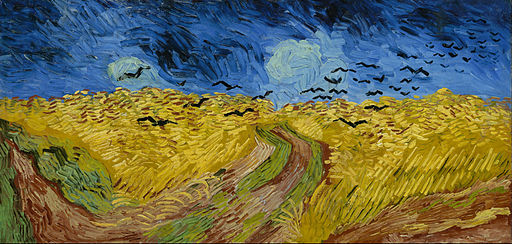
Scarecrow Visits a Wheatfield in Auvers

Wheatfield with Crows

Scarecrow Visits a Wheatfield in Auvers

The corvids claim he was a crow. A man,
but still a crow, who knew the faith of grain
and light, the atomic distinction
between stillness and the wind’s first
flutter, the shape of loneliness and dark
skies parted by song and wing. He was
a vanishing point, and all-seeing eye.
Or, perhaps, dare I say, one of my kind,
separated from his base, destined
to observe, to record in bold,
thick strokes the hues that words
can only negate. In each of his fields,
celebration blossoms. We see what lurks
beneath the surface—that boy
walking outside the frame, a cat
behind the church—conversation
beyond speech. And in the sky, our sky,
crows suspended in directionless glory,
flying to and from, in simplicity, black
on blue and gold, above the wheat, without end.

This poem is special to me, as it represents success, such as that exists in the poetry world, on multiple levels. I wrote it as part of a fundraiser for Brick Street Poetry, a local non-profit poetry organization, and I am in great debt to Kerfe Roig for providing the inspiration, and original title, “Scarecrow Visits Van Gogh’s Wheatfield in Auvers.” The poem popped out, rather magically, almost as you see it here, in perhaps an hour. Then a few months later, a miracle happened—it was accepted for publication in The Threepenny Review, one of my white whales, an unattainable, if ever there was. Threepenny is known for quick responses. My previous two submissions were rejected in one day and two days. I expected the same for this, and was pleasantly surprised to make it to day three. And then I received the acceptance! Eight months later it appeared in print, nestled next to a story by Wendell Berry (!), and among works by Charles Simic and Philip Lopate, among others. I am still pinching myself…

On Parting (after Tu Mu)

file000736221785

On Parting (after Tu Mu)

This much fondness numbs me.
I ache behind my drink, and cannot smile.
The candle too, hates parting,
and drips tears for us at dawn.

A non-poet friend asked why I’m dabbling in these adaptations. After all, she said, they’ve already been translated. Why do you breathe, I replied, admittedly a dissatisfying, snarky and evasive answer. So I thought about it. Why, indeed. The usual justifications apply: as exercises in diction and rhythm, it’s fun, it’s challenging. But the truth is I love these poems, these poets, and working through the pieces allows me to inhabit the poems in a way I can’t by simply reading them. And there is a hope, however feeble, of adding to the conversation a slight nuance or a bit of texture without detracting from or eroding the original.

The transliteration on Chinese-poems.com reads:

Much feeling but seem all without feeling
Think feel glass before smile not develop
Candle have heart too reluctant to part
Instead person shed tear at dawn

red_coat

This first appeared on the blog in October 2014.

In Praise of Rain (with recording)

file00093561951


In Praise of Rain

Which is not to say lightning or hail.
Sometimes I forget to open the umbrella

until my glasses remind me: Wake up, you’re
wet! If scarcity breeds

value, what is a thunderhead worth
in July? A light shower in August?

Even spreadsheets can’t tell us.

***

“In Praise of Rain” is included in my recently released chapbook, Buddha’s Not Talking, available from the publisher, Slipstream Press. Signed copies may be purchased exclusively from Loud Bug Books in Indianapolis. Simply type in “Okaji” to view all of my available books, or just add the title. $10 plus shipping and tax (where applicable).

file8541339345592

Lament for Five White Cat (after Mei Yao-ch’en)

file3461249385398

Lament for Five White Cat (after Mei Yao-ch’en)

Five White cat always made sure
no rats gnawed my books,
but this morning Five White died.

On the river I offered up rice and fish,
and buried you in its lazy currents,
chanting my lament. I could never neglect you.

One time you caught a rat
and carried it squealing around the yard
to frighten all the other rats
and keep my cottage clear of them.

We’ve shared space aboard this boat,
and although the food is meager
it’s free of rat piss and droppings
because you were so diligent,
more so than any chicken or pig.

Some people speak highly of horses,
saying nothing compares to them or donkeys.
But we’re done with that discussion!

My tears prove it so.

* * *

The transliteration from Chinese-poems.com:

Self have 5 white cat
Rat not invade my books
Today morning 5 white die
Sacrifice with rice and fish
See off it at middle river
Incantation you not you neglect
Before you bite one rat
Hold in mouth cry around yard remove
Want cause crowd rat frightened
Thought will clear my cottage
From board boat come
Boat in together room live
Dry grain although its thin
Evade eat drip steal from
This real you have industriousness
Have industriousness surpass chicken pig
Ordinary person stress spur horse drive
Say not like horse donkey
Already finish not again discuss
For you somewhat cry

A Song Dynasty poet, Mei Yao-ch’en (or Mei Yaochen) died in 1060. His great poems live on.

DSC_1646

Cracked


Cracked

When you say smile, I hear footsteps.
When you say love, I think shortened breath,
an inner tube swelling in the abdomen,
and the magic of tension and elasticity.
Decision, indecision. Bursting
points. The child’s hand clenching
a pin. I tell myself this, too,
will pass, that life’s gifts
balance hurt with pleasure. One
kiss lands in softness. Another twists
into bruises and cracked ribs. Two
nights in intensive care, perpetual
nerve-shredding. When you say quiet,
I see headstones. When you say
please, I feel fingers at my throat.


“Cracked” first appeared in Noble Gas Quarterly. I’m grateful to the Noble Gas team for taking this piece.


Love, Scattered (Cento)

image


Love, Scattered (Cento)

I cull and offer this and this,
and these last definite whorls

or later star or flower, such
rare dark in another world,

outdistancing us, madness
upon madness, the crest

and hollow, the lift and fall,
ah drift, so soft, so light,

where rollers shot with blue
cut under deeper blue as the

tide slackens when the roar of
a dropped wave breaks into it,

and under and under, this
is clear—soft kisses like bright

flowers— why do you dart and
pulse till all the dark is home?

I am scattered in its whirl.


* * *

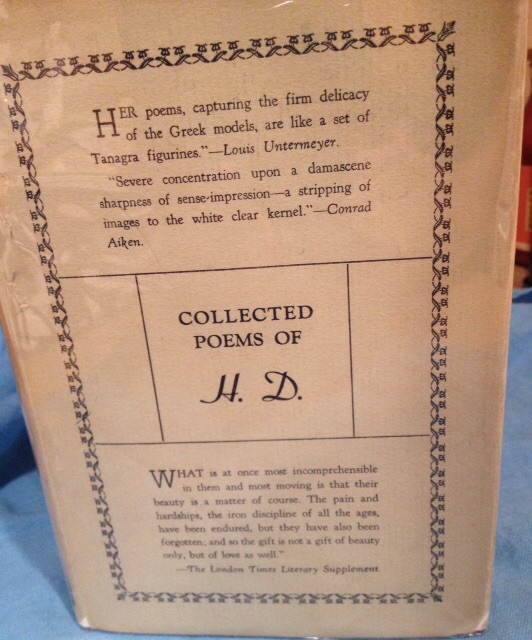
This cento is composed exclusively of lines taken from fifteen pages in the Collected Poems of H.D., 6th printing, 1945. Hilda Doolittle is a fascinating figure in 20th century American poetry. You might look at the Poetry Foundation’s biography for further information:

http://www.poetryfoundation.org/bio/h-d

image


Laocoön

GREEK COLUMN LINDOS


Laocoön

This figure of complexity
persuades a lingering

glance, the two-fold
inclination entwined,

horror expressed
in tandem, the sons’

limbs compressed
as the father struggles,

realizing true
sacrifice, the inward

grasp of storm and
wrath and serpent,

his face
echoing those yet

to come, breached
walls, a city in

flames, the cries
of warnings unheeded.


the_kelpies

Laocoön, through Virgil’s Aeneid, is the source of the phrase “Beware of Greeks bearing gifts.” The poem, which first appeared in The Blue Hour Magazine, was inspired by the sculpture “Laocoön and His Sons,” which resides at the Vatican. You might find Wikipedia’s entry of interest. Originally posted on the blog in February 2016.

Yesenin

image

Yesenin

Respite, involuntary and gentle
circling one’s
collar, a touch barely felt, renewed.

Or, the other turns,
belying expression and the halted voice.

The recursive window, closing.
A final poem in blood.

And beyond the glass? The face behind
the indifferent mask
designs its own

smile, risking everything
as the chair’s leg tilts,

inertia become constriction,
the taut lapse begun.

* * *

A fascinating poet, Sergei Yesenin died nearly 90 years ago. You might check out his bio on wikipedia.

image