Announcing January 21st Zoom Poetry Reading

Black Dog Poetry Open Mic 2025

I’m thrilled to announce that I am the featured poet for the January 2025 Black Dog Poetry Open Mic. Many thanks to Sandy Coomer, co-host of the reading and the founding editor of the Rockvale Review. I am especially grateful for this online venue, as my health prevents me from participating in the numerous in-person readings traditionally required to launch and celebrate the publication of one’s first full-length collection. Our Loveliest Bruises is the culmination of much labor, exasperation, love, encouragement, luck and persistence, and I cannot adequately express my gratitude for this opportunity. Thank you!

Please note that an open reading follows my presentation. Poets are requested to present one brief poem. If you’re interested (and I’m talking to you, poet friends), please let me know and I’ll provide contact information. Black Dog Poetry Open MIc has a FaceBook page, where details can also be found.

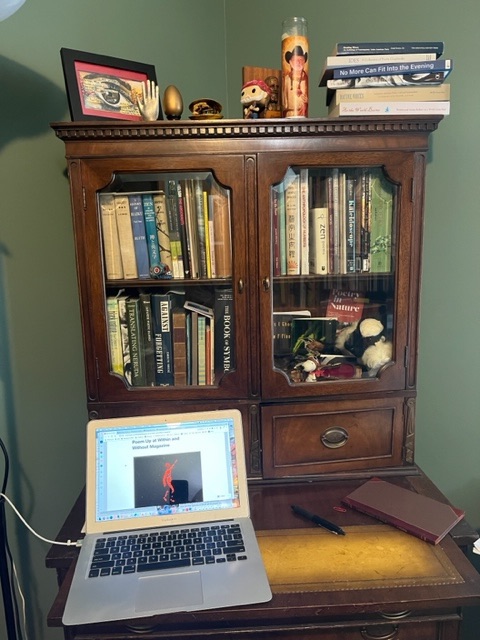
Poem Up at Silver Birch Press

My poem “My Mother’s Ghost Sits Next to Me at the Hotel Bar” is live at Silver Birch Press. Many thanks to editor and publisher Melanie Villines for her continuing support. The poem was originally published inThe Lake, and is included in my first full-length book, Our Loveliest Bruises, forthcoming this fall from 3: A Taos Press.

Celebration 5

nine

5

Woe is me! Break out the tiny violins! I am in full-whine mode!

Numbers, numbers, numbers, numbers. Add, divide, multiply, subtract. Take note, shift columns. Despair. For months, the numbers have been backhanding me, to and fro, up and down. Bullying, mocking, teasing mercilessly, always heading in the wrong direction. Property taxes have increased. Life expectancy has plummeted. The bank account is steadily dwindling. With my illness, work, or a job, isn’t really feasible, though occasionally I sell a book or two (not mine, mostly scholarly or collectible tomes), which brings in a few bucks. And inflation! Everything costs more. Just a few years ago I seldom paid more than a dollar a pound for chicken thighs. Nowadays we’re lucky to pay four times that amount. And so it goes.

But, a few weeks ago, the numbers finally stepped in firmly on my side! In May, scans showed that my lung cancer had spread to the brain; nine small lesions were found, cause for concern, as you might imagine. Now, nine is a fascinating number, majestic, mystical, some might say. Multiply it by two, and you get 18. Add the two digits that comprise 18, one and eight, and you get 9. Multiply it by three: 27. Total the two digits forming 27, and you get, yes, 9. Multiply it by four, by five, by six, by seven, eight or nine. Fifteen. Twenty. Add the digits that comprise the sum and you return to nine. Interesting, no?*

But I’ve digressed. Nine is not the digit one wants to hear when discussing the number of lesions manifested in one’s brain. That was the situation a few months ago. But now, apparently, the numbers have taken my side, and I no longer need concern myself with that figure. Recent scans revealed that the lesions have resolved; they’ve disappeared! In other words, the treatment is working. Oh, the cancer is still with me elsewhere, but after months of bad report after bad report, the news is finally trending in the right direction.

So today I praise the magical number nine, which, in my case, has transformed itself into nothing, a circumstance most worthy of commemoration. What numbers do you celebrate, and why?

*If this sounds familiar, you may have read my essay originally posted here in February 2014.

Celebration 4

ashtray in desk

4

In my desk, nestled among the odd assortment of books and keepsakes (including Hashimoto, my stuffed toy dog companion of nearly sixty years), sits an old, chipped, cut glass ashtray bearing eclectic objects. The ashtray was my mother’s, and was one of the few possessions she was able to bring with her to the U.S. after she married my dad. It’s a rather ironic keepsake, as my mom, a heavy smoker for some sixty years, died from lung cancer, and it appears that I will, too, though I’ve never smoked. Nevertheless, it remains one of my most prized possessions. In it, you’ll find an old, broken, silver pocket watch (a father’s day gift to my dad in the late 70s), a lock of Stephanie’s hair, my dad’s original army dog tags, multiple mandolin and guitar picks, including one given to me by Kinky Friedman, author, musician, and one-time candidate for governor for the state of Texas, and various polished stones. Not one of these items has great monetary value, yet they’re all priceless to me. They all have stories.

What are your treasures? How did they come to be so valued? What are their stories?

Celebration 3

desk photo

3

I have always loved books, their smell and heft, bindings, illustrations, and of course, the stories within. But I don’t recall the title of the first book I personally checked out of the library. I was five-years old, in first grade. It was a Friday, the book was replete with color illustrations, and the story was, perhaps, about a little bear. So long ago. But I read and reread that book all weekend, and I felt (and still feel!) the awe and wonder, mystery and power of that glorious artifact.

Nearly sixty years later, that awe has never diminished. The books behind my desk’s glass doors offer glimpses at rare beauty and yes, secrets. In front of me sits a U.S. first edition of Remy de Gourmont’s A Night in the Luxembourg (Boston, 1919), which may be an interesting relic in and of itself, but this particular volume bears the bookplate of Jun Fujita, historical figure, poet and photographer extraordinaire. Alongside it rests a much thumbed copy of The Book of Symbols, a source of great contemplation, insight and forehead slapping.

On the shelf above that a volume titled The Anthropology of Numbers, also a treasured resource, nestles just to the left of Kaleidoscope: Poems by American Negro Poets, a landmark 1967 anthology edited by Robert Hayden, the Consultant in Poetry to the Library of Congress from 1976 to 1978. Should your eyes wander down this shelf, you’ll also discover an inscribed copy of David Wevill’s Other Names for the Heart: New and Selected Poems 1964-1984, Maggie Nelson’s The Argonauts, and Kenkō’s Essays in Idleness, translated by Donald Keene.

Why are these books here? How have they come to be gathered in this house in Indiana, on these particular jumbled shelves? Who are the authors? What is their significance? Who knows them, feels them, understands them? What wisdoms have they endured?

Share with me your favorite books—from the volumes you’ve read time and again, to the ones you own simply because you were compelled to possess them, and those that have great significance to you, even if you’ve not read them and never will.

Self-Portrait as Hoot Owl


Self-Portrait as Hoot Owl

Who do you think I am, what will
grace serve, where in this moonless
void might you lie, can we echo
through the hours and never attach
ourselves to one discernable tree?
Is query my only song? Is sadness
yours? Wrapped around these
priceless silhouettes, our voices
merge downhill near the creek’s
rustle, below the seeping clouds
and stars yet somehow above the
night and tomorrow’s slow ascent
into more questions, more doubt.


* * *

“Self-Portrait as Hoot Owl” first appeared in Issue 125 of Right Hand PointingThank you to editors Dale Wisely, Laura M. Kaminski, F. John Sharp and José Angel Araguz for taking this piece.


And: A Mythology


And: A Mythology

Balancing the chair on two legs,
you claim no past,
and gravity,
though complicit in the future,
aligns itself with the mass.
No connections fuse the two.
Or, lying there, you bridge gaps,
clasping hands with distant cousins,
awake in the moment
yet ready to drift and continue,
a solitary seed awaiting nourishment,
steady, existing only between.


“And: a Mythology” first appeared in May 2020 at Literati Magazine. Many thanks to editor Renée Sigel for taking this and several other pieces.

.

Riddle, Dollar, String


Riddle, Dollar, String 

Living between, she pretends the comfort of walls
within walls, the unseen’s dispensation.
A slow dragging. The raked leaves.

And all the naked oaks bowing to the wind,
feeling the scratch of impending growth,
the twig’s pearl poised to push through
this mask, stolen sounds dotting the morning.

Later, watching lizards on the wall
or the haze of bees surrounding the agave.
No one pays. Limestone. Mulch. Light.
Unformed thoughts snaking through.

Like that line wrapped around her waist,
another purpose only she could explain.

“Riddle, Dollar, String” first appeared in The New Reader Magazine, in March 2018.

Sometimes Love is a Dry Gutter

Sometimes Love is a Dry Gutter 

Or a restless leaf, a footprint.

Is fault on a blameless day,
scrawled on a washed-out sky.

My friend’s music orbits his home,
worms through the cracks
in the bluest lines, ever new

and permanent, staining even his hope
long after the lights stutter away.
And the rain’s attenuated sorrows?

They’re coming, he says. Like goats
through a fence. Like lava. Like tomorrow.

* * *

“Sometimes Love is a Dry Gutter” was first featured at Vox Populi in January 2017. I’m grateful to editor Michael Sims for supporting my work. It is the opening poem to my recently released chapbook, Buddha’s Not Talking, which is available here for $10 plus shipping and tax (where applicable). Simply type in “Okaji” to view all of my available books, or just add the title.

Self-Portrait as Window

window

Self-Portrait as Window

When you look through me
which darkness illuminates
your vision, outlining the
ghosts of never was and not
yet? Or do your eyes glare
back in silent terror, knowing
the power of liquid made
solid, of light transformed to
electricity and by inference
these words or the shades
drawn by voice command?
Transparent, elusive, evident,
I stand alone, clear. Hidden.

“Self-Portrait as Window” first appeared in The Dew Drop in November 2020.