Destined by Gravity to Fail, We Try


Destined by Gravity to Fail, We Try

Having fallen from the roof not once, but twice,
I verify that it is not the fall but the sudden stop that hurts.

The objectivist sense of the little: the and a, my house in this world.

Galileo postulated that gravity accelerates all falling bodies at the same rate.

While their etymologies differ, failure and fall share commonalities,
though terminal velocity is not one.

The distance between the glimpsed and the demonstrated.

Enthralled in the moment, Icarus drowned.

Rumor has it his plunge was due not to melting wax but to an improper mix
of rectrices and remiges: parental failure.

Thrust and lift. Drag. Resistance.

Acknowledgment of form in reality, in things.

When the produced drag force equals the plummeting object’s weight, the
object will cease to accelerate and will move at a constant speed.

To calculate impact force accurately, include the stopping distance in height.

Followed by long periods of silence.

 

house

This first appeared on the blog in December 2015.
 

Celestial Navigation


Celestial Navigation

Even dung beetles
know the stars,

how they shape
destination.

Motion ceases with arrival.

This body attracting
that. The heart

losing itself
to the moon’s

pull, another wave
falling.

Does light descend
or rise?

Subtle yet observant.

Like truth, like
destiny shivering

through the coldest hour,
saying Welcome, welcome!


“Celestial Navigation” was first published in Nine Muses Poetry in July  2019.


Dragging the River


Dragging the River 

Knowing the truth of it, he marvels
at the red grape’s resiliency,
how it contains itself even after
a fall. What matters, what doesn’t.
Those simplistic thoughts
dissipating in the coffee’s sad
swirl. And what they wanted,
truly wanted, even more than
that first plunge of lips to private
flesh or the forbidden highlights
in the book of dreams never to
be opened. He looks over the side,
but can’t divine the message
in the brown ripples. A wine bottle
bobs by, followed by an inflated vest
and two snarled branches. Everything
revealed in its time.

 * * *

“Dragging the River” first appeared in May 2019 in The Elixir Magazine out of Yemen.

Poem Ending with a Whimper


Poem Ending with a Whimper

The best liar wins.

You can’t stop talking
and the truth embedded in strands
frays with each word slipping
from your cruel mouth.

If I tilt my head just so, I see God.

Or what passes for God at the periphery:
a fly stain on the window, the redness
at the eye’s corner, the shrike’s beak.

Silence fills me daily

and trickles out in utterances and sighs
meant only for you.

Who lies best?

I look to the ground for answers.

What replies is a tail between its legs,
a headless shrug,            a whimper.


“Poem Ending with a Whimper” was published in Volume 3 of Lamplit Underground. Thank you, Janna Grace, for taking these pieces.

Lamplit Underground is a beautifully illustrated publication. Please take a look!


Another Goodbye


Another Goodbye

Look: my windblown self, laid open,
or, another insolent word
like the wing of that crested bird
rephrased and tossed aside, broken.

This hill is a rocky ocean
of thorn and desire, absurd
in winter’s glaze, another slurred
and curtained morning forgotten.

Now lost habitats surround me.
Dead brush and loose skin drape my nights.
Remember, what is past, has passed.

The kettle whistles. I pour tea,
think of who I was. Oh, the delights
of leaving: nothing ever lasts.


* * *

“Another Goodbye” first appeared  in Grand Little Things, a publication that “embraces versification, lyricism, and formal poetry,” in July 2020.

Thank you, editor Patrick Key, for taking this piece.

Love, Scattered (Cento)

image


Love, Scattered (Cento)

I cull and offer this and this,
and these last definite whorls

or later star or flower, such
rare dark in another world,

outdistancing us, madness
upon madness, the crest

and hollow, the lift and fall,
ah drift, so soft, so light,

where rollers shot with blue
cut under deeper blue as the

tide slackens when the roar of
a dropped wave breaks into it,

and under and under, this
is clear—soft kisses like bright

flowers— why do you dart and
pulse till all the dark is home?

I am scattered in its whirl.


* * *

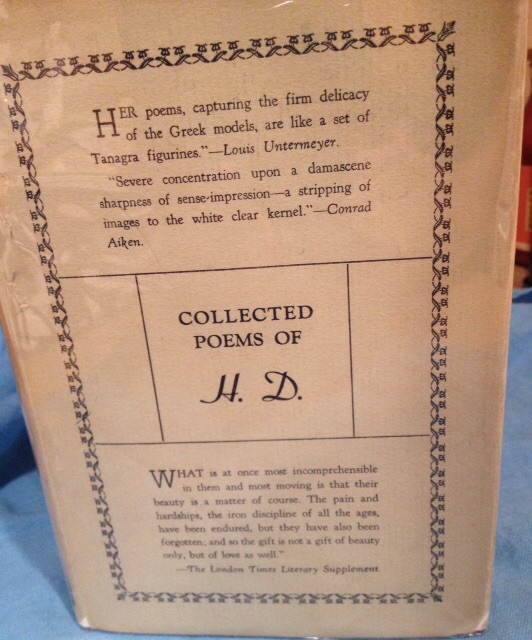
This cento is composed exclusively of lines taken from fifteen pages in the Collected Poems of H.D., 6th printing, 1945. Hilda Doolittle is a fascinating figure in 20th century American poetry. You might look at the Poetry Foundation’s biography for further information:

http://www.poetryfoundation.org/bio/h-d

image


Why I Hate Mowing the Lawn

lawnmower

Why I Hate Mowing the Lawn

The unmowed green reveals its secrets
blade by blade, shadowed and fresh.
Don’t look, it says, whisper deep
into my chlorophyll. Save this blue.
It unveils other nuances, confiding in
contrast and symmetry, employing
your eyes and their measures. The quiet,
all-encompassing and subtle. So true.

* * *

“Why I Hate Mowing the Lawn” was first published at Buddhist Poetry Review.Thank you, Jason Barber, for taking this poem.

Nebraska

Nebraska

What have we crumpled and tossed
into the trashcan across the blacktop

if not decades of forfeited days
and those broken-feathered

regrets pinned under glass. Groaning,
incapable of elegance, still I long

to be those undulating grains by
the roadside in the great between.

Crows caw out of sight as I pump
gas and watch your hair blowing

in the angled light. Sing me your
favorite birdsong. Whisper the cloud’s

name. Tomorrow we’ll dream in Iowa
of corn that is not just corn, but

the emblem of that junction between
innovation and form, function and all

that blisters under the sun’s unforgiving
eye. I want to infiltrate each kernel,

peer through the veiled yellow-white,
recover sweetness, flatten the curve.

“Nebraska” first appeared in the journal ONE ART. Thank you to editor Mark Danowsky for taking this piece. 

Cornfield

Laocoön

GREEK COLUMN LINDOS


Laocoön

This figure of complexity
persuades a lingering

glance, the two-fold
inclination entwined,

horror expressed
in tandem, the sons’

limbs compressed
as the father struggles,

realizing true
sacrifice, the inward

grasp of storm and
wrath and serpent,

his face
echoing those yet

to come, breached
walls, a city in

flames, the cries
of warnings unheeded.


the_kelpies

Laocoön, through Virgil’s Aeneid, is the source of the phrase “Beware of Greeks bearing gifts.” The poem, which first appeared in The Blue Hour Magazine, was inspired by the sculpture “Laocoön and His Sons,” which resides at the Vatican. You might find Wikipedia’s entry of interest. Originally posted on the blog in February 2016.

Inheritance

lightning jar

Inheritance

All this is mine and I praise the sky
offering surcease
in the form of vapor and a darkening

of its measure, accrued
in the way of interest owed,

increasing like vermin, circling back
then beginning anew.

I count each drop delivered.

The window’s eye blinks
and a lone flash stitches the day.

Each rumble is a coffin’s lid slammed shut.
Wanting nothing, I demand more
and receive only what I want,
a reckoning of desire and
needs ignored.

I have buried your demands.
I have delivered each counted drop.

All this is mine.

* * *

“Inheritance” first appeared in The Closed Eye Open, a publication focusing on consciousness. Many thanks to editors Daniel A. Morgan, Maya Highland and Aaron Lelito for taking this piece.