My poem “Driving without Radio” is up at Split Rock Review. And there’s a recording of it, as well. Many thanks to editor Crystal Gibbins for providing a home for this one.

My poem “Driving without Radio” is up at Split Rock Review. And there’s a recording of it, as well. Many thanks to editor Crystal Gibbins for providing a home for this one.

Parting from Wang Wei (after Meng Haoran)
These quiet days are ending
and now I must leave.
I miss my home’s fragrant grasses
but will grieve at parting – we’ve
eased each other’s burdens on this road.
True friends are scarce in life.
I should just stay there alone, forever
behind the closed gate.
* * *
“Parting from Wang Wei” is included in my micro-chapbook, No Eye But The Moon’s, available via free download at Origami Poems Project.
The transliteration on Chinese-poems.com reads:
Quiet end what wait
Day day must go return
Wish seek fragrant grass go
Grieve with old friend separated
On road who mutual help
Understanding friend life this scarce
Only should observe solitude
Again close native area door

Autumn Winds (after Li Po)
Clear autumn winds swirl
below the moon’s glow,
scattering the gathered leaves.
The startled crows return.
When will we see each other again?
This hour, this lonely night, my feelings grow brittle.
The transliteration on Chinese-poems.com reads:
Autumn wind clear
Autumn moon bright
Fall leaves gather and scatter
Jackdaw perch again startle
Each think each see know what day
This hour this night hard be feeling
“Autumn Winds” first appeared in September, 2014. I started the adaptation in the heart of summer, hoping that it would offer a respite from the unrelenting Texas heat…


Lament for Five White Cat (after Mei Yao-ch’en)
Five White cat always made sure
no rats gnawed my books,
but this morning Five White died.
On the river I offered up rice and fish,
and buried you in its lazy currents,
chanting my lament. I could never neglect you.
One time you caught a rat
and carried it squealing around the yard
to frighten all the other rats
and keep my cottage clear of them.
We’ve shared space aboard this boat,
and although the food is meager
it’s free of rat piss and droppings
because you were so diligent,
more so than any chicken or pig.
Some people speak highly of horses,
saying nothing compares to them or donkeys.
But we’re done with that discussion!
My tears prove it so.
The transliteration from Chinese-poems.com:
Self have 5 white cat
Rat not invade my books
Today morning 5 white die
Sacrifice with rice and fish
See off it at middle river
Incantation you not you neglect
Before you bite one rat
Hold in mouth cry around yard remove
Want cause crowd rat frightened
Thought will clear my cottage
From board boat come
Boat in together room live
Dry grain although its thin
Evade eat drip steal from
This real you have industriousness
Have industriousness surpass chicken pig
Ordinary person stress spur horse drive
Say not like horse donkey
Already finish not again discuss
For you somewhat cry
A Song Dynasty poet, Mei Yao-ch’en (or Mei Yaochen) died in 1060. His great poems live on.
This adaptation first appeared in November 2014, and is for one of my favorite poets, Jeff Schwaner, whose Mei Yao-ch’en sequence has entertained, inspired and enlightened me. You can find the sequence here: http://jeffschwaner.com/mei-yao-chen-sequence/


Posting this in response to Jeff Schwaner’s Full Moon Social. No time to write a new one, so I hope this oldie will do.
Letter from Insomnia
Accepting Li Po’s tragedy,
apocryphal or not,
we embrace her imperfect
reflection
rippling in the breeze,
but manage to surface.
I once thought I would name a child Luna
and she would glow at night
and like Hendrix, kiss the sky.
But that was whimsy
and only candles light this room
at this hour
on this particular day
in this year of the snake.
And what fool would reach for a stone orbiting at
1,023 meters per second?
There are clouds to consider, the stars
and the scattering rain
and of course wine
and the possibilities within each glass
and the drops therein.
We must discuss these matters
under her gaze, where smallness gathers.
This originally appeared in Middle Gray in October, 2013. It was written in response to a poem my friend Michael sent me, replying to this poem.

Letter from Austin
Michael, when you say moons do you see
cold stone floating in the firmament
or phrases frayed in the mouth and spat on paper?
And does the Spanish moon simmer at a similar
pace to mine or yours? Which embers blush brighter?
But let’s turn to estuaries, to salt and clamor and gun-
running poets and interrupted words sold in stalls
between parenthetical gates, to incomparable cavas
and the deterioration of envy and intervening years.
Or perhaps mislaid passion – a friend claims love
is merely a bad rash, that we scratch and scratch
and inflame but never truly cure what ails us. Sounds like
politics to me. Or sports. And business. Or neighborhoods.
On my street people should cook and play music together,
laugh, raise chickens and read good books. They should
brew beer, swap tomatoes, recite each other’s poetry and sing
in tune. But we’re different here, preferring instead electronics
glowing in dimly lighted rooms. I reject this failure, as I also
reject the theory of centrifugal force spinning off the moon’s
body from the earth’s crust, preferring to imagine a giant
impact blasting matter into orbit around what morphed into the
earth, and somehow accreting the stuff into this orb we
sometimes worship. This, to me, is how good relationships
form: explosions of thought and emotion followed by periods
of accretion. But what I mean is I hope this finds you well
by the river of holy sacrament. Remember: brackish water
bisects our worlds. Turn. Filter. Embrace. Gotta run. Bob.
Originally published in Heron Clan 3.

This is my offering for Jeff Schwaner’s “Full Moon Social” celebration.
October 8, 1914
Listen…
three silences
none harsher than your breath
dissipating into the night’s
bright mouth.
Later
Rainfall
and wind. How I
would like to have touched you
if only with words trembling from
my lips.
October 8, 2014
A moon
that we might share
from mountain to the sea
a gift belonging to no one
but you.
Adelaide Crapsey’s last full moon lit the skies on October 4, 1914. She died four days later, at age 36. A poet well ahead of her time, she created the American cinquain, a five-line form of 22 syllables which I have followed in these three poems.
I discovered only after-the-fact that the Full Moon Social Jeff Schwaner hosted on October 8, 2014 fell on the 100th anniversary of Adelaide’s death. These poems were written with that particular evening still looming brightly in mind, to honor Adelaide Crapsey and the moon, whose separate but entwined lights we still share and celebrate.
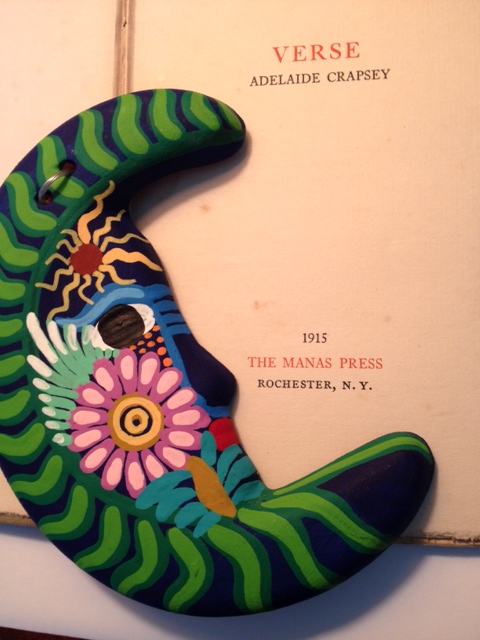
In my hand is a copy of a slim volume of her poetry, titled Verse and published posthumously in 1915. The following cinquain is from this book:
Moon-Shadows
Still as
On windless nights
The moon-cast shadows are,
So still will be my heart when I
Am dead.
Those interested in further details on Adelaide Crapsey might look here: http://www.poetryfoundation.org/bio/adelaide-crapsey
Details on the Full Moon Social may be found on Jeff Schwaner’s blog: http://jeffschwaner.com/2015/03/01/fullmoonsocial-anyone-thursday-march-5-2015/
Thinking of Li Po at Sky’s End (after Tu Fu)
Cold wind rises at the sky’s end.
What does he consider?
And when will the geese arrive?
The rivers and lakes are full this autumn
but poets’ fates are seldom pleasant.
Demons love to see us fail.
Let’s think of dead Ch’u Yuan
and offer poems to the river.
The transliteration on Chinesepoems.com reads:
Thinking of Li Po at the End of the Sky
Cold wind rise sky end
Gentleman thought resemble what?
Goose what time come?
River lake autumn water much
Literature hate fate eminent
Demons happy people failure
Respond together wronged person language
Throw poems give Miluo
According to the notes at Chinesepoems.com, the wild goose is a symbol of autumn, letters and travellers in difficulties. The wronged person is Qu Yuan, a poet of the fourth century BC who drowned himself in the Miluo river – another exiled poet later threw some verses into the river as an offering to him.

Lament for Five White Cat (after Mei Yao-ch’en)
Five White cat always made sure
no rats gnawed my books,
but this morning Five White died.
On the river I offered up rice and fish,
and buried you in its lazy currents,
chanting my lament. I could never neglect you.
One time you caught a rat
and carried it squealing around the yard
to frighten all the other rats
and keep my cottage clear of them.
We’ve shared space aboard this boat,
and although the food is meager
it’s free of rat piss and droppings
because you were so diligent,
more so than any chicken or pig.
Some people speak highly of horses,
saying nothing compares to them or donkeys.
But we’re done with that discussion!
My tears prove it so.
The transliteration from Chinese-poems.com:
Self have 5 white cat
Rat not invade my books
Today morning 5 white die
Sacrifice with rice and fish
See off it at middle river
Incantation you not you neglect
Before you bite one rat
Hold in mouth cry around yard remove
Want cause crowd rat frightened
Thought will clear my cottage
From board boat come
Boat in together room live
Dry grain although its thin
Evade eat drip steal from
This real you have industriousness
Have industriousness surpass chicken pig
Ordinary person stress spur horse drive
Say not like horse donkey
Already finish not again discuss
For you somewhat cry
A Song Dynasty poet, Mei Yao-ch’en (or Mei Yaochen) died in 1060. His great poems live on.
This one is for Jeff Schwaner, whose Mei Yao-ch’en sequence has entertained, inspired and enlightened me. You can find the sequence here: http://jeffschwaner.com/mei-yao-chen-sequence/
Parting from Wang Wei (after Meng Haoran)
These quiet days are ending
and now I must leave.
I miss my home’s fragrant grasses
but will grieve at parting – we’ve
eased each other’s burdens on this road.
True friends are scarce in life.
I should just stay there alone, forever
behind the closed gate.
The transliteration on Chinese-poems.com reads:
Quiet end what wait
Day day must go return
Wish seek fragrant grass go
Grieve with old friend separated
On road who mutual help
Understanding friend life this scarce
Only should observe solitude
Again close native area door
 O at the Edges