Thirty-Five Years Later, I Raise My Hand

Thirty-Five Years Later, I Raise My Hand

In spring 1983 I enrolled in a poetry writing course thinking it might help improve my short fiction. I was a history major by default, had never taken a course in poetry, but believed, with absolutely no evidence, that I could write fiction. At the time I would have been hard-pressed to name five contemporary poets, even counting my professor. To be honest, the class struggled to hold my attention. Only about a quarter of the students seemed interested in writing, and the instructor was a bit, uh, tired. But for the first time in my life I read, really read, poetry. I fell in love with Galway Kinnell, Ai, James Wright and Carolyn Forche, to name just a few of my early enthusiasms. I wanted to write like them. So I wrote. And wrote. And wrote. Most of it was laughably bad, but somehow I managed to win an undergraduate poetry contest, which suggested that hope existed. Maybe someday, I thought, one of my poems will be published. This radical idea had never occurred to me before. Publication seemed to be the privilege of special people, and a lifetime of gathered fact revealed that I was unequivocably nothing special.

Early on in the semester, perhaps even in the first class, the professor asked how many of us thought we’d still be writing poetry in twenty years. I didn’t raise my hand. I didn’t know where I’d be in six months, much less what I’d be doing in twenty years. Since I’d realized late in the game that teaching was not for me, I had no job prospects, and few marketable skills, despite experience in chugging beer, manning sound-powered phones on a ship’s helicopter tower, scraping barnacles and bending rules. The world was limited. The world was limitless.

Another gray day

dividing the old and young

Oh, this aching hip!

A song from that time:

Shadow Charm

Shadow Charm

When you place your mouth
to my ear

how does the ocean know
which wave

to relinquish?
In your darkness I find teeth.

Blessings of the meek-throated.

A ribbed tunnel. Codicil.

Your tongue scrawls: too late,
the unsaid     nerve-sparked and

dilated     too late

And my skin replies: with
lightning     all strikes

count     to each its charge

“Shadow Charm” was published in August 2017 in The Icarus Anthology.

Letter to Wright from Between Gusts

pickles

Letter to Wright from Between Gusts

Dear Tami: The wind here speaks an undiscovered language:
diffident, it lurks in the background, stuttering, fingering
everything, shifting directions, mocking us, barely noticeable
until it gets pissed off and BLOWS! Then, shit happens. Pickle
jars appear in purses. Love notes remain unwritten. Shingles
flap across the lawn and idiots are elected to office (nothing new,
I know). When I was a kid I marveled at those fortunates who
lived under the same roof for years, for decades, entire lives, while
my family rolled around the globe, collecting vaccination scars
like postcards or nesting dolls. How interesting, I thought then,
to know and be known, to avoid the perpetual newcomer’s
path. Having shared this house with my wife and various dogs,
birds, rodents, insects and arachnids for thirty-three years, I now
know this – home is not a stationary edifice. No cornerstone
defines it any better than fog rubbing the juniper’s tired back,
or courting mayflies announcing warmth’s arrival in their brief
pre-death interludes. Desire is a feckless mistress; after obtaining
the prize, we miss the abandoned and wonder what might have
been. When you arrive at your new town remember this: no one
is stranger to you than yourself. I speak from experience, having
absorbed differences at one end only to watch them emerge
hand-in-hand at the other, like newborn twins or nearly forgotten
reminders of an uncle’s kindness in a year of typhoons and sharp
replies and rebuilt lives. Home is a smile, a lover’s sleepy touch
at 3 a.m., or the secret knock between childhood friends reunited
after decades. It lives in soft tissue, not steel, and breathes water
and air, flame and soil and everything between. But it can’t exist
without your mind and body lugging it around. I would like to
tell you what the wind is saying, but it’s singing different tunes
these days, and my translation skills begin and end in that still
place between gusts, floating in the twilit air like so many empty
pockets. These are the only words I have. Not much to hang a hat
on, and I apologize for my shortcomings and inability to expound
with clarity. I speak in poetry, but mean well. May your moons
be bright and your winds wild yet gentle, even if you can’t fathom
their meaning. I’ll keep trying if you will. All the best, Bob.

“Letter to Wright from Between Gusts” was published at The Lake in August 2017. Many thanks to editor John Murphy for accepting this piece, and to T.S. Wright for inspiring it.

Self-Portrait with Bruise

deepfriedbutter

Self-Portrait with Bruise

Some damages announce, others conceal.
How else may we continue

despite our best
inattentions? And which treasure
do we truly hold

closer, the blood orange
or the blade
that parts its segments? At

thirty I would have chosen
one. At forty, the other. Now,
options spread like branches among the cedars.

Ruptured vessels reveal our lapses.

***

This was published in Shadowtrain in August 2015, and appeared here in March 2016.

orange

Recording of December Moon (1999)


December Moon (1999)

If loneliness breathes,
then rain is its heart,

always falling to its lowest point
before receding. Water graces us

daily in all its forms – the slowest
drop, the line of ice on the wall,

your breath, so soft and even
in the cool night. But no one,

no thing, can fill the void of
departure. You exhale and turn

away, and the air, with its empty
arms, embraces the space

you’ve left. I feel this daily,
whenever we part. At forty-one

I’ve known you half my life
but have loved you even longer,

through the millennium’s demise
and all that preceded or follows.

The brightest moon for a century to come
is but a shadow in your light.

It’s hard to believe that I wrote “December Moon” over eighteen years ago. Busy with books, work and life, I didn’t write much in the nineties. But this, the last poem of that decade, surfaced a few years ago. The sentiments are as true today as they were then. I am a lucky man.

streetfog

Music: “Nightdreams” Kevin MacLeod (incompetech.com)
Licensed under Creative Commons: By Attribution 3.0 License
http://creativecommons.org/licenses/by/3.0/

Forgetting Charm


Forgetting Charm

Even your bones remember what you’ve long discarded.

This field of stone grows beyond sight.

In our house the tang of burnt sugars.

You say I love you in four languages I do not speak,
but never in the one I claim.

We light fires with stolen paper.

Douse them with stored rain.

Fragmented memories fill our cupboards.

Did I once know you?

Take these words from me.
Bury them in daylight.

* * *

“Forgetting Charm” was published in The Icarus Anthology in August 2017.

Nine Ways of Shaping the Moon

file9781336412046(1)

Nine Ways of Shaping the Moon

                                         for Lissa

1
Tilt your head and laugh
until the night bends
and I see only you.

2
Weave the wind into a song.
Rub its fabric over your skin.
For whom does it speak?

3
Remove all stars and streetlights.
Remove thought, remove voice.
Remove me. But do not remove yourself.

4
Tear the clouds into threads
and place them in layered circles.
Then breathe slowly into my ear.

5
Drink deeply. Raise your eyes to the brightness
above the cedars. Observe their motion
through the empty glass. Repeat.

6
Talk music to me. Talk conspiracies
and food and dogs and rain. Do this
under the wild night sky.

7
Harvest red pollen from the trees.
Cast it about the room
and look through the haze.

8
From the bed, gaze into the mirror.
The reflection you see is the darkness
absorbing your glow.

9
Fold the light around us, and listen.
You are the moon in whose waters
I would gladly drown.

* * *

First posted in October 2014, and again on Valentine’s Day in 2016 and 2017, “Nine Ways of Shaping the Moon” also appears in my chapbook, If Your Matter Could Reform.

file0002123668173

Empty Cup

Empty Cup

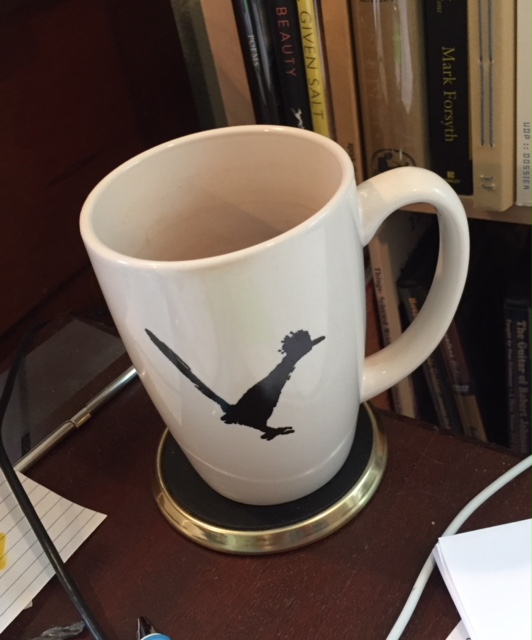
I set down my cup, pour
tea and think this day, too,
may never end.

With what do we quantify love? How does grief measure us? Nine days ago I wrote “My father is dying and I’m sipping a beer.” More words followed, but I did not write them, choosing instead to let them gather where they would – among the darkening fringe at light’s edge, in that space between the shakuhachi’s notes, in the fragrance of spices toasting in the skillet. In unwept tears. Everywhere. Nowhere.

Seven days ago I wrote “My father is dead.” Again, I chose to let the unwritten words gather and linger, allowing them to spread in their own time, attaching themselves to one another, long chains of emptiness dragging through the days.

If experience reflects truth, sorrow’s scroll will unravel slowly for me, and will never stop. I feel it beginning to quiver, but only the tiniest edge emerges. I am nothing, I say. I am voice, I am loss, I am name. I am memory. I am son.

I have fifty-nine years
and no wisdom to show for it.
Never enough. Too much.

Missing Loved Ones

Missing Loved Ones

You marvel that a simple garment retains so much of a person’s
being. I watch the worm swinging on its long thread

from one side of the door’s frame to the other,
wondering how to avoid it should I go out, but a sparrow

solves that problem. In 365 BC, Gan De detected what was likely
Ganymede, but history records no other sightings until Galileo

in January, 1610. Thus an entity with twice the mass of our
moon went missing for 1,900 years, which helps explain

the parameters of oblivion. But nothing equals the heft
and gravitational pull of those we miss – the dead, the gone,

the lost, the never-coming-back – a friend’s laughter
still echoing twenty years later, a lover’s taste and smell

rekindled with each autumn’s first fire, or the dog’s warmth.
Small wonder that we ever exit the house, leaving these

companions behind. I watch the sparrow snatch another
snack, and consider the mechanics of loss. Ubiquitous, but

generated anew. Unique yet common, unfelt and devastating.
Late at night, you say, I draw comfort from cloth, stroke

the once inhabited trousers or the flannel sheets resting
in the drawer. This scarf, her love. That shirt, my heart.

“Missing Loved Ones” was drafted during the August 2016 Tupelo Press 30-30 challenge, and was subsequently published in Eclectica in summer 2017. Many thanks to editor Jen Finstrom for accepting the poem, and to Emily Bailey, good friend of many years and former office mate, for sponsoring the poem and suggesting the title.

Biography (Cento)

cage


Biography (Cento) 

I am becoming
one of the old

men, but you,
you are earth.

Where is the moment
that lingers,

the static of lost
voices and the feel

of the cleft in the bark.
Ask me anything.

Why am I
grown so cold?

Have you been here?
Thinking

is wind in a cage;
it does not say anything.

* * *

Credits:

James Wright, Cesare Pavese, Ruth Ellen Kocher, HD, Eduardo C. Corral,
Adelaide Crapsey, Denise Levertov, Blaga Dimitrova, Jacques Roubaud,

* * *

A cento is composed of lines from poems by other poets.

For further information and examples of the form, you might peruse the Academy of American Poets site: http://www.poets.org/poetsorg/text/poetic-form-cento


globe

This first appeared here in September 2016.