My poem “Self-Portrait as Blemish” is up at Tiny Wren Lit. I am grateful to editor Dana Knott for taking this piece.

My poem “Self-Portrait as Blemish” is up at Tiny Wren Lit. I am grateful to editor Dana Knott for taking this piece.

The Sky Refutes East and West
Here, the horizon lingers.
The open eye, the mouth’s shape.
A hoop, the circle without iris.
Does the screech owl acknowledge latitude and hemisphere?
The Semitic alphabet contained no vowels, thus O
emerged as a consonant with a pupil, morphing into a dotted ring,
and later, with the Greeks, an unembellished circle (which of course
they cracked open and placed at the end). The female lays eggs
on the remnants of earlier meals lining the bottom of her den.
If you listen at night you might hear the purring of a feathered
cat (the Texas screech owl’s call varies from that of its eastern cousins).
The difference between sphere and ball.
To pronounce the Phoenician word for eye, sing the lowest note possible,
then drop two octaves. They usually carry prey back to their nests.
Screech owls are limited to the Americas.
Coincidence and error, the circumference of other.
***
“The Sky Refutes East and West” was first published in Prime Number Magazine, and also appears in my chapbook The Circumference of Other, included in Ides: A Collection of Poetry Chapbooks (Silver Birch Press, 2015). It made its first appearance here in May 2016.


My poem “Where Grief Falls” is featured at Great Lakes Review. I am grateful to the team at GLR for taking this piece.

The Geography of Silence
1. Laundry drooping at midday.
2. She dreams off-key, in pastels.
3. With misunderstanding comes anger.
4. Mata! Mata! Again!
5. Ashes crossing the ocean.
6. Sweat, and the taste of separation.
7. Reaching for past moons, she cries.
8. Death’s shade.
9. Rice.
10. Self-sacrifice, the centered gift.
11. Inward, always. Inward.

.

Window Open, Closed
We enter daylight in the shape
of praise, little words
billowing through wire mesh. Across
the highway a busboy questions time
and the concept of never, while
someone plucks leaves from the bay
tree and plans her day. Roger Bacon
longed to manipulate the inner essence
of inanimate objects, to harness their force,
and a lonely man swallows prescription drugs
deliberately, releasing their attributes over time.
My eyes redden from juniper pollen as the moon
spins invisibly above our roofs, tugging at the
clouds. I once traced in a building of music
the organ’s sound to the woman I longed
to attract. Now, the window prevents the passage
of solids, but waves penetrate. I spread my fingers
across the glass, but feel no vibrations. Distant
sirens announce a procession of cause and intent,
of carelessness and indecision. Somewhere a voice rises.
* * *
This originally appeared during Bonnie McClellan’s 2015 International Poetry Month celebration, and is included in The Circumference of Other, my offering in the Silver Birch Press chapbook collection, IDES, available on Amazon. A recording of the poem may be found on Bonnie’s site.


That Number upon Which the Demand Lieth
Overcoming duality, yet binding: the trinity.
Beyond the contrast of two, it initiates the concept of many.
Albertus Magnus claimed that three lives in all things.
Becoming; being;
disappearing.
In Old Saxon, the month of May is named trimilki, season of three milkings.
Number as quality depends upon the visual field.
The ancient Egyptian sign for the plural requires three strokes.
Points; lines;
angles.
Lao-tzu said the triad produces all.
Acronyms, sports, and traffic lights reflect our ternary culture.
The devil may appear in the form of a three-legged hare.
Witness; testament;
tribute.
Representing the unknowable: I, you, and the beyond.
The figure of completion, the number of the cube.
A Sumerian number sequence began “man, woman, many.”
Curse; liturgy;
blessing.
The scale as a succession of thirds.
Imperfection implies the concealment of perfection.
Shiva’s number, his eyes, his braids, his place.
Root; third;
fifth.
The triangle in Euclidean space.
I walk the three roads to the commonplace, preferring rhetoric.
Three to through, it penetrates the personal, unhinges that door.
The law; the land;
the world to come.
“That Number upon Which the Demand Lieth” was published in Posit: A Journal of Literature and Art in September 2017. I am grateful to editor Susan Lewis for taking this piece.

“With These Nine Figures” is included in Purifying Wind (now available as an Ebook for $4.99, and in print for $12.00), an anthology of pieces about or mentioning vultures.
With These Nine Figures
… and with the sign 0…any number may be written.
Leonardo of Pisa (Fibonacci)
We attain from emptiness and the Sanskrit shoonya, from safira and sifr, zero.
As in unoccupied, as in void, as in what brims the homeland of null.
I once counted thirty-four black vultures orbiting my neighbor’s hill.
Despite appearing in Mayan codices, they neither sing nor cipher.
Fibonacci’s Book of the Abacus introduced the decimal system to Europe.
Regarding the tyranny of mathematics, is nothing something?
From alterity to belonging, its provenance assumes an absence of being.
Which is not to suggest xenophobia or superiority in order.
Whether depicted by empty space, wedges, or hooks, it held place.
Representation not of the object, but of its purpose, its path.
Black vultures do not smell carrion, but pillage from those that can.
Obliterative in the west wind, subtractive, unbound, they spiral.
Are the circlers in the sky symptomatic or merely symbolic?
Comparing negative infinity to its positive sister, I observe their way.
* * *
“With These Nine Figures” originally appeared, with a companion recording, in Clade Song in summer 2013. I had asked a friend for five or six words to use in a poem. She provided tyranny, emptiness, xenophobia, pillage and at least one other that I’ve forgotten. But it wasn’t nothing.

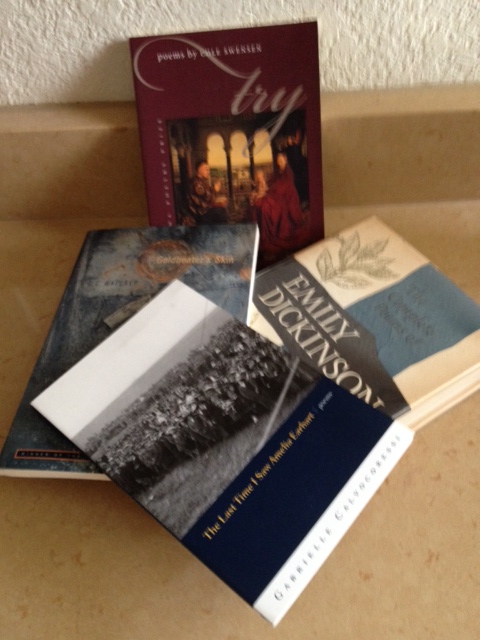
I’m staring at the flight of beers that Jon has placed in front of me. On the left I find Real Ale Brewing Company’s Phoenixx Double ESB. Next to it rests Ranger Creek’s Saison Oscura, followed by Revolver Brewing’s High Brass Golden Ale, and finally, Southern Tier Brewing’s Creme Brulee Stout. I sip the Phoenixx ESB, and am delighted to find it just as I remembered: dry, but sweet, without being overly bitter. Rich, deceptive, caramely odor, amber color. Overtones, hidden layers. I immediately think of Cole Swensen and her book Try, my real introduction to her work, how she reflects tone and imagery, perception and language, intricately weaving them into patterns, into narrative bits to be experienced and savored. “There’s a world out there that isn’t there,” the Phoenixx, evidently a fan of Cole Swensen, whispers.
I linger over the last sip of the ESB, and move on to the Saison Oscura, which quite frankly, surprises me. And that’s good. My preferences edge towards the bitter, and most of the saisons I’ve tried have finished a tad fruity and sweet for my palate. Not so with Ranger Creek’s rendition. Its beguiling light body, with notes of pepper and spice, end with just the right note of bitterness. But which poet, which book would I pair with this dark saison? Someone who juggles the lyrical with harsh realism, whose voice blends and releases the bitter, the forsaken, in distilled snippets of striking clarity. Ah, yes. I have just the book, The Last Time I Saw Amelia Earhart, by Gabrielle Calvocoressi, and the line:
The whole world tastes like salt,
crows overhead shout, Gone, gone
gone. She can’t help me any more.
I’ll have to walk.
It’s much more difficult to pair the Revolver Brewing High Brass Golden Ale with a favorite poet, because, sadly, I find it lacking. It’s light in the mouth, and, to take Gertrude’s quote totally out of context, there is no there there. If I’m to choose a blonde ale, I’d much prefer Real Ale Brewing’s Fireman’s #4. But waste not, want not. I down it, and consider which poet would not only transcend this disappointment, but also hand it a one-way ticket to, perhaps, Stein’s lost Oakland? Easy. G.C. Waldrep, whose Goldbeater’s Skin sets its barbed hooks into my flesh each time I open it. And for this particular occasion, I find no poem more appropriately titled than “What Begins Bitterly Becomes Another Love Poem,” in which he writes:
We stood without shadows on asphalt at midday.
What we call patience is only fire again, compressed.
And fire should accompany Southern Tier’s Creme Brulee Stout. A crackling fire fending off the icy, shingle-ripping wind, with Miles Davis echoing in the background, an exquisite meal resting comfortably in the belly, and the pleasure of knowing that the book you’re about to dip into is an endless well. Quite simply, it’s a liquid dessert. Light coffee, a tad chocolatey, with big vanilla. Medium body, sweet. Smells like creme brulee. Tastes like it. But it’s beer. It tells the truth, but tells it slant! And who better to accompany this frothy delight than Emily Dickinson?
Tell all the truth but tell it slant,
Success in circuit lies,
Too bright for our infirm delight
The truth’s superb surprise…
Onward to the next flight, and more truth. More poetry. More beer. More surprise!
This last appeared on the blog in 2018.

Kites
Will viewpoint shift with my spine’s slow
compression, or will this
window admit only true images
in the shortened days to come?
I pencil phrases on bone-shaped kites
and release them to the afternoon.
Call them prayers, name them moans.
Each string is a regret freed, a separate
skeleton, let go. My two selves shudder
in the attempt. I await the perfect breeze.

“Kites” first appeared here in July 2016.

Self-Portrait with Orbit
An arced path around a central point, bound to but held apart,
as in night’s returning grace, or standing waves.
In periapsis, you reach out as I slowly withdraw.
Gravity does not prevent departure but prolongs it.
The acceleration of a body is equal to the sum of the gravitational forces,
divided by its mass. I rise from the chair but can’t escape.
Not circular but elliptical.
Where falling away and curving from never meet.
Realizing that I am neither focus nor center, I discover place
in symmetry, in flow and subtraction.
A cloud obscures the sun and you close your eyes.
I wither at the thought of scaling or relative size, or your departure.
In the simplest Klemperer rosette, four bodies cycle their dances,
heavy, light, heavy, light, in a rhombic configuration.
My arteries fill in opposition to desire.
Wanting you, I absolve weight and listen, accept my place.
“Self-Portrait with Orbit” last appeared on the blog in 2019, and is included in The Circumference of Other, my offering in the Silver Birch Press publication, IDES: A Collection of Poetry Chapbooks, available on Amazon.
 O at the Edges