Gemini Ink Writers Conference in San Antonio, July 2018

Gemini Ink Writers Conference in San Antonio, July 2018

This 3-day conference has quite the line up in poetry, with renowned poet and editor Veronica Golos, Pulitzer Prize winner Vijay Seshadri, and Ruth Lilly Prize winner and Pulitzer Prize finalist Martín Espada. I can’t pass up this opportunity, and have already registered for Veronica Golos’s workshop. The conference runs from Friday, July 20 until 6:00 p.m. Sunday, July 22. If you’re a local or don’t mind traveling and want to sample the Texas summer (we do have air conditioning), you might consider Gemini Ink Writers Conference. I’m excited!

The non-poetry offerings are equally impressive, but hey, I’m a poet, and will let someone else address those.

Recording of “Balance”

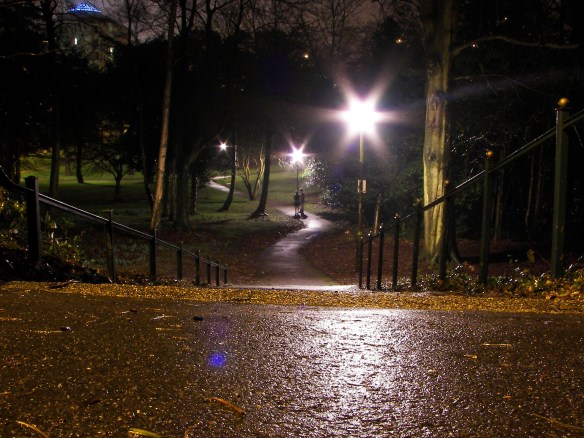
star lights


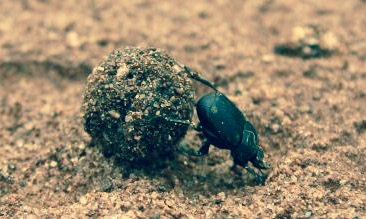
Balance

Navigating
by stars,

one ball
buried,

another
gathering,

the dung
beetle

straight-lines,
maintains

position,
forever

looking forward
and up.

image

“Balance” first appeared here in February 2016, and is included in my just released micro-chapbook Only This, available for free download from Origami Poems Project.

“Nightdreams” Kevin MacLeod (incompetech.com)
Licensed under Creative Commons: By Attribution 3.0 License
http://creativecommons.org/licenses/by/3.0/

Awakened, He Turns to the Wall (Cento)

cell

Awakened, He Turns to the Wall (Cento) 

Then, everything slept.
Where were you before the day?

You see here the influence of inference,
whereby things might be seen in another light,

as if the trees were not indifferent, as if
a hand had suddenly erased a huge

blackboard, only, I thought there was
something even if I call it nothing,

like the river stretching out on its
deathbed. No one jumps off.

* * *

A cento is composed of lines from poems by other poets. This originated from pieces by: Larry Levis, Jacques Roubaud, Lorine Niedecker, Gustaf Sobin, Denise Levertov, Elizabeth Spires, William Bronk, Vicente Huidobro, Ingebord Bachmann

For further information and examples of the form, you might peruse the Academy of American Poets site: http://www.poets.org/poetsorg/text/poetic-form-cento

erase

This last appeared here in February 2017.

Martín Espada’s “Here I Am”


Find the stunning poem here, then read his explanation for writing elegies for the living.

I May be a Genius

Thanks to Margaret Langstaff, I’ve learned that despite all evidence to the contrary, I may indeed be a genius. Read her “Einstein’s Desk and Mine: A Sort of Comparative Analysis.”

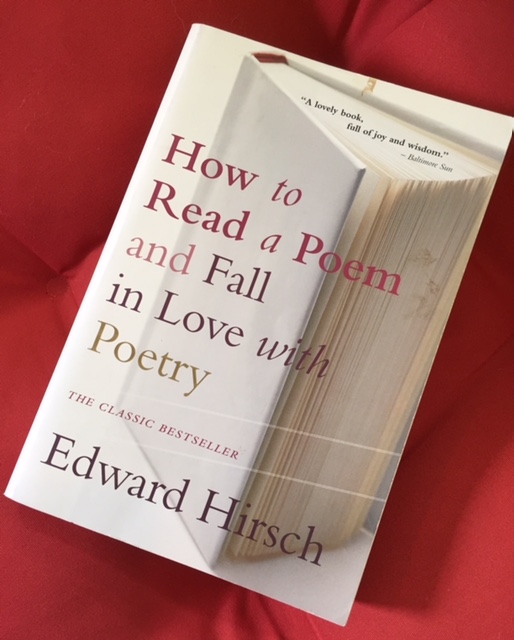
Edward Hirsch’s How to Read a Poem and Fall in Love with Poetry

In a nod to National Poetry Month, the Poetry Foundation has posted the first chapter of Edward Hirsch’s superb How to Read a Poem and Fall in Love with Poetry. One of my favorite all-time reads. If you haven’t read this book, dip into the first chapter now.

Earth’s Damp Mound

OLYMPUS DIGITAL CAMERA

Earth’s Damp Mound
for P.M.

I. February 1998.

That week it rained white petals
and loss completed its

turn, the words finding themselves
alone, without measure,

without force, and no body to compare.
Though strangers spoke I could not.

Is this destiny, an unopened
mouth filled with

pebbles, a pear tree
deflowered by the wind? The earth’s

damp mound settles among your bones.

II. Count the Almonds

What bitterness
preserves your sleep,

reflects the eye’s
task along the inward thread?

Not the unspoken, but the unsayable.

Curious path, curious seed.
A shadow separates

to join another, and in the darker
frame carries the uncertain

further, past silence, past touch,
leaving its hunger alert and unfed,

allowing us our own protections.

III. The Bowl of Flowering Shadows

Reconciled, and of particular
grace, they lean, placing emphasis on balance,

on layer and focus, on depth of angle
absorbing the elegant darkness,

a lip, an upturned glance, the mirror.

What light caresses, it may destroy.
Even the frailest may alter intent.

So which, of all those you might recall,
if your matter could reform

and place you back into yourself,
would you choose? Forgive me

my selfishness, but I must know.

IV. Requiem

Then, you said, the art of nothingness
requires nothing more

than your greatest effort.
And how, seeing yours, could we,

the remaining, reclaim our
space without encroaching on what

you’ve left? One eye closes, then
the other. One mouth moves and another

speaks. One hears, one listens, the eternal
continuation. Rest, my friend. After.

Prentiss Moore influenced my reading and writing more than he ever realized. We spent many hours talking, eating, arguing, drinking, laughing. Always laughing – he had one of those all-encompassing laughs that invited the world to join in. And it frequently did. Through Prentiss I met in person one of my literary heroes, Gustaf Sobin, whose work Prentiss had of course introduced me to. Those few hours spent with the two of them driving around in my pickup truck, discussing poetry, the Texas landscape, horticulture and the vagaries of the publishing world, are hours I’ll always hold close.

Earth’s Damp Mound last appeared here in February 2016. It was first published in the anthology Terra Firma, and is included in my chapbook, If Your Matter Could Reform.
file0001831388228

John Ronan On Seamus Heaney’s “Digging”


A few days ago I read a glowing review of an Instagram poet, whose name I’ll not mention, which contrasted her writing to Seamus Heaney’s. In short, the reviewer complained that Heaney’s writing was too complicated, used too many words, and took too long to read. Yeah, I thought, but he never wasted one!

Needing an antidote to that vapid assessment, I found John Ronan’s essay on Heaney’s “Digging.” I feel much better now.

And here’s a recording of the poem.

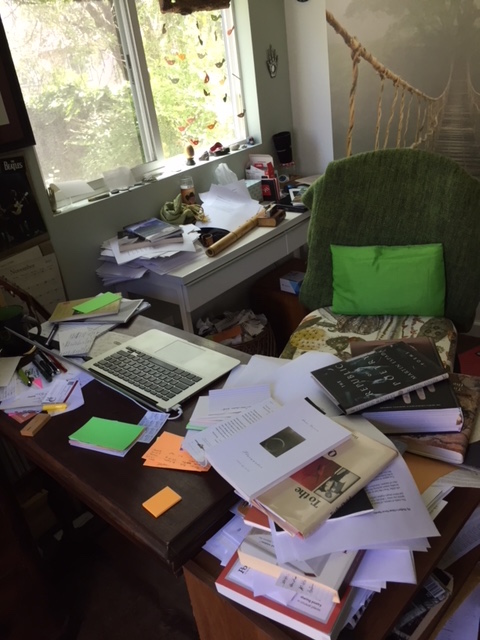
Dobie’s Desk

Dobie’s Desk

Sitting at this desk, I wonder
whose words will emerge

from the stained wood,
its whorls and cracked surface

detailing a specific language
of the inert and precious.

Earlier I rapped the cistern
to verify water level,

and a week ago startled
a cottonmouth sunning its lengthy

self at the crossing. The door
just blew open, perhaps,

or a ghost wished to offer its
voice, neither malice

nor approval imbedded
in the gesture. History

shadows me despite my best
efforts. I walk, drink water,

write, think of friends left
behind or gone ahead,

reading between the grains
and dark spaces, looking for rain

in the blue, for light and benediction
and the secret poetry of furniture.

Which Poet, Which Beer (4)

I come here to sit quietly, emerging from my shack, if only briefly, to eavesdrop and observe, to sip beer and participate in the world of commerce. Ah, yes. The grocery store. If only all of them housed craft-beer bars. I place cilantro and shallots in my basket, add arugula, asparagus and a lime, and wander over to the fish case where two small fillets of Chilean sea bass, the commercial name for Patagonian toothfish, catch my eye.

Finally at the bar, I order Lone Pint Brewery’s Zeno’s Pale Ale, and overhear a disquisition on hydration and landscaping, and a conversation on war and snipers and gratitude. The ale arrives with a light, lacey head, exudes a bready malt profile upfront, and a pine-citrus punch at the back. I can’t quite uncover the truth of the flavor, but enjoy the search, and amidst the swirling combination of voices and beer I somehow think of Veronica Golos’ “Snow in April,” a ghazal in her stunning book Vocabulary of Silence.

“Has my flock of flowers died? An ambush, a bullet-shot
of cold. Undone beneath the snow, what’s truth, in April?”

What is the sniper’s truth? What gratitude might we find within April’s layers? I have no answers, only more questions, and with more questions comes thirst.

My second beer is a curious blend of old and new – a Belgian-style quadrupel that, don’t laugh, smells a bit like a cola, but in a good way. Unibroue’s Trois Pistoles is dark brown, let’s call it mahogany, with a fruity but mellow flavor and a toasty malt finish. And well balanced – with an alcohol content of 9%, it’s strong, but not too strong. Historical undercurrents flow through this brew, yet it also brings with it an appreciation of the new and popular, which leads to thoughts of one of my favorite poets, Frank Bidart, whose work often refers to and resonates with historical figures (in the book at hand, Watching the Spring Festival, Tu Fu and Catullus come to mind), and his poem “Sanjaya at 17,” referencing an American Idol contestant:

“There is a creature, among all others, one,
within whose voice there is a secret voice
which once heard
unlocks the door that unlocks the mountain.”

Today the mountain does not swing open for me. Perhaps a second Trois Pistoles might have done the trick, but instead, knowing I have to prepare dinner, starting with a compound butter of shallot, cilantro, garlic and lime zest, I request a mere taste of Founder’s Breakfast Stout, because, well, the idea of stout for breakfast has a certain appeal, though in my case would not be practical, as it would likely put me to sleep. And yes, it contains both chocolate and coffee (Sumatra and Kona), tastes a bit smoky, is smooth and luxurious in the mouth, and makes me long for a lonely, cold winter’s night in a far-off country, a fire crackling with just a hint of madness, and the full moon leering down at all of us, but particularly the dead genius that was Thomas James, whose poem “Wild Cherries,” from his one and only book Letters to a Stranger, ends:

I watch you eat, tasting yourself perhaps,
Some bitterness that is a part of you,
And I accept it gratefully. When you smile,
I see you dying in that single instant.
Walking back home, into ourselves, we enter
A far-off country neither of us wanted.”

Oh, those things we want and don’t want. To feel. To write. To cook, to sing. To share. To love. To be alone. To be numb. To do nothing. To do everything…