Some Answers You Never Considered

Some Answers You Never Considered

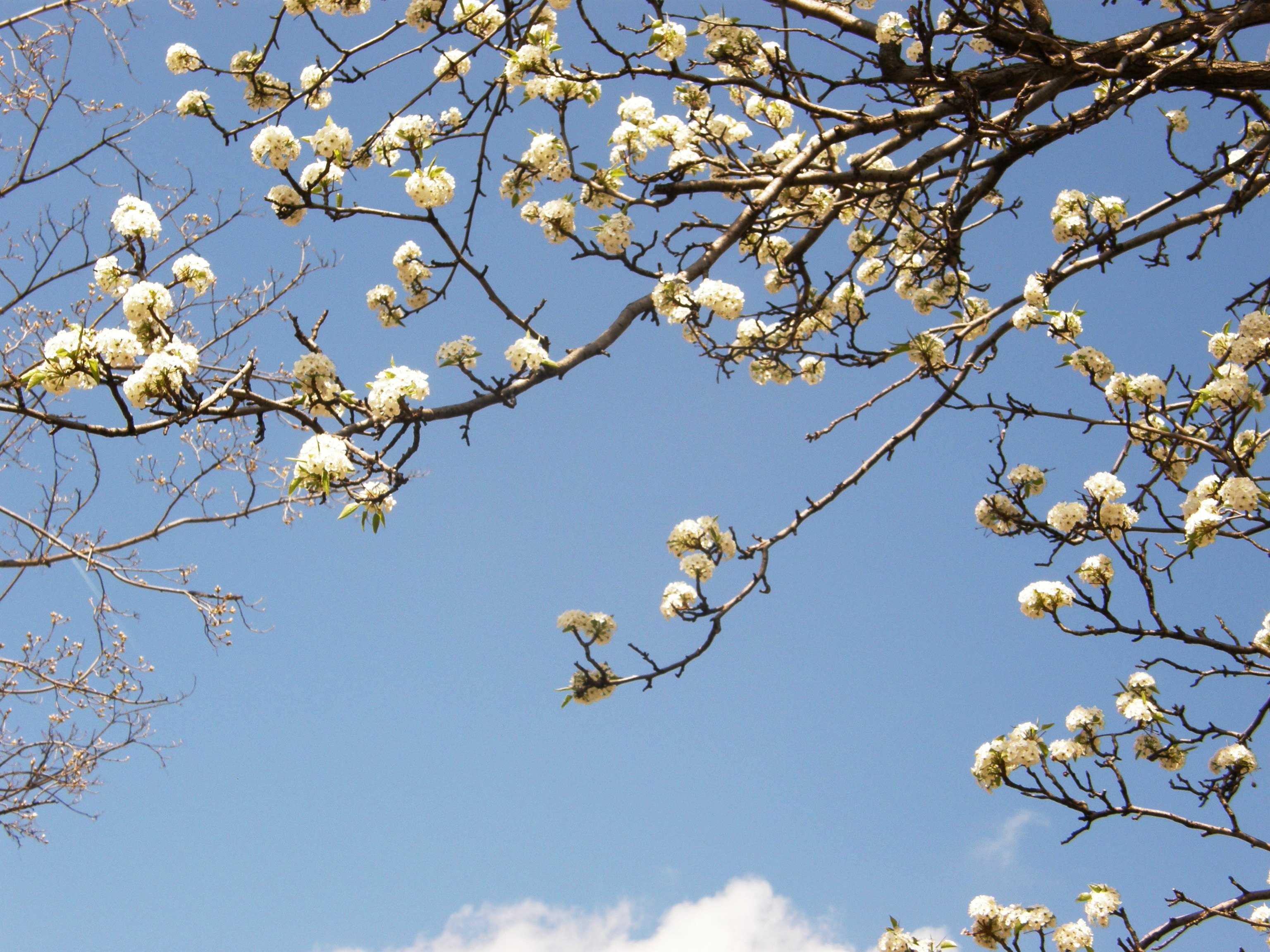
At the cusp of night, before the sun steams out in the ocean,
and blues abandon the reds.

Nothing rests at the core of zero.

Cerulean blue was first marketed as coerulium.

What we consider sky includes only its lowest reaches.

Even considering a dense history with kites, I humbly concede,
and admit sacrifice as atonement, with grace.

No. I say it again. No.

Your visual system constructs the colors you see.

Only when the wind unbuttons its greatcoat, or at the tip
of an icicle, just before the drop catches itself.

Release the line and know the freedom of loss.

Transparent yet wide, unfolded like a fist freeing
a swarm of bees into honeyed air, it contains us.

Your inability to see it does not refute the horizon’s base.

If I knew I’d tell you.

* * *

“Some Answers You Never Considered” first appeared in Underfoot in October 2017.

Numbers numbers numbers: NINE

file0002037739398

Numbers numbers numbers: NINE

Early on in my other life I was hand-picked and hired to assist with budgets, to work with numbers. One of the higher-ups remarked that my spelling score was quite good for a “numbers person.” This amused me to no end, as I’d no inkling that a) anyone in the world considered me fluent with numbers, or b) that the mundane labor that comprised my livelihood had been noticed, much less evaluated, by someone beyond my small, three-person office (certainly no one noticed the writing I’d produced and published). More than a quarter century later, I’m still amused. And still working with numbers, which even now remain mysterious, magical, and even inspiring.

Take the number nine. Multiply it by two, and you get 18. Add the two digits that comprise 18, one and eight, and you get 9. Multiply it by three: 27. Total the two digits forming 27, and you get, yes, 9. Multiply it by four, by five, by six, by seven, eight or nine. Add the digits that comprise the sum and you return to nine. Interesting, no?

It appears everywhere. In Islamic cosmology, the universe is built of nine spheres. In Ancient Mexico, the netherworld consisted of nine layers. The magic square consists of nine parts. Beijing was designed as a center with eight streets. Hindu temple foundations contain jewels and nine distinct grains. The human body has nine openings. The number also appears in both sacrificial and healing rites. The River Styx bends nine times. I could go on (we haven’t scratched the surface), but will refrain.

And if this piece piques your curiosity, you might find this poem inspired by zero (a truly fascinating subject) of interest:

http://www.cladesong.com/okaji.withtheseninefigures.html

Or this one, “That Number upon Which the Demand Lieth,” which takes up the number three.

Earth’s Damp Mound

OLYMPUS DIGITAL CAMERA

Earth’s Damp Mound
for P.M.

I. February 1998.

That week it rained white petals
and loss completed its

turn, the words finding themselves
alone, without measure,

without force, and no body to compare.
Though strangers spoke I could not.

Is this destiny, an unopened
mouth filled with

pebbles, a pear tree
deflowered by the wind? The earth’s

damp mound settles among your bones.

II. Count the Almonds

What bitterness
preserves your sleep,

reflects the eye’s
task along the inward thread?

Not the unspoken, but the unsayable.

Curious path, curious seed.
A shadow separates

to join another, and in the darker
frame carries the uncertain

further, past silence, past touch,
leaving its hunger alert and unfed,

allowing us our own protections.

III. The Bowl of Flowering Shadows

Reconciled, and of particular
grace, they lean, placing emphasis on balance,

on layer and focus, on depth of angle
absorbing the elegant darkness,

a lip, an upturned glance, the mirror.

What light caresses, it may destroy.
Even the frailest may alter intent.

So which, of all those you might recall,
if your matter could reform

and place you back into yourself,
would you choose? Forgive me

my selfishness, but I must know.

IV. Requiem

Then, you said, the art of nothingness
requires nothing more

than your greatest effort.
And how, seeing yours, could we,

the remaining, reclaim our
space without encroaching on what

you’ve left? One eye closes, then
the other. One mouth moves and another

speaks. One hears, one listens, the eternal
continuation. Rest, my friend. After.

Prentiss Moore influenced my reading and writing more than he ever realized. We spent many hours talking, eating, arguing, drinking, laughing. Always laughing – he had one of those all-encompassing laughs that invited the world to join in. And it frequently did. Through Prentiss I met in person one of my literary heroes, Gustaf Sobin, whose work Prentiss had of course introduced me to. Those few hours spent with the two of them driving around in my pickup truck, discussing poetry, the Texas landscape, horticulture and the vagaries of the publishing world, are hours I’ll always hold close.

Earth’s Damp Mound last appeared here in February 2016. It was first published in the anthology Terra Firma, and is included in my chapbook, If Your Matter Could Reform.

file0001831388228

Q&A with Poet Stephanie L. Harper (Part 2)

I’m pleased to present part 2 of the Q&A with poet Stephanie L. Harper:

If you were a poetic form, which would you be?

I would be a poetic form that could seep down into darkness, molecule by molecule, through miles of porous rock, to return to the wellspring, then rise again to the surface, and wash over the grief-stricken with the all immensity of love and joy in my depths. I’m pretty sure that would make me an elegy.

What themes or traits will readers find in your work? What will they not find?

My work is chock full of mythological creatures, archetypal symbolism, and nature imagery (i.e., birds, seascapes, wolves, forests, volcanoes). It touches often on spirituality (and/or religiosity), sometimes alludes to current events (and associated dismay), and has an overall feminist and philosophical bent. My love for and awe of my children shows up a lot, too. Some of my poems address such uncomfortable subjects as child abuse and misogyny, but I try to avoid any superfluously vulgar or violent language. It occurs to me that I’ve tended to give the explicit erotic love bandwagon a wide berth, which I don’t anticipate will cease to be the case, but I suppose stranger things have happened…

List three favorite poets, an admirable animal, and your go-to beverage.

Ocean Vuong, https://www.newyorker.com/magazine/2015/05/04/someday-ill-love-ocean-vuong

Melissa King Rogers, https://www.rattle.com/deus-ex-machina-by-melissa-king-rogers/

Emma Gonzalez, https://www.motherjones.com/politics/2018/03/emma-gonzalez-is-responsible-for-the-loudest-silence-in-the-history-of-us-social-protest/

It bears mentioning that on another given day, I’d likely have chosen three different poets, but it’s also true that anyone I’d think to include would be someone whose work I return to again and again.

Animal: I think animals, in general, are admirable for being better and more pure in every moment than we humans ever will be in our best, most authentic moments, but sometimes an animal will stand out for me as being exceptional, even by animal standards. One example that comes to mind straightaway, is a she-leopard whose brutal and remarkable story I once followed in a nature documentary. It was years ago, when my kids were still quite young. In one of the episodes, the leopard returned to her den to find that her cub had been swallowed by a giant python. Desperate to retrieve her cub, whom she must have known was already dead, she relentlessly attacked the python, issuing blow after calculated blow clearly designed to maim and traumatize the snake without killing it, so that it would regurgitate the cub, which it eventually did. The mother leopard then performed a harrowingly elaborate mourning ritual, during which she paced and mewled and roared, and ultimately ingested her cub, presumably to protect its body from the elements, or, perhaps, to achieve a final moment of closeness. In any case, that ordeal was devastating, nausea-inducing, heart-rending, absolute perfection, like nothing else I’ve ever witnessed. I still can’t recall or write about it without tears welling up.

Go-To Beverage: This is where things get really interesting! Sorry, NOT. I drink a cup of coffee with a splash of almond milk pretty much every morning. Without it, not only is my ability to interface with the world on a conscious basis severely impaired, but my chances of experiencing a raging migraine by late afternoon are increased by a factor of ten. That is all.

And your creative process? Could you offer us a glimpse into how your poems develop from first glimmer to fully realized piece? Do you follow a regular writing routine? Do you listen to music while writing? Write in public or in solitude?

There’s a ubiquitous voice out there in literary world that would have us believe no one can be a serious writer without following a strict writing practice. As someone who doesn’t operate well with routines (which is far from saying that I’m not a creature of habit, but that’s a story for another day), that’s always been a sore subject for me, and so I’ve done a lot of soul-searching about what does or doesn’t constitute success as pertains to who I am and what I do. For one thing, I’m learning that my tendency to get obsessive over whether or not I’m performing to some prescribed standard of “real poet” (as opposed to “full-of-shit pretender,” that is), is a recipe for performance anxiety tenderloins braised in a tangy reduction of doom. I suppose it’s true that a heaping serving of doom has on occasion successfully fed a convincing performance, but it’s not a sustainable diet for me.

So, while I’ve never figured out a methodical way to conjure creative output in written form “on demand,” I’ve come to realize that this fact doesn’t necessarily mean I’m any less invested in the work. I’m finally understanding that everything I do in the course of living (i.e., being in the world each day, reading, sharing in the joys, frustrations, and griefs of my family and friends, everything that goes into raising and championing my kids, even menial chores and any and all associated avoidance tactics, and did I mention reading?) is oriented toward the work of poetry. Eventually, invariably, the imagery-laden phrase-fragments I find myself chanting in the shower, or in the car, will rise to a critical point of insistence that they be born, obliging me to do something about it—a something which tends to involve either a journal, a screen, or the back of a receipt. Then, once such a creative burst has resulted in a new, nebulous little life-form, said infant poem may demand extensive attention in the way of crafting, cross-referencing, cajoling, and other various cerebrations over the course of months, or sometimes even years. Occasionally, though, a poem will learn as a result of my ministrations to pull off a pretty persuasive full-realization act.

Please tell us how or why you turned to writing poetry?

 When I was a youngster, my teachers used to call me a “gifted” prose writer (go figure), and anyone who’s ever received a personal letter (whether in handwritten, or electronic form) from me would attest to my proclivity for words, and lots of them, but I’ve actually always preferred poetry as my vehicle for creative expression. I don’t believe I ever had a pivotal moment of “turning to” writing poetry, but rather, simply, that I am a Poet. It’s a fact about my life that it’s taken me the better part of my lifetime so far to figure out, but I’m learning that it’s more a matter of how I’m wired to relate to the world and others in it, than of my having chosen to practice one form of art over another.

I think of poetry as an attempt to account for and share the truth (in terms of emotional, experiential immediacy) as accurately and proximally as human language will allow, given that language can only at best be a pale stand-in for any actual thing we mean to express. Insofar as telepathy hasn’t yet evolved in humans to the extent that it could viably supersede our linguistic systems as the primary mode of communication, poetry strikes me as the closest we can get to understanding one another.

I am a Poet, not because I think there’s something special about me that I need to tell everyone, but because I’ve found nothing more fortifying and validating than those moments in which I’ve recognized myself in someone else. And so, what moves me to give something of myself to the world in the form of poetry, is not so much a hope of getting something in return, as it is of being a gift that’s received.

Would you mind sharing a bit about your background?

You might say that I’ve taken an anti-establishment approach to achieving Poethood, in that I never earned an MFA, or even studied in any writing program. But the truth of the matter is, my sans-MFA route was not for a lack of trying to pry my way into the establishment. When I was a senior at Grinnell College (IA), graduating with a double major in English and German, I applied to a boatload of graduate programs in creative writing. Several of my professors made a point of advising me against including any of my poetry in the writing samples I submitted with my applications, stating euphemistically that it “wasn’t ready.” The non-conformist in me did not heed, and did not prevail. A year later, stubbornly submitting more of my “poetry” with my applications to yet another batch of writing programs, resulted in more resounding rejections. I did, however, manage to find my way into one of the top Ph.D. programs in German literature in the country at the time, at the University of Wisconsin in Madison, where I studied and taught for four years while completing my MA, and two additional years of coursework toward my Ph.D. After the accrual of much debt, my life took an abrupt, yet immensely welcome turn toward marriage and motherhood. I’ve since made a show of pursuing other “respectable” career paths, including completing the prerequisite science courses for a nursing program I ended up not applying to, and a stint in theological seminary as a Master of Divinity candidate, during which time my son was diagnosed with autism, which suddenly made my true calling crystal clear… Societally-induced guilt over “wasting my education” be damned: I’ve spent twenty years so far as a Mother, doing exactly what I was meant to do—which, as it turns out, has amounted to a pretty stellar education in the poetic arts…

* * *

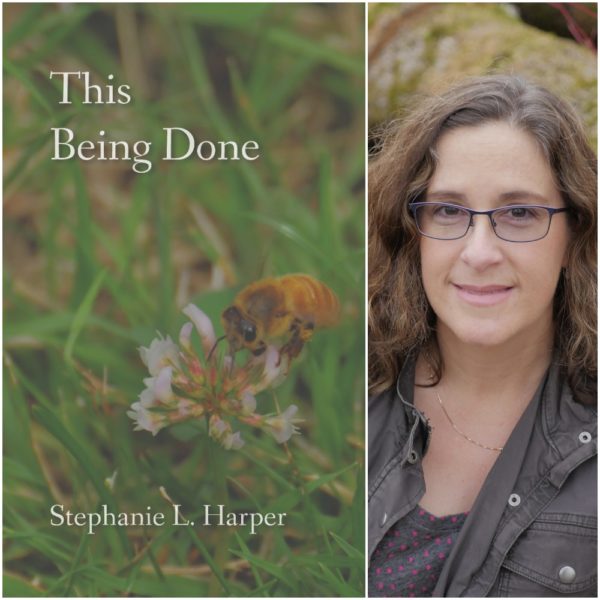
This concludes our Q&A, but while you’re awaiting your copy of This Being Done (the pre-publication sales period ends April 27), you might read Stephanie’s poem “How to Be a Malacologist” in Panoply, or visit her blog.

Love, Scattered (Cento)

image

Love, Scattered (Cento)

I cull and offer this and this,
and these last definite whorls

or later star or flower, such
rare dark in another world,

outdistancing us, madness
upon madness, the crest

and hollow, the lift and fall,
ah drift, so soft, so light,

where rollers shot with blue
cut under deeper blue as the

tide slackens when the roar of
a dropped wave breaks into it,

and under and under, this
is clear—soft kisses like bright

flowers— why do you dart and
pulse till all the dark is home?

I am scattered in its whirl.

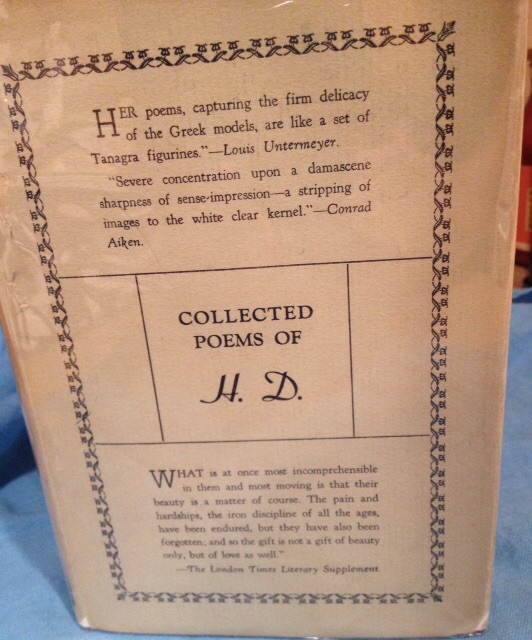
This cento last appeared here in October 2016, and is composed exclusively of lines taken from fifteen pages in the Collected Poems of H.D., 6th printing, 1945. Hilda Doolittle is a fascinating figure in 20th century American poetry. You might look at the Poetry Foundation’s biography for further information:

http://www.poetryfoundation.org/bio/h-d

image

Q&A with Poet Stephanie L. Harper (Part 1)

I’m pleased to offer this Q&A with poet Stephanie L. Harper:

You have a chapbook, This Being Done, coming out soon. Can you tell us something about it? From where did the title come?

 Yes, I’m thrilled that this debut of my work in book form is making its way into the world. The title, This Being Done, is an excerpt from my poem, “An Elegy for Birds & Bees,” which, the more I think about it, the more I believe is the crux of the collection. The poem came to me when I was profoundly depressed and drifting—feeling as if my childbearing days being behind me was somehow synonymous with not having (and not deserving to have) an identity or purpose for my own sake. The poem’s opening lines, “over & over in habitual drone /i repeat a phrase in my mind that no one knows i say / because i have not told / i am saying i’m done,” are at once a funeral dirge, and a spiritual awakening; with the aggrieved instance of awareness that the “being done” is my effective death, comes the terrifying sense that “thisbeing done” could be the only segue through which I might return to some kind of viable life. What ensues is a deliberate and laborious taking up (again) of the direction I’ve always been going in, because the alternative to doing so is simply not tenable; and I’m grateful to say that it’s the way I’m headed still. So, what I hope the book as a whole will offer readers, is something to hold onto in the way of resonance, or solidarity, to bolster them for their respective journeys.

(Note from RO to blog readers: You must read these poems. If the book is not within your budget, ask your library to order it.)

Please tell us how or why you turned to writing poetry?

 When I was a youngster, my teachers used to call me a “gifted” prose writer (go figure), and anyone who’s ever received a personal letter (whether in handwritten, or electronic form) from me would attest to my proclivity for words, and lots of them, but I’ve actually always preferred poetry as my vehicle for creative expression. I don’t believe I ever had a pivotal moment of “turning to” writing poetry, but rather, simply, that I am a Poet. It’s a fact about my life that it’s taken me the better part of my lifetime so far to figure out, but I’m learning that it’s more a matter of how I’m wired to relate to the world and others in it, than of my having chosen to practice one form of art over another.

I think of poetry as an attempt to account for and share the truth (in terms of emotional, experiential immediacy) as accurately and proximally as human language will allow, given that language can only at best be a pale stand-in for any actual thing we mean to express. Insofar as telepathy hasn’t yet evolved in humans to the extent that it could viably supersede our linguistic systems as the primary mode of communication, poetry strikes me as the closest we can get to understanding one another.

I am a Poet, not because I think there’s something special about me that I need to tell everyone, but because I’ve found nothing more fortifying and validating than those moments in which I’ve recognized myself in someone else. And so, what moves me to give something of myself to the world in the form of poetry, is not so much a hope of getting something in return, as it is of being a gift that’s received.

Would you mind sharing a bit about your background?

You might say that I’ve taken an anti-establishment approach to achieving Poethood, in that I never earned an MFA, or even studied in any writing program. But the truth of the matter is, my sans-MFA route was not for a lack of trying to pry my way into the establishment. When I was a senior at Grinnell College (IA), graduating with a double major in English and German, I applied to a boatload of graduate programs in creative writing. Several of my professors made a point of advising me against including any of my poetry in the writing samples I submitted with my applications, stating euphemistically that it “wasn’t ready.” The non-conformist in me did not heed, and did not prevail. A year later, stubbornly submitting more of my “poetry” with my applications to yet another batch of writing programs, resulted in more resounding rejections. I did, however, manage to find my way into one of the top Ph.D. programs in German literature in the country at the time, at the University of Wisconsin in Madison, where I studied and taught for four years while completing my MA, and two additional years of coursework toward my Ph.D. After the accrual of much debt, my life took an abrupt, yet immensely welcome turn toward marriage and motherhood. I’ve since made a show of pursuing other “respectable” career paths, including completing the prerequisite science courses for a nursing program I ended up not applying to, and a stint in theological seminary as a Master of Divinity candidate, during which time my son was diagnosed with autism, which suddenly made my true calling crystal clear… Societally-induced guilt over “wasting my education” be damned: I’ve spent twenty years so far as a Mother, doing exactly what I was meant to do—which, as it turns out, has amounted to a pretty stellar education in the poetic arts…

Would you offer up some of your influences – poetic and otherwise? What draws you to that work?

Whenever someone asks me about my influences, everything I just knew perfectly in the second prior congeals into a blur of inaccessibility. It’s kind of like when something suddenly reminds of a film I saw decades ago, and I need to tell my husband immediately what it was called or who was in it, because it’s now the only thing that matters, which usually goes something like this:

Me: You know, the one about aristocrats in France in like the 18th century? And the bad playboy guy tricked the faithful married woman into falling in love with him, but then he accidentally fell in love with her, too, and he tried to set things right, but then she died of a broken heart? Oh yeah, and that actress was in another movie—something about witches, maybe—with the guy from that horror movie in the late 70s that was filmed in part at the Timberline Lodge on Mt. Hood… I’m sure the title has something French in it, but it was an American film. I think it came out in the late 80s or early 90s? Oh, yeah, and the Fatal Attraction lady played some kind of villain…

Husband (never surprised, always a bit concerned): Dangerous Liaisons?!!??

Well, now that my expertly executed stall tactic has bought me a semblance of clarity, I feel compelled, first off, to mention Carl Jung’s Man and His Symbols and Clarissa Pinkola Estés’ (also a Jungian psychologist) amazing work on the female psyche, Women Who Run With the Wolves. Other “poetic and otherwise” influences that are making their way to the conscious fore, in no particular order, are Siddhartha Mukherjee’s The Emperor of All Maladies; Rosemary Radford Ruether’s Sexism and God-Talk; Henri Nouwen’s The Wounded Healer and Our Greatest Gift; Shakespeare’s Hamlet; Ursula LeGuin’s Earthsea series; Oliver Sacks’s Musicophilia; Douglas Adams’ Hitchhiker’s Guide to the Galaxy; Kahlil Gibran’s The Prophet; John Keats’s everything; Paul Celan’s Death Fugue; Martin Heidegger’s Being and Time and Letter on Humanism; Samuel Taylor Coleridge’s Kubla Kahn; Edgar Allan Poe’s The Raven; Elizabeth Barret Browning’s How Do I Love Thee…; and Dr. Seuss’s Horton Hatches the Egg.

I generally admire literature that is meticulously crafted, with strong musicality, exquisite observations about the human condition, and/or wry humor; but what the works that have had the deepest impact on me all have in common, is something I experience more viscerally, as a singular degree of earnestness, or a rarity of insight that can only be described as one thing: genius.

* * *

We’ll continue Part 2 of this Q&A in a few days, but in the meantime, you might read Stephanie’s poem “How to Take an Amazing Photo of a Solar Eclipse,” or listen to her read “Anatomy of a Fustercluck.”

White Mules and a Column of Smoke

vinyl

White Mules and a Column of Smoke

I am thinking of a place I’ve never seen or visited,
much like Heaven or Jot ‘Em Down, Texas, but with better
beverages and the advantage of hindsight and seasoning,
a glance back or to the peripheral, with a side of memory
and sliced, pickled jalapeños topping a pile of imagination.

And how do we so clearly remember what never occurred?
That book I read in 1970 was first published three years
later. A drowned childhood acquaintance ordered a beer
and sat next to me at a party in college. The open fields
I recall from the garden walls in France, where homes stood.

If only we carried with us slide shows or grooved vinyl
to trace back our lives – photos and recordings of those daily
remembrances – detailed notes indexed on cards, or data
embedded in our palms and accessed by eye twitches.
Would such evidence improve our lives?

Which filters shutter moments and thoughts, twist them
into balloon animals we no longer recognize? False
accusations and convictions aside, can we trust what we
know to be true? That oak stands where it has for four
decades. I bleed when cut. The sky still leers above us.

“White Mules and a Column of Smoke” was drafted during the August 2016 Tupelo Press 30/30 challenge. I am grateful to Natalie Butler, who sponsored the poem and whose photo inspired me.

John Ronan On Seamus Heaney’s “Digging”


A few days ago I read a glowing review of an Instagram poet, whose name I’ll not mention, which contrasted her writing to Seamus Heaney’s. In short, the reviewer complained that Heaney’s writing was too complicated, used too many words, and took too long to read. Yeah, I thought, but he never wasted one!

Needing an antidote to that vapid assessment, I found John Ronan’s essay on Heaney’s “Digging.” I feel much better now.

And here’s a recording of the poem.

Interview Up at The Quiet Letter

The Quiet Letter, a platform dedicated to contemporary literature, is based in India and operates from a small provincial town. Editor Pawan N. Hira recently interviewed me. The poetry world is indeed great and small, global and local.

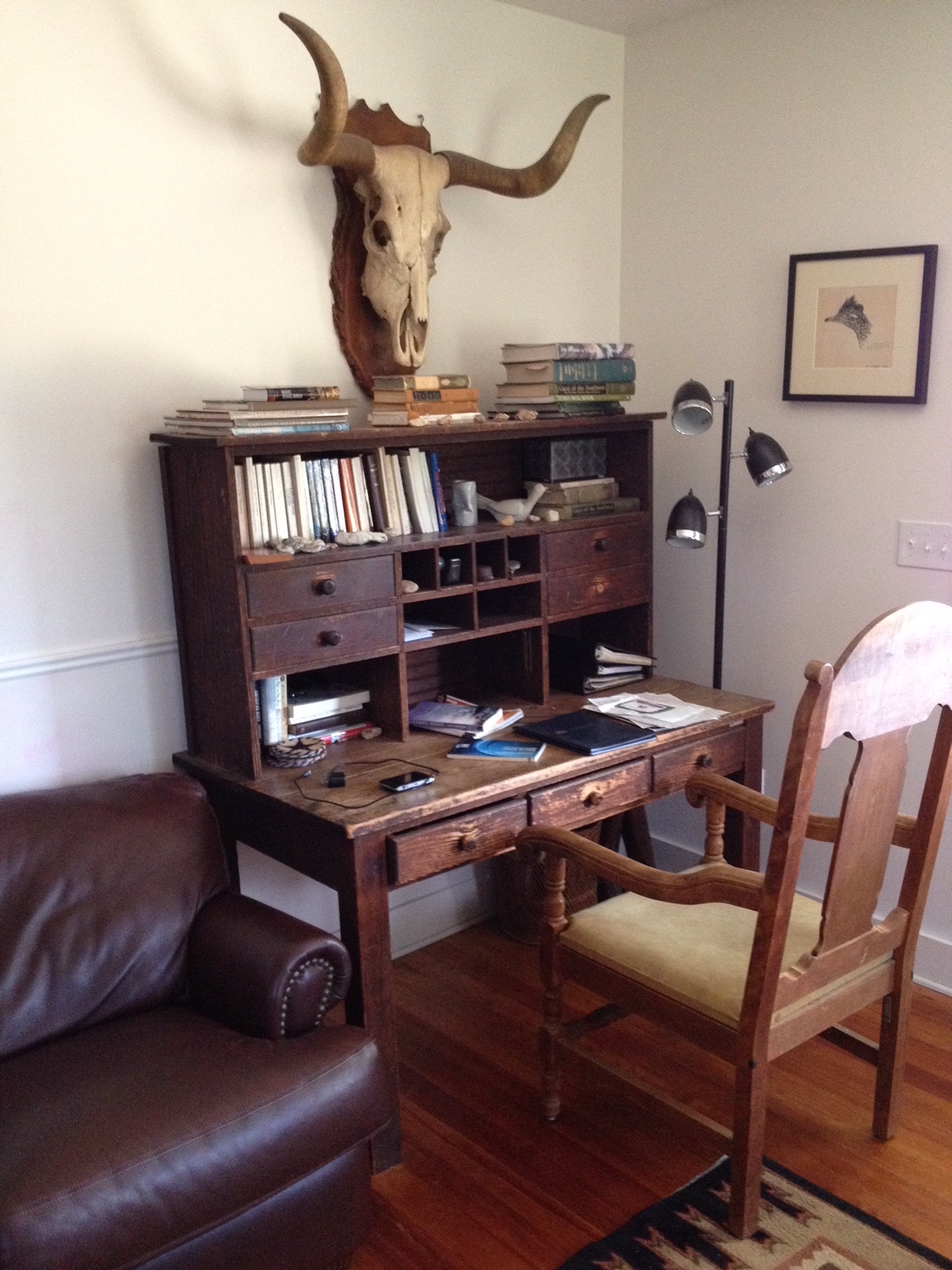
Dobie’s Desk

Dobie’s Desk

Sitting at this desk, I wonder
whose words will emerge

from the stained wood,
its whorls and cracked surface

detailing a specific language
of the inert and precious.

Earlier I rapped the cistern
to verify water level,

and a week ago startled
a cottonmouth sunning its lengthy

self at the crossing. The door
just blew open, perhaps,

or a ghost wished to offer its
voice, neither malice

nor approval imbedded
in the gesture. History

shadows me despite my best
efforts. I walk, drink water,

write, think of friends left
behind or gone ahead,

reading between the grains
and dark spaces, looking for rain

in the blue, for light and benediction
and the secret poetry of furniture.