And All Around, the Withered

And All Around, the Withered

I total the numbers printed
on passing boxcars,

multiply by seven, then add two,
subtracting every third odd number,

only to find, in the end, myself
tethered to this empty platform,

spelling hapless with integers,
acknowledging Zahlen and

the infinite. Sometimes gravel, too,
calls to me and I observe space

in the path’s patterns, constellation
stacked upon constellation,

multi-dimensional galaxies
expanding in one swooping arc,

heroic eagles and exploding stars
complicit in their deeds and forever

locked in sequence, yet when I explain
my vision, the words emerge

as convex polyhedrons or inverted,
drooled gasps, and people turn aside.

That boy’s two bricks shy a full load, they
say. The lights are on but nobody’s home.

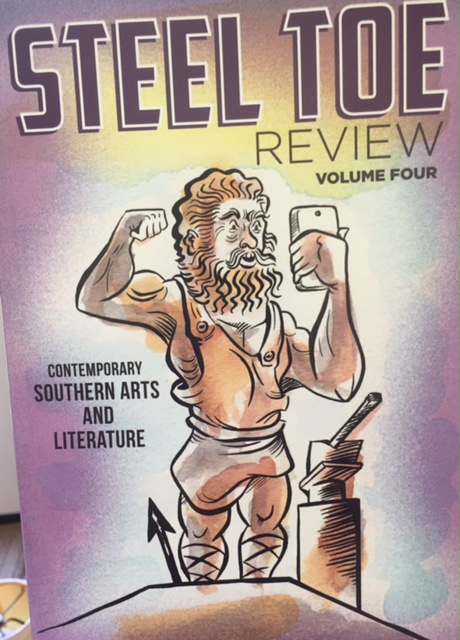
“And All Around, the Withered” was published in Steel Toe Review in January 2017.

Requiem

file0001789222317(1)

Requiem

That it begins.
And like a wave which appears
only to lose itself

in dispersal, rising whole again
yet incomplete in all but
form, it returns.

Music. The true magic.

Each day the sun passes over the river,
bringing warmth to it. Such

devotion inspires movement: a cello in the
darkness, the passage of sparrows. Sighs.

The currents are of our own
making. If we listen do we also

hear? These bodies. These silent voices.

* * *

“Requiem” was written in the 80s, in response to a piece of music. It made its most recent appearance here just a few years ago.

DSC02722

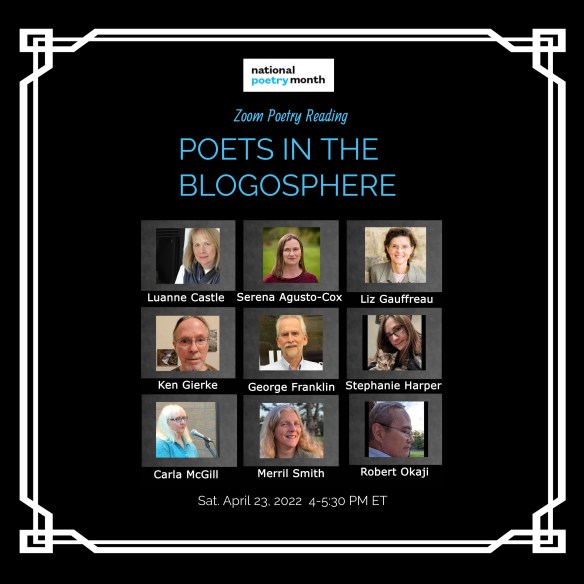
April 23rd National Poetry Month Zoom Reading: Poets in the Blogosphere

Poets of the Blogosphere

The theme for National Poetry Month 2022 is There’s A Poem in This Place. Two places to find contemporary poetry at its most vibrant are in the blogging community and at live readings. On 23 April 2022 from 4-5:30 PM ET, the two places come together when a select group of poets from the blogosphere present a live reading of their poetry at Poets in the Blogosphere. Most poetry is meant to be read aloud, and hearing poets read their own work is a heightened experience.The event is moderated by Elizabeth Gauffreau.

Please join me and my friends on Saturday, April 23, 2022 4-5:30 PM ET

Registration required: https://tinyurl.com/Poets-in-the-Blogosphere

It’s going to be fun! 

N Is Its Child


N Is Its Child

If darkness produces all, from where do we obtain nothing?

As a line becomes the circle, becomes a mouth, becomes identity.

In mathematics, n signifies indefinite; in English, negation.

The no, the non, the withdrawal, the taking away.

A heart with trachea represented zero in Egyptian hieroglyphs.

My mouth forms the void through the displaced word.

Conforming to the absent, the missing tongue serves soundlessness.

Aural reduction, the infinite unclenched: n plus n.

Shiva, creator and destroyer, defines nothingness. As do you.

One and one is two, but zero and zero is stasis.

Pythagoreans believed that all is number, and numbers possess shape.

The letter N evolved from a cobra to its present form.

One may double anything but zero.

Unspoken thought, disorder. The attenuated voice swallowing itself.


* * *

N Is Its Child” was first published in Issue 4 of ReservoirI am grateful to editor Caitlin Neely for accepting this piece.


At Work I Stand Observing My Diminished Self


At Work I Stand Observing My Diminished Self


1 (reflection)

Six iterations, alike but lessened in sequence, and always in pairs:
front and back, oblique, the two mirrors becoming four, then six.

A perfect mirror reflects and neither transmits nor absorbs light.

Tilting my chin, I accept reflectance according to its distribution.

Retina as transducer, producing neural impulses.

The images consume no space but the effect is of distance.

Vision is not simply the retina’s translation
but counts inference and assumption among its influences.

The sum and product of its parts: 1 + 2 + 3, or, 1 x 2 x 3.

Angles achieve distinctions apparent at each adjustment.

Turning slightly, I detect movement in each replica.

A six-door cubic cage depicting the bondage of sense and elements.

It is possible to withdraw from this frame.


2 (answers)

Does the weaker eye perceive less.
Who conceals the shadow’s death.
Is a distal truth a lie or merely implication.
How do you rid the mirror of its ghosts.
What resonates in the echo’s decline.
Did the light switch subvert the blackened image.
Apparition, projection or visual representation.
When do waves not disturb.
At what point does belief transmute sight.
What fixes the mirror’s image.
Who closed his eyes and saw light.


3 (prosopagnosia)

I sip coffee and gaze out the second-floor window.

More light enters my neighbor’s office than mine.

Calculate the difference between illumination and glare.

Looking ahead, I claim no face and recognize no one.

The eye converts a signal from one form of energy to another.

Accepting light from external objects, I perceive reflection as the true arbiter.

The dissected path impairs transduction.

Face as identifier: to make, to do.

Translation: imperfection: diminishment.

Blink.

* * *

“At Work I Stand Observing My Diminished Self” was published in Posit in October 2017.

Before We Knew


Before We Knew

All thought of consequence
melted with that first touch
of tongue to skin, no respite
to be found in that heat,

no shade at all. I recall
hitching a ride later with a
German couple who lit up
and passed the joint without

asking, and after their
Cinquecento sputtered away,
I walked down to the bar at the
waterfront for an espresso and

to watch the lights spark along
the bay.  A few times a week
I’d see a boat putter in and tie up,
and the one-armed man would

display his catch or a carton
of bartered Lucky Strikes, but
not this night. The moon
weighed heavy on my shoulders

as I trudged home, remembering
the way you’d smiled and said,
from some place I’d never
witnessed before, come here,

now, as if I could have said no and
turned around, as if another urge
could have inserted itself
in that moment, in that life, ever.

* * *

“Before We Knew,” first appeared in Sleet Magazine in August 2018. I am grateful to editor Susan Solomon for taking this poem.


Happy Circuitry

circuit


Happy Circuitry

                        for Margaret Rhee

The body’s landscape defines its genealogy: my father was a board,
my mother, an integrated circuit, my great-grandmother, an abacus,
and her progenitors, tally sticks. In the third century the artificer
Yan Shi presented a moving human-shaped figure to his king, and
in 1206 Al-Jazari’s automaton band played to astonished audiences.
Nearly 300 years later Da Vinci designed a mechanical knight, and
four centuries after that Tesla demonstrated radio-control. Twenty-two
motors power my left hand; Asimov coined the term robotics” in 1941.
Pneumatic tubes line my right. Linear actuators and muscle wire,
nanotubes and tactile sensors, shape my purpose, while three brains
spread the workload. If emotion = cognition + physiology, what do I
lack? I think, therefore I conduct, process, route and direct. Though
I never eat, I chew and crunch, take in, put out, deliver, digest. Life is
a calculation. Death, a sum. No heart swells my chest, yet my circuits
yearn for something undefined. Observe the blinking lights, listen for
the faint whir of cooling fans. I bear no lips or tongue, but taste more
deeply than you. Algorithms mean never having to say you’re sorry.


* * *

This piece was originally drafted during the August 2015 Tupelo Press 30-30 Challenge, and is dedicated to Margaret Rhee, whose book Radio Heart; Or, How Robots Fall Out of Love inspired me. Thanks Kris, for sponsoring and providing the title!

The poem was published in October 2017 by Figroot Press.


Some Answers You Never Considered


Some Answers You Never Considered

At the cusp of night, before the sun steams out in the ocean,
and blues abandon the reds.

Nothing rests at the core of zero.

Cerulean blue was first marketed as coerulium.

What we consider sky includes only its lowest reaches.

Even considering a dense history with kites, I humbly concede,
and admit sacrifice as atonement, with grace.

No. I say it again. No.

Your visual system constructs the colors you see.

Only when the wind unbuttons its greatcoat, or at the tip
of an icicle, just before the drop catches itself.

Release the line and know the freedom of loss.

Transparent yet wide, unfolded like a fist freeing
a swarm of bees into honeyed air, it contains us.

Your inability to see it does not refute the horizon’s base.

If I knew I’d tell you.


* * *

“Some Answers You Never Considered” first appeared in Underfoot in October 2017.


Snails

Snails

How convenient to carry a home on one’s back, I
think, disregarding heft and plumbing and the shape
of rooms too hollow to feel. Yesterday a box of African
chapbooks migrated to my doorstep, and I plucked
yellowing leaves from the tomato plant by the poetry
shack. Marine snails constitute the majority of snail
species, but we count first what we can see. Everything
turns–the days buzz by like male blackchins swooping
through their pendulum air-dance, and I tally my
diminishing hours from the safety of these walls.
Heliciculture is another word for snail farming, but
reminds me of stars spiraling wildly above my roof
each night, spewing poetic fire throughout the cosmos.
The neighbor mows her lawn and I observe the wind
stepping from treetop to treetop, another sign of the
earth’s continued rotation. Their slime permeates human
cosmetics to minimize premature skin aging, and was
once used medicinally to soothe coughs (I write this
as mucus slides down my throat, a response of the
lung’s filtration system to histamines). There is much
to consider about the intricacies of harvesting slime.
Most snail species consume plants, but a few are
predatory carnivores, which leads to questions
about their prey. Cooked in butter with garlic, served
with a dry white? I spear one, contemplate texture
and move on to the next, leaving behind no visible trail.


* * *

My poem “Snails” was published on Vox Populi  in October 2017. Many thanks to founder and editor Michael Simms for giving this poem a home.

Love Song for the Dandelion


Love Song for the Dandelion

When you scatter
I gasp

aware that the windborne
carry truths

too powerful to breathe
too perfect

to bear

What is your name
I ask

knowing the answer
all along


* * *

“Love Song for the Dandelion” first appeared in Rue Scribe in September 2018. Many thanks to Eric Luthi and the editors at Rue Scribe for accepting this piece and several others.