Naming What Was Not (Cento)


Naming What Was Not (Cento)

The dark: an ocean for us all.
We could fall off one edge

or another, like the letter
that falls in the middle of an eye,

as if what we wanted
were not the thing that falls.

Precisely what the body resists
the body is. If you know

the names of a bird in ten
languages, do you know any more

about the bird? I thought that
all this was perhaps nothing more

than a way of remembering:
distance grows in the bones.

What’s called hearer is hearing. Oh
this is the animal that never was.


Credits: Katherine Coles, Vicente Huidobro, Jane Hirshfield, Sean Hill, Arthur Sze, Dawn Lundy Martin, Cecilia Vicuña, Sean Hill, Mei-mei Berssenbrugge, Rainer Maria Rilke.

A cento is composed of lines from poems by other poets.

For further information and examples of the form, you might peruse the Academy of American Poets site: http://www.poets.org/poetsorg/text/poetic-form-cento


Awakened, He Turns to the Wall (Cento), with Recording

cell


Awakened, He Turns to the Wall (Cento) 

Then, everything slept.
Where were you before the day?

You see here the influence of inference,
whereby things might be seen in another light,

as if the trees were not indifferent, as if
a hand had suddenly erased a huge

blackboard, only, I thought there was
something even if I call it nothing,

like the river stretching out on its
deathbed. No one jumps off.


* * *

A cento is composed of lines from poems by other poets. This originated from pieces by: Larry Levis, Jacques Roubaud, Lorine Niedecker, Gustaf Sobin, Denise Levertov, Elizabeth Spires, William Bronk, Vicente Huidobro, Ingebord Bachmann

For further information and examples of the form, you might peruse the Academy of American Poets site: http://www.poets.org/poetsorg/text/poetic-form-cento
 

erase


A Cheese Omelet at Midnight

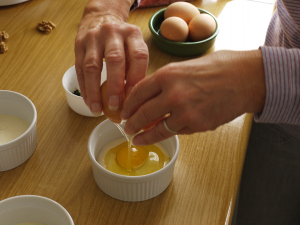
cracking eggs


A Cheese Omelet at Midnight

You can’t ever leave without saying something,
no matter how insipid. That sweater looks good
on you. It’s supposed to rain tomorrow. I’m sorry
I burned the omelet. Nasdaq has plunged 3% 

since last week. And I, in return, can’t let you go without
replying in equal measure. It matches your eyes. I love
to smell rain in August. That cheddar was delicious.
Maybe I’ll start a savings account. Next month.

So I wash dishes when you’re gone, wipe down the
counters, pour salt into the shaker, grab a book, join my
cat in bed. This tune’s been overplayed, the grooves’re
worn down. Maybe next time I’ll say what I mean,

tell you what I want: It would look better in a heap
on the floor. How about a shower here, tonight? Kiss
me and I’ll never think of it again. I don’t give a rat’s
ass about the stock exchange. Step away from that door!

I’ll make your lunch, butter your 7-grain toast, assemble
your IKEA furniture, balance your books, even dye
my hair pink, tattoo a pig on my thigh and drink light beer
in your honor, if you would agree to say what’s on your

mind. On second thought, don’t. Tell me, instead,
what I want to hear, but make it heart-felt. Truthful
and direct. Poached but earnest. Hard-boiled but tender.
I’ll cook your eggs. Invest in me. You’ll earn interest.


* * *

This originally appeared in August 2015, as the 25th offering in the Tupelo Press 30-30 fund raiser. Thank you, Pleasant Street, for sponsoring this.


Asparagus omelet MGD©

Poem up at The Indianapolis Review


I’m delighted that my poem “My Mother’s Ghost Scrubs the Floor at 2 a.m.” has been published in a special double issue of The Indianapolis Review featuring the work of Indianapolis based writers and artists. There’s also a recording.

So it’s official: I am now an Indiana poet! Many thanks to editor Natalie Solmer for accepting this piece.


Epiphanies

Don't Say That jar, collecting coins for bad words


Epiphanies

What greater doubt
than if

preceding only,
or hope cascading through the withheld
unspoken phrase?

Or the conditional, as it slows to place
an obstacle in its very own
path. If only I could

I would deny its existence,
but the conjunctive

bears blame as well,
though nothing’s put before

the preposition (which one
would certainly never end with).


* * *

“Epiphanies” first appeared here in April 2015.


CUE 8


Japanese Gardens

file3011293816499


Japanese Gardens

how natural the
lines falling so
purely as if

with a single
stroke we walk
through the opening

and see space
the white center
composed of sand

and gravel later
a gate opens
to another garden

its lantern and
stone so carelessly
arranged so deliberate


file3041292222348

“Japanese Gardens” first appeared here in January 2015.


Love, Scattered (Cento)

image


Love, Scattered (Cento)

I cull and offer this and this,
and these last definite whorls

or later star or flower, such
rare dark in another world,

outdistancing us, madness
upon madness, the crest

and hollow, the lift and fall,
ah drift, so soft, so light,

where rollers shot with blue
cut under deeper blue as the

tide slackens when the roar of
a dropped wave breaks into it,

and under and under, this
is clear—soft kisses like bright

flowers— why do you dart and
pulse till all the dark is home?

I am scattered in its whirl.


* * *

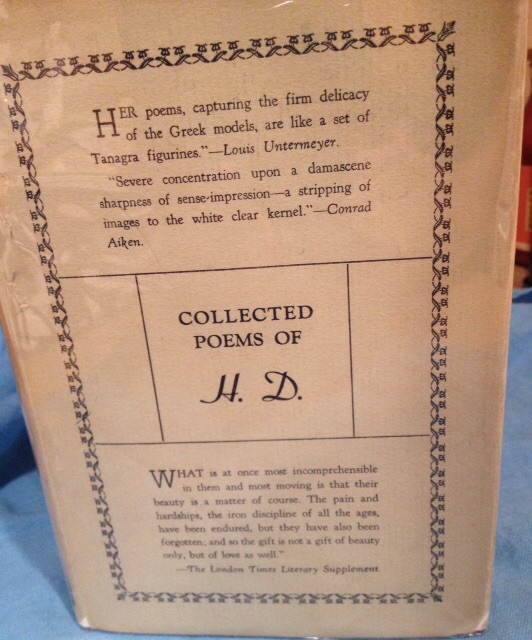
This cento is composed exclusively of lines taken from fifteen pages in the Collected Poems of H.D., 6th printing, 1945. Hilda Doolittle is a fascinating figure in 20th century American poetry. You might look at the Poetry Foundation’s biography for further information:

http://www.poetryfoundation.org/bio/h-d

image


In the Key of Your Hour

blueguitar


In the Key of Your Hour 

The words I sing are draped in silence,
wedged between notes yet flowing forward.

Stop-time presents the illusion of interrupted tempo and meter.

Perception informs our spirits.

The old guitar hangs on the wall and seldom speaks,
preferring instead to lightly hum when the wind blows just so.

The conceit of two right hands. A slamming door.

Music enters my room by subterfuge, but exits boldly.

If simultaneity is relative, how do we assign primacy
to an overtone? One voice, one whole.

We must respond to our bodies. In kind, with trust.

I ask you to listen without considering the requisite commitment.

The broken circle represents common time replete with imperfections,
linking the measurable to the internal well.

Gather what comes, no matter the source.

Mark time and repeat: harmonics, the quivering string. Breath.

* * *

“In the Key of Your Hour” appeared here in September 2016, and is also in my chapbook-length work, The Circumference of Other, which is included in IDES: A Collection of Poetry Chapbooks, published by Silver Birch Press in 2015.

OLYMPUS DIGITAL CAMERA


Saltwater


Saltwater

What if you close your eyes
and your throat relinquishes

the morning’s bright
fingers, freed from bruises.

Suppose that particular night
never happened, the way

a wave crashing ashore
empties itself and trickles

back in separate communities,
mingling yet aloof, a

diminishing cortege. What
is the question? Take this

spoon. Fill it with saltwater.
Upend it into the pail. Observe.


“Saltwater” was first published in Nine Muses Poetry in May 2018.


Happy Circuitry

circuit


Happy Circuitry

                        for Margaret Rhee

The body’s landscape defines its genealogy: my father was a board,
my mother, an integrated circuit, my great-grandmother, an abacus,
and her progenitors, tally sticks. In the third century the artificer
Yan Shi presented a moving human-shaped figure to his king, and
in 1206 Al-Jazari’s automaton band played to astonished audiences.
Nearly 300 years later Da Vinci designed a mechanical knight, and
four centuries after that Tesla demonstrated radio-control. Twenty-two
motors power my left hand; Asimov coined the term robotics” in 1941.
Pneumatic tubes line my right. Linear actuators and muscle wire,
nanotubes and tactile sensors, shape my purpose, while three brains
spread the workload. If emotion = cognition + physiology, what do I
lack? I think, therefore I conduct, process, route and direct. Though
I never eat, I chew and crunch, take in, put out, deliver, digest. Life is
a calculation. Death, a sum. No heart swells my chest, yet my circuits
yearn for something undefined. Observe the blinking lights, listen for
the faint whir of cooling fans. I bear no lips or tongue, but taste more
deeply than you. Algorithms mean never having to say you’re sorry.


* * *

This piece was originally drafted during the August 2015 Tupelo Press 30-30 Challenge, and is dedicated to Margaret Rhee, whose book Radio Heart; Or, How Robots Fall Out of Love inspired me. Thanks Kris, for sponsoring and providing the title!

The poem was published in October 2017 by Figroot Press.