I hope to offer monthly Q&A sessions with some of my favorite poets. Daniel Paul Marshall is the first of these.

Daniel lives on the island of Jeju, a self governing province of Korea, where he lives with his wife and dog and runs a guesthouse and cafe. When he isn’t cooking omelets or pasta you’ll find him by the sea searching for mermaids, fishermen or something peculiar, or just waiting for Jeju to come to him with poetry.
RO: Daniel, please tell us how or why you turned to writing poetry?
DPM: i wrote poems in school when puberty hit. i was your typical awkward teenager, overrun with puppy fat & a face full of zits. i wrote poems about the pretty girls, & in as cliché a mode as is conceivable, pined for their affections. All very silly. i sent one to some poetry website, which you could enter a poem into the database of, which automatically became placed in a competition. i got some letter months later from said website saying my poem was picked as a semi-finalist & that i was to go to Washington for a ceremony & what not. My parents were more naïve than me (this was the early days of the internet) heaping praise on me & wondering where this poetry ability came from. i was dubious about it. My poem wasn’t that good, even i knew that. So i sent another, but this time i wrote it to be terrible on purpose. Lo & behold i got a letter in the post a couple weeks later with the same invitation but for this new more terrible poem. This was my inception into poetry writing. From the beginning i was critical of myself to stop me from any delusion & to make me improve.
There was then a yawning gap, as school life in small town England wasn’t exactly a burgeoning environment of sensitive poetic sorts. i carried my sensitivity, knowing i’d one day be able to do something with it when i got older.
It was when i started the independent student life at university, living away from home that i began to seriously study & the desire to be a good poet took hold. i knew i was no good, but i was in for the long haul. i had made a decision with myself.
When i started reading poetry every day in my early twenties, what struck me about it was how poetry had this capacity to express what no other medium can express, that there is something inherent in the presentation of emotion & reality in the poem, which can only be expressed with poetry’s parameters. That expressiveness is multi-tiered, multi-dimensional & i base entirely on speculation reinforced by my trust in my sensibilities & i am sure anyone dedicated to an art will have something similar to say- & i wouldn’t quarrel with them.
i first began writing imitations in university & practicing using metrical forms. i read the Princeton Encyclopedia of Poetry & Poetics avidly, learning new techniques & then putting them into practice; this taught me the modalities, the nuances & methods of poetry. i figured out sound, form & function. i also cut my teeth on new words i learned whilst reading poetry & yes, the dictionary, developing a sense for the various or sometimes, limited contexts they can be used in.
Poetry took on an importance for me, an importance attributed not just to the acoustics of words, but to the potential expression in metrical style, scansion, grammar, punctuation, the whole lark of the poetic act became a complex system, which i could wrap my head around. i am not a smart person, everything i do is achieved through trial & error, until it gets done. i have this method of doing things because my memory is poor, a problem i share with Michael Hoffman, which makes me feel much better about it. So poetry was the first complex system that i could grasp. Systems fascinate me, especially poetic, religious or philosophical systems. This undertaking to get at the nuts & bolts of poetry was due to my lecturer, Nikolai Duffy, who told me a poet can only break with established forms & develop a voice when they fully understand poetic technique. i am still learning, but i am past the shaky knees, quivering lips stage of no-confidence.
RO: Would you offer up some of your influences – poetic and otherwise. What about their work intrigues you?
DPM: During university i just read as widely as possible & took advantage of a library crammed with potential influences. During this time, experience never had any say in poetry: i was fascinated by the long narrative poems of Blake, Shelley & their inspiration, Milton. i also read a lot of Robert Browning & Gerard Manley Hopkins. My early poetic projects were ambitious epics i didn’t have the poetic resource of mind to complete, i’d get maybe 100 lines in & hit a brick wall.
The expansion of the interior spiritual mood was an experience i wanted to conduct in myself; so i read a lot of religious literature: the Upanishads, Bodhidharma, Lao Tzu, Jung, in hope of giving the poets i read a spiritual context beyond the time span of their generation. i was very uncomfortable with reading a writer just in relation to the zeitgeist: everything seemed like just another way of expressing something hidden within every person, which if understood could alter mankind’s problem with itself. i believed poetry could completely overhaul the world for the better if we only figure out that literature is one whole expression of this in disparate parts.
i don’t believe this now. Perhaps some other time could be used for why my mind changed as it is a long & not that interesting story.
It was reading the Modernists & (for want of a better word) the Confessionalists such as Berryman, Lowell & Roethke who first gave me reason to see experiential poetry as containing some value. My first almost successful, ambitious project was a parody of Berryman’s Dream Songs, called the Lucid Sutras, in which a proganist, Candlewick was flanked by a Blakean spectre whose name changed depending on Candlewick’s mood & another inner voice called Subhuti. Candlewick had numerous mis-adventures ever tugged between his Id, Ego & Super Ego personas. i wrote them in what i called fractured terza rima, rather than Berryman’s broken sonnets. i think i got 50 poems in before i’d used up all i’d learned ever & ran out of steam, abandoning the project. i’d done nothing yet, to stoke the embers.
i have never really been inspired directly by a poet, not consciously. i tend to borrow their forms.
What influences me these days is my environment. i am very fortunate to live in a place very remote from British or Western culture. & it is the similarities to Western cultures against the backdrop of so much difference, which in itself can spawn more difference. i don’t know if that just makes sense in my head. It often feels analogous to coming across the latest issue of Cosmopolitan in the Vatican library, it just becomes so odd that it provokes a questioning response & this has somehow honed my visual stimuli, which has become converted into poetry.

This was the hardest question to answer. i realize that anything that once influenced me has now been rebelled against or brushed aside. i want to write the song of myself for once. i have only been writing myself for about a year. i have been writing poetry for ten years almost & i am only 30 so a long time in the making.
RO: Who are some of your favorite contemporary creatives?
DPM: i am very new to reading or looking at contemporary poetry or art. So i can’t really give as good an answer as i would like, but i’ll give it a shot. Since using the internet better, i have discovered a variety of exceptional writers. Michael Symmons Robert’s last book of poems Drysalter has been a read i refer back to, as his vocabulary & capacity to focus on something expansive in just 15 lines is astonishing. The book is a series of 150 poems each 15 lines each & what he achieves with those constraints is the sign of a master at work. Some very relevant meditations & his ability to distance himself from what seem like fictionalized accounts, but may be his own experiences, we just aren’t sure, but he staggers, whatever his mode. His use of simple lines packed full of sentiment & emotion that leaves you offering your heart to him is monumental; in one poem O song, there is a verse that if i can write a verse half as good in my entire life i’ll hop off the mortal coil finally proud of myself, it goes
O man of sorrows, I missed you
as you passed me in the street last night.
The wind funneled between buildings,
blew grit into my eyes, fine sand
miles from the sea. I am so sorry.
I still haven’t landed on exactly what the apology is for at the end, but it breaks my heart into sea lace.
Will Self is two novels into a trilogy, he has written Umbrella & Shark, both of which are mind bending novels exploring the depths & potential of stream of consciousness. Though i don’t read much prose, Self’s novels are works i anticipate as his language & style is inimical. When i first dived (under?) into Umbrella the shock of the style gave me a feeling of vertigo. You sort of spiral into, as if on a helix-slide, but when you get your second wind, it is a joy & becomes really very palatable.
i have been fortunate enough to meet, through blogging, some poets who have helped me modernize, to be a writer in a contemporary sense rather than palely imitating a bygone era, which really has no relevance; just by reading them & getting out of the asinine opinion that only previous generations wrote good poetry has been a major, important reversal for me; you wouldn’t be reading this, i am sure of that without this awakening.
Jose Angel Araguz was really the first when i read his poetry published in The Inflectionist Review perhaps my favorite poetry journal & i am now fortunate enough to talk with him about his work, which is a pleasure. The tenderness with which he writes is astonishing, his Book of Flight is a triumph- aphoristic, taut poems which just make you want to pick up a pen & respond in some way, by annexing something to humanity’s literary oeuvre.
i recently read Tim Miller’s To the House of the Sun, which is something i could hardly believe exists in this day & age; a civil war epic constructed from a vast accumulation of literature that Miller has mined over a ten year period to write an original piece of literature; he even went & lived in different parts of the country to learn more about the places he wanted to include in his protagonist’s journey. i was surprised by it as the epic poem is not a form people go for, for writing or reading. i think to attempt a renaissance of that form is admirable. In his own words, he says it is more a document for posterity. A behemoth of a text that just leaves you with mouth agape at his dedication to inspired literature from across all cultures. What i took from Miller was a reason to write: a hope that some future writer with Miller’s love of history & literature, who may mine the Millenials & write an entire text that tackles so many humane themes.
Our Bob here, he must be mentioned, not just because he has threatened his reputation by featuring me here, but we’ve all read his work & try to wrap our heads around his wonderful ability to juxtapose & poeticize what seem impossible to juxtapose & poeticize & in doing so brings so much joy to our ears & hearts.
i am not much of an art fan but i quite like the British artist Robert Nicol & Vladimir Kush; also Andrea Kowch is an immensely talented painter. Steve McCurry’s photography is tremendous. The abstract Berlin based artist Matt Kofflan, a friend & very talented chap is someone i never understood for a long time, till i opened my mind up to the contemporary world. His dye pieces look like nebulae bursting into form. You can check him out at mtkofflan.com. If i keep going it will start to get tedious i like so many things.
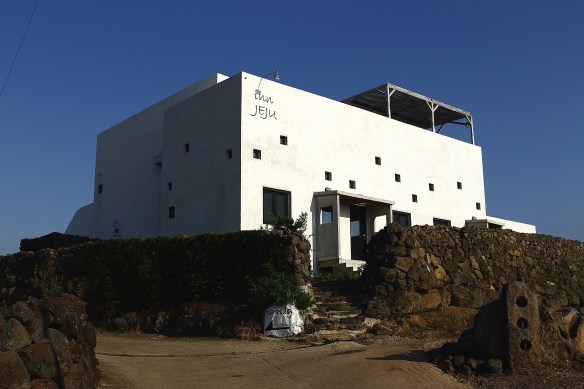
RO: Would you mind sharing a bit about your background? How did you come to run a guesthouse and cafe on Jeju Island?
DPM: i was a teacher for a few years in different parts of the country. i disliked it. It wasn’t shall we say, my cup of tea. My wife has always been a business minded person & owing to my dislike of my job, she bought some land & managed to formulate this plan. i should add that i gave half of my wages for a year toward the building & the land was bought with an investor’s money.
i was working in a mountainous region, teaching through the week & going to visit a monk on the weekend, where i would enjoy the quiet, learn a bit about building stuff, help the monk build paths & do renovations of his old property; practiced Korean too. During this time my wife worked in Seoul & started planning. i had actually told her i was going to return to England as the thought of teaching my whole life in Korea, was just something i couldn’t do; we weren’t married at the time. Sounds cruel doesn’t it, but Korea had taken its toll on me & the idea of staying for a woman seemed naïve, especially if i would be stuck doing something i don’t need to do that makes me unhappy; i didn’t want to pass my depression on, i thought it best to return to England, but…
i was prepared to work hard building something though as i had been interested in Jung’s Bollingen tower & also Gary Snyder & even Kenneth Burke, who all built things, whether paths, houses or meditation rooms. i could only do this because of being open to a rough lifestyle; the comfort of classrooms & city life makes me tense up.
The only experience i’d had was helping the monk, but that was a wholly other kind of construction, pretty basic stuff, metal sheeting & just drilling; next thing i know i’m mixing concrete, chopping wood, hauling 40kg bags of cement, tying iron strips, carrying bricks in a backpack up a scaffold- really hoving into the teeth of it. i grumbled, it was bloody hard, but i felt proud of myself for once; because i was doing something hard & i’d only ever done things that made me bored before, work wise at least.
My wife decided to build a café too as i impressed her with how quickly i learned to cook things & how popular western food is with Koreans. It is a novelty thing, no different to how we see other cuisines in the West. It was a no brainer for her. i don’t cook too badly, but to Koreans it is very impressive if only because it feels like an authentic, Western culinary experience. You can find some fine roasteries on the island too, so serving coffee is always a good idea. i serve hand dripped coffee only & the beans are superb. We have nothing of this sort of quality in Britain: coffee is terrible in England.
i often feel i fall into things, i just never say no to an opportunity, as long as when i gauge it in relation to something ordinary it seems like something unique & grand, i’ll hop on board.
We’ll continue this Q&A in a few days, but let’s end today’s portion with one of Daniel’s poems.
the heron
ㄹ
look here see the heron, stiff as a quill, as elegant,
its slow footing, sostenuto, its flight, encumbered almost,
heavy, a bit awkward (if you’ve ever handled a quill
you’ll know exactly what i mean) & yet it maneuvers a
turbulent wind, shifts it even, at will with the steady
beat of its wing. avoids all obstacles with gazelle ease,
ripples the ghyll like a feathery Christ – still as taxidermy
in their unrivalled Bodhidharmic mood & teach
us how with disapproving nods of non-essential flow.
i see them flanked by sewage on all sides; their evolution
ransacked, yet a healthy colony teems the shallow waters
of Hallim,-& i’d heard they’d rather wade pristine environments.
ㅌ
i’m more like a dog: restless & sweaty, agitated for next;
give a brief sniff to things; uncompromising in my forwardness;
lash out from a leash invisible if concentrated on my anger;
communicate with excrement & whines; scratch myself incessantly
– but i’m looking into how i might become more like the heron
: evoke a clear response to noise with wet feet soft as ear lobes.