Sheng-yu’s Lament (after Mei Yao-ch’en)

DSC_1243


Sheng-yu’s Lament (after Mei Yao-ch’en)

First heaven took my wife,
and now, my son.
These eyes will never dry
and my heart slowly turns to ash.
Rain seeps far into the earth
like a pearl dropped into the sea.
Swim deep and you’ll see the pearl,
dig in the earth and you’ll find water.
But when people return to the source,
we know they’re gone forever.
I touch my empty chest and ask, who
is that withered ghost in the mirror?


* * *

“Sheng-yu’s Lament” is included in my micro-chapbook, No Eye But The Moon’s, available via free download at Origami Poems Project.

The transliteration on Chinese-poems.com reads:

Heaven already take my wife
Again again take my son
Two eyes although not dry
(Disc) heart will want die
Rain fall enter earth in
Pearl sink enter sea deep
Enter sea can seek pearl
Dig earth can see water
Only person return source below
Through the ages know self (yes)
Touch breast now ask who
Emaciated mirror in ghost


SAM_0841

Self-Portrait as Question


Self-Portrait as Question 

Walking hand-in-hand with what,
who presupposes why, and when
huddles with where before skittering
off to its murky corner. Sometimes
I present myself as a shy minute
or a cloud’s effigy streaming across
a scruffy field. Few suspect the truth.
Answers ricochet from the limestone
wall, but no one nabs them. I react
quickly and offer the unknown, the
life I claim, my name, in return.


* * *

“Self-Portrait as Question” was first published in Rue Scribe in September 2018. Many thanks to Eric Luthi and the editors at Rue Scribe for accepting this piece and several others.

Beer Bottle Suizen

Beer Bottle 

Beer Bottle Suizen

No rules apply here. I blow
into the empty bottle and achieve
silence. Tilting it, I adjust my mouth’s
shape and blow across the glass lip,
receiving a flicker of tone in return.
Repeat. More of the same. Discarding
the vessel, I open another, drink deeply.
Become the emptying.

* * *

Note: Suizen (blowing zen) is the practice of playing the shakuhachi (traditional Japanese bamboo flute) to attain self-realization.

“Beer Bottle Suizen” first appeared in Subterranean Blue in March 2020.

The End of Something


The End of Something

I would never pin this silence
to a board, but her anger tempers
sunset, and my response remains
contained. The paper stars
I nailed to the bookcase rustle
when the door opens. She
swallows wine, I sip tea
and offer no explanations.


“The End of Something”  first appeared in Volume 3 of Lamplit Underground. Thank you, Janna Grace, for taking these pieces.

Lamplit Underground is a beautifully illustrated publication. Please take a look!


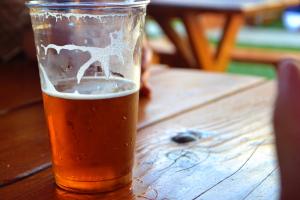
Which Poet, Which Beer (4)


I come here to sit quietly, emerging from my shack, if only briefly, to eavesdrop and observe, to sip beer and participate in the world of commerce. Ah, yes. The grocery store. If only all of them housed craft-beer bars. I place cilantro and shallots in my basket, add arugula, asparagus and a lime, and wander over to the fish case where two small fillets of Chilean sea bass, the commercial name for Patagonian toothfish, catch my eye.

Finally at the bar, I order Lone Pint Brewery’s Zeno’s Pale Ale, and overhear a disquisition on hydration and landscaping, and a conversation on war and snipers and gratitude. The ale arrives with a light, lacey head, exudes a bready malt profile upfront, and a pine-citrus punch at the back. I can’t quite uncover the truth of the flavor, but enjoy the search, and amidst the swirling combination of voices and beer I somehow think of Veronica Golos’ “Snow in April,” a ghazal in her stunning book Vocabulary of Silence.

“Has my flock of flowers died? An ambush, a bullet-shot
of cold. Undone beneath the snow, what’s truth, in April?”

What is the sniper’s truth? What gratitude might we find within April’s layers? I have no answers, only more questions, and with more questions comes thirst.

My second beer is a curious blend of old and new – a Belgian-style quadrupel that, don’t laugh, smells a bit like a cola, but in a good way. Unibroue’s Trois Pistoles is dark brown, let’s call it mahogany, with a fruity but mellow flavor and a toasty malt finish. And well balanced – with an alcohol content of 9%, it’s strong, but not too strong. Historical undercurrents flow through this brew, yet it also brings with it an appreciation of the new and popular, which leads to thoughts of one of my favorite poets, Frank Bidart, whose work often refers to and resonates with historical figures (in the book at hand, Watching the Spring Festival, Tu Fu and Catullus come to mind), and his poem “Sanjaya at 17,” referencing an American Idol contestant:

“There is a creature, among all others, one,
within whose voice there is a secret voice
which once heard
unlocks the door that unlocks the mountain.”

Today the mountain does not swing open for me. Perhaps a second Trois Pistoles might have done the trick, but instead, knowing I have to prepare dinner, starting with a compound butter of shallot, cilantro, garlic and lime zest, I request a mere taste of Founder’s Breakfast Stout, because, well, the idea of stout for breakfast has a certain appeal, though in my case would not be practical, as it would likely put me to sleep. And yes, it contains both chocolate and coffee (Sumatra and Kona), tastes a bit smoky, is smooth and luxurious in the mouth, and makes me long for a lonely, cold winter’s night in a far-off country, a fire crackling with just a hint of madness, and the full moon leering down at all of us, but particularly the dead genius that was Thomas James, whose poem “Wild Cherries,” from his one and only book Letters to a Stranger, ends:

I watch you eat, tasting yourself perhaps,
Some bitterness that is a part of you,
And I accept it gratefully. When you smile,
I see you dying in that single instant.
Walking back home, into ourselves, we enter
A far-off country neither of us wanted.”

Oh, those things we want and don’t want. To feel. To write. To cook, to sing. To share. To love. To be alone. To be numb. To do nothing. To do everything…


This first appeared on the blog in September 2017.


Before September

Before September

In that before-September haze I knew
the birds’ names but not their language,
I saw green in the distance while grass
grew tall and light never lingered.
Questions cratered my moons. Answers
hid between sunbursts. My lips formed
soundless words and glass crunched
underfoot everywhere I walked.
Nothing sparkled under the skies.
Even gemstones and feathers in morning
dew dulled the day’s arc, printing
their notes of lonesome protest in rock
shade and tree droop, in acquiescence,
in quietude. And then you spoke.

* * *

“Before September” first appeared in The Field Guide Poetry Magazine. Thank you to editor Amanda Marrero for taking this piece.

Self-Portrait as Glass

hourglass

Self-Portrait as Glass

Find form in chaos, precision
in the random. This door,
this flask, this lens. A jar
on the hill. I look through
and see myself staring back,
thinking of sand and salts
and the durability of love
in this transparent world.
But I am obsidian, a dark
iris of volcanic fire and
debris. Try as you will,
you’ll never touch my light

.

“Self-Portrait as Glass” first appeared in Windows Facing Windows Review.

Scarecrow Sings the High Lonesome

Welcome Corvids


Scarecrow Sings the High Lonesome

Nothing about me shines or sparkles. If asked,
I would place myself among the discarded —
remnant cloth and straw, worn, inedible,
useless, if not for packaging intended to
convey a certain message, which I of course
have subverted to “Welcome, corvids!” Even
my voice lies stranded in the refuse, silent
yet harmonious, clear yet strangled, whole
and unheard, dispersed, like tiny drops of
vapor listing above the ocean’s swell, enduring
gray skies and gulls and those solemn rocks
bearing their weight against the white crush.
Why do I persist? What tethers a shadow
to its body? How do we hear by implication
what isn’t there? Bill Monroe hammered
his mandolin, chopping chords, muting,
droning, banging out incomplete minors
to expectant ears, constructing more than
a ladder of notes climbing past the rafters
into the smoky sky. What I sing is not
heard but implied: the high lonesome, blue
and old-time, repealed. Crushed limestone
underfoot. Stolen names, borrowed sounds.
Dark words subsumed by light, yellowed,
whitened, faded to obscurity, to obscenity.

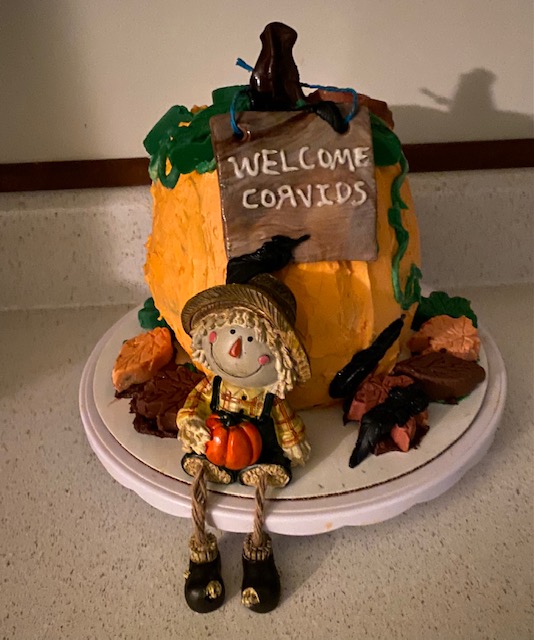
Who among you has eaten a cake based on a poem? Stephanie L. Harper made this for me to celebrate a recent birthday. The photo doesn’t do it justice – the level of detail, especially in the crow feathers, doesn’t come through. An incredible cake by an incredible poet and human being. And wife! I am a lucky man.

“Scarecrow Sings the High Lonesome” first appeared in Crannóg, in June 2017.

On Parting (after Tu Mu)

file000736221785

On Parting (after Tu Mu)

This much fondness numbs me.
I ache behind my drink, and cannot smile.
The candle too, hates parting,
and drips tears for us at dawn.

A non-poet friend asked why I’m dabbling in these adaptations. After all, she said, they’ve already been translated. Why do you breathe, I replied, admittedly a dissatisfying, snarky and evasive answer. So I thought about it. Why, indeed. The usual justifications apply: as exercises in diction and rhythm, it’s fun, it’s challenging. But the truth is I love these poems, these poets, and working through the pieces allows me to inhabit the poems in a way I can’t by simply reading them. And there is a hope, however feeble, of adding to the conversation a slight nuance or a bit of texture without detracting from or eroding the original.

The transliteration on Chinese-poems.com reads:

Much feeling but seem all without feeling
Think feel glass before smile not develop
Candle have heart too reluctant to part
Instead person shed tear at dawn

red_coat

This first appeared on the blog in October 2014.

Parting from Wang Wei (after Meng Haoran)

P1010508


Parting from Wang Wei (after Meng Haoran)

These quiet days are ending
and now I must leave.

I miss my home’s fragrant grasses
but will grieve at parting – we’ve

eased each other’s burdens on this road.
True friends are scarce in life.

I should just stay there alone, forever
behind the closed gate.


* * *

“Parting from Wang Wei” is included in my micro-chapbook, No Eye But The Moon’s, available via free download at Origami Poems Project.

The transliteration on Chinese-poems.com reads:

Quiet end what wait
Day day must go return
Wish seek fragrant grass go
Grieve with old friend separated
On road who mutual help
Understanding friend life this scarce
Only should observe solitude
Again close native area door

file5971307479422