
Celebrate Tax Day with poetry! Featured readers include Christine Beck, Katy Chrisler, D.G. Geis, Robert Okaji, Pamela Paek, D. Ellis Phelps and Ronnie K. Stephens.

Celebrate Tax Day with poetry! Featured readers include Christine Beck, Katy Chrisler, D.G. Geis, Robert Okaji, Pamela Paek, D. Ellis Phelps and Ronnie K. Stephens.
My guest post is now up on A Holistic Journey. Many thanks to Holistic Wayfarer for the invitation.
By the second week I learned that Texans sweat as much
as the French, and swear even more, that you couldn’t fight one
twin without taking on the other. But the librarian would slip me
the choicest donated fiction, and I played baseball every day in the
vacant lot until sundown called the players home to black and white
body counts and cigarette commercials on the three channels we got.
Sometimes I lay in bed under the half-light of the whirring fan
blades, and dreamt of heroes and ornithopters, zebras and the scent
of chocolate chip cookies in the oven. Other nights I wondered
how words could rest so calmly on one page yet explode off the next,
or why a man would climb a tower in Austin to kill fourteen people.
Wasn’t living a matter of simple subtraction?
One by one the days parted and I walked through the dwindling
heat…
View original post 56 more words
My conversation with Mockingheart Review editor, Clare L. Martin.
A MockingHeart Review Conversation with Robert Okaji, author of If Your Matter Could Reform (Dink Press, 2015)
MHR: Hi, Robert. I am glad we have this opportunity to talk to one another about your new chapbook, If Your Matter Could Reform. I have a few questions which I hope will illuminate us.
RO: Thank you, Clare. I’m thrilled that you asked.
MHR: The first poem is “Wind” which introduces us to the ethereal voice that has a calming effect but also the authority and power to speak the deepest questions that you explore in the book. I love the wind motif that blows in and out of poems, like a wind. What does the wind signify to you and what can we learn, formally, from paying attention to your use of it?
RO: We share our lives with the wind, yet are able to see it…
View original post 660 more words
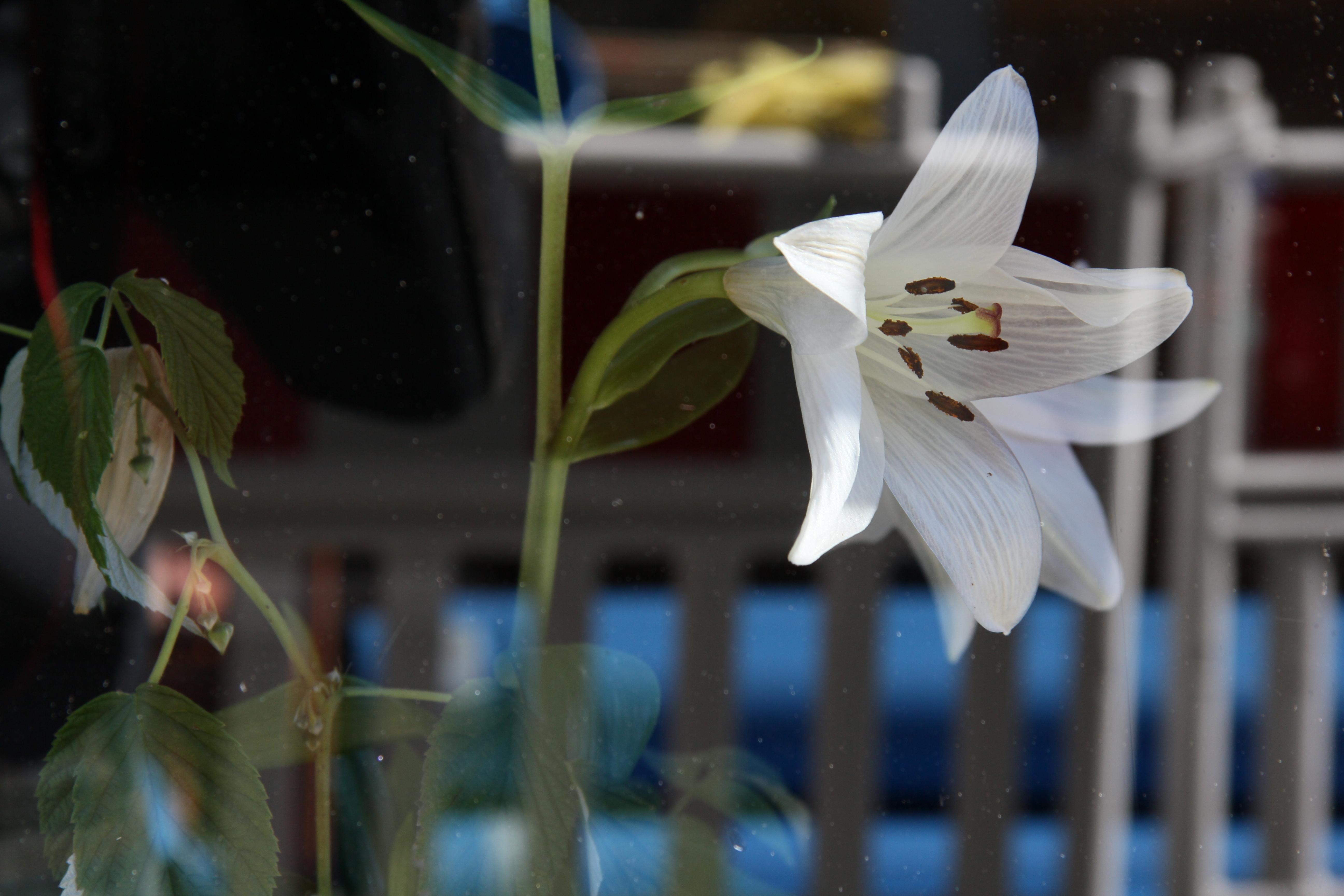
Meditation in White (Lilies)
Clouds pass my high window quickly, abandoning the blue.
Indefinite mass, indeterminate, impersonal
as only intimates may know.
Though you lay there, nothing remained in the bed.
Which is the blank page’s gift, the monotone
or a suggestion of mist and stripped bones.
The nurse marked the passage with pen on paper.
Renewal, departure. A rising.
I accept the ash of suffering
as I accept our destination, the morning
and its offerings, with you in synthesis,
complete and empty, shaded in contrast,
wilting, as another opens. Laughter eases the way.
***

This first appeared in Shadowtrain.

Ode to Being Placed on Hold
The music rarely
entertains,
but I find
peace between
the notes,
sometimes,
and embrace
the notion that
I’ve been inserted
in that peculiar
capsule between
speech and the
void, imagining
myself somewhere,
floating, free
of care and
gravity,
beer can
satellites
orbiting my head,
with bites of
pungent cheeses
and baguette
circling in
their wake,
a gift, you see,
like rain in
August or
a warm voice
saying hello.
“Ode to Being Placed on Hold” was my 23rd offering of the Tupelo Press 30-30 marathon in August 2015. Many thanks to Mary “marso” of the blog “marsowords” who sponsored and provided the title.

As Breath Defines Constriction (Solar Wind)
The snake swallows itself, integrating the opposite. Or, illustrating the
nature of earthquakes, encourages conjecture.
Wind meditation. The practice of circling mountains, of emptying oneself.
Matter accelerating away from the sun. The prickly pear on the roof.
The Tendai monks of Hiei run 40 kilometers each day for 100 consecutive days.
Only then may they petition to complete the thousand-day trial.
Coronal mass ejections temporarily deform the Earth’s magnetic field.
I sweat while driving to the store for cold beer.
The heliopause is the point at which the solar wind’s strength is no longer
sufficient to push back the interstellar medium.
No matter its destination, a comet’s tail always points away from the sun.
At which point does one hear the sound of sunlight entering stone?
They must complete the thousand-day challenge or die. To this end,
each monk carries a knife and length of rope on his journey.
A map is simply paper. Solar wind, cord of death.
Stones in the path, quivering earth. Eyes focused ahead.
***
“As Breath Defines Constriction” is included in The Circumference of Other, my offering in the Silver Birch Press publication, IDES: A Collection of Poetry Chapbooks, available on Amazon.


Thunderstorm Below the Mountain
(after Hokusai)
Lacking humility, I take without thinking.
How far we’ve come, to look below for
lightning, the valleys shaken
with thunder, answers
like pebbles flung outward,
each to its own arc, separate
yet of one source, shaded into the question.
Is it for the scarcity of reach,
the reverse view through the bamboo rings
well out of sight, that
breath in the wave’s tuck or
smoke mingling with the clouds
and figures collecting salt,
that I edge myself closer, again,
to this place? To be nothing
presumes presence in absence.
Lacking humility, I accept without thinking.


In Praise of Darkness
Night falls, but day
breaks. A raw deal,
no doubt, but fairness
applies itself unevenly. Who
chooses weeds over
lies, flowers over truth?
Last night’s rain fell, too,
but didn’t crack the drought.
Again, we think injustice!
Again, we consider falls.
* * *
This was originally posted in September 2014.

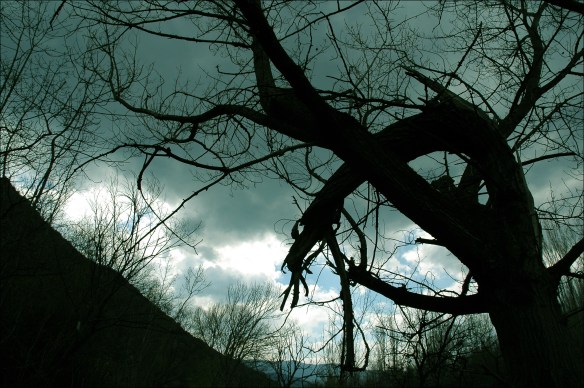
Chill (Cento)
I shiver a little, with the evening,
and you print a shadow like a thin twig.
Wait for my death, then hear me again.
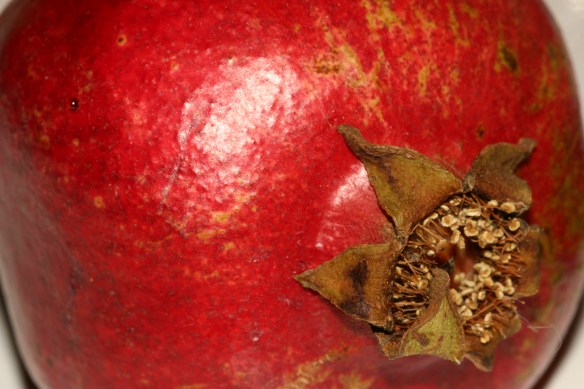
He believes a pomegranate is a thesaurus,
the thundercloud, tomorrow’s puddle. Is
this hunger unlike that of others?
When a drowning man calls out,
his voice follows him downstream.
Why am I grown so cold?
A cento is composed of lines borrowed from other poets. “Chill” owes its existence to: James Wright, H.D., Ingeborg Bachmann, Eduardo C. Corral, Blaga Dimitrova, Forrest Gander, Yusuf Komunyakaa, and Adelaide Crapsey.
Self Portrait with W
One might claim a double victory, or after the Roman Empire’s fall, a reclamation
from the slurred “b” and its subsequent reduction.
Survival of the rarely heard, of the occipital’s impulse.
The oak’s crook performs a similar function.
Shielding myself from adjuration, I contemplate the second family
root, weighted in weapons, in Woden, in wood.
Not rejection, but acceptance in avoidance.
The Japanese homophone, daburu, bears a negative connotation.
Original language was thought to be based on a natural
relation between objects and things.
Baudelaire’s alphabet existed without “W,” as does the Italian.
The recovery of lost perfection is no longer our aim.
When following another, I often remain silent.
As in two, as in answer, as in reluctance, reticence.
We share halves – one light, one shadowed, but both of water.
Overlapped or barely touching, still we complete.
* * *
“Self-Portrait with W” originally appeared in the Silver Birch Press Self-Portrait series, and was reprinted in my chapbook, The Circumference of Other, included in Ides, a one-volume collection of fifteen chapbooks published by Silver Birch Press and available on Amazon.com.


 O at the Edges