Day Twenty-two, Tupelo Press 30/30 Project

origami

Eight days to go, with three title sponsorships still available! Who will challenge Ron and Plain Jane for the worst title in the history of the Tupelo 30-30 Project? Can anyone rival Jeff’s title for length? Do I hear 80 words? A hundred? Or Stephanie’s for brevity (one four-letter  – but not that kind of four-letter – word)? Anyone?

“Setting Fire to the Origami Crane (the One Floating on Muscongus Bay) at Sunset” is among the Day Twenty-two offerings of the Tupelo Press 30/30 Project (9 poets have agreed to write 30 poems apiece in 30 days, to raise funds for Tupelo Press, a non-profit literary publisher). Many thanks to Jilanne Hoffman, who sponsored and provided the title.

Setting Fire to the Origami Crane (the one floating on Muscongus Bay) at Sunset

Who is to say which comes first, the flaming crane
or the sunset’s burst just over the horizon

and under the clouds? There are causes and causations,
an illness named bad air and another attributed to wolf…

To see the rest of the poem, click here

Tomorrow’s poem is titled “Ode to Being Placed on Hold,” thanks to the kindness and generosity of artist/writer Mary “marso” of the blog “marsowords.”

I hope that the sponsored titles and my responses to them have been entertaining, but other sponsorship opportunities abound. For information on these and their corresponding incentives, click here.

“Name That Poem” sponsorships are still available for Wednesday through Sunday. Conjure up a title (be creative, be weird, be gentle, be poetic, oh, heck, be mean if you wish), donate $10 to Tupelo Press, let me know what the title is, and I’ll write the poem. The  sponsored poems thus far have been a blast to write, and the titles have led me to poems I’d not otherwise have written. If you’re so inclined, please visit the 30/30 blog at: Donate to Tupelo. Scroll down to “Is this donation in honor of a 30/30 poet?” and select my name, “Robert Okaji,” from the pull down so that Tupelo knows to credit the donation to me. And please let me know as soon as possible what your title is.

Thank you for your support! Only 8 poems remaining!
Three Cinquains under the Moon (for Adelaide Crapsey)

file0001462341793

This is my offering for Jeff Schwaner’s “Full Moon Social” celebration.

October 8, 1914

Listen…
three silences
none harsher than your breath
dissipating into the night’s
bright mouth.

Later

Rainfall
and wind. How I
would like to have touched you
if only with words trembling from
my lips.

October 8, 2014

A moon
that we might share
from mountain to the sea
a gift belonging to no one
but you.

Adelaide Crapsey’s last full moon lit the skies on October 4, 1914. She died four days later, at age 36. A poet well ahead of her time, she created the American cinquain, a five-line form of 22 syllables which I have followed in these three poems.

I discovered only after-the-fact that the Full Moon Social Jeff Schwaner hosted on October 8, 2014 fell on the 100th anniversary of Adelaide’s death. These poems were written with that particular evening still looming brightly in mind, to honor Adelaide Crapsey and the moon, whose separate but entwined lights we still share and celebrate.

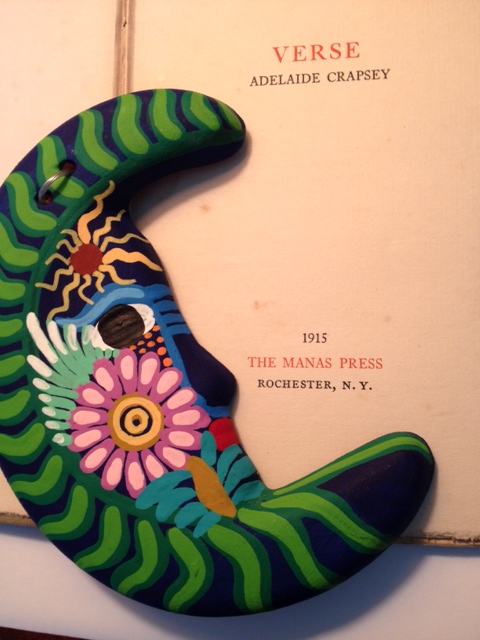
In my hand is a copy of a slim volume of her poetry, titled Verse and published posthumously in 1915. The following cinquain is from this book:

Moon-Shadows

Still as
On windless nights
The moon-cast shadows are,
So still will be my heart when I
Am dead.

Those interested in further details on Adelaide Crapsey might look here: http://www.poetryfoundation.org/bio/adelaide-crapsey

Details on the Full Moon Social may be found on Jeff Schwaner’s blog: http://jeffschwaner.com/2015/03/01/fullmoonsocial-anyone-thursday-march-5-2015/

photo(21)

My Poem “Ashes” Reprinted on The Reverie

file0001138262091

My poem “Ashes,” which appeared in Extract(s) two years ago, has been reprinted on The Reverie Poetry Journal‘s blog:

Ashes

DSC_0206

Endurance, 1946

file000428116082

Endurance, 1946

Unaware of the day’s movements, she paints her
reply to the bracelet of light flaring above

the horizon. Tomorrow’s edict is gather,
as in retrieving a sister’s bones in black

rain, reassembling in thought
a smile that could not endure despite

its beauty. I seek a place
of nourishment and find empty bowls.

What is the symbol for peace, for planet?
How do we relinquish the incinerated voice?

Under the vault of ribs lie exiled words, more
bones, and beneath them, relentless darkness.

And whose bodies mingle in this earth?
Whose tongue withers from disuse?

The eight muscles react to separate stimuli,
four to change shape and four to alter position.

Turning, she places the brush on the sill
and opens the window to the breeze.

Exit the light, exit all prayer. Ten strokes
form breath. She does not taste the wind.

Atomic Bomb Dome_03


Sheng-yu’s Lament (after Mei Yao-ch’en)

DSC_1243

Sheng-yu’s Lament (after Mei Yao-ch’en)

First heaven took my wife,
and now, my son.
These eyes will never dry
and my heart slowly turns to ash.
Rain seeps far into the earth
like a pearl dropped into the sea.
Swim deep and you’ll see the pearl,
dig in the earth and you’ll find water.
But when people return to the source,
we know they’re gone forever.
I touch my empty chest and ask, who
is that withered ghost in the mirror?

The transliteration on Chinese-poems.com reads:

Heaven already take my wife
Again again take my son
Two eyes although not dry
(Disc) heart will want die
Rain fall enter earth in
Pearl sink enter sea deep
Enter sea can seek pearl
Dig earth can see water
Only person return source below
Through the ages know self (yes)
Touch breast now ask who
Emaciated mirror in ghost
SAM_0841

Lament for Five White Cat (after Mei Yao-ch’en)

file3461249385398

Lament for Five White Cat (after Mei Yao-ch’en)

Five White cat always made sure
no rats gnawed my books,
but this morning Five White died.

On the river I offered up rice and fish,
and buried you in its lazy currents,
chanting my lament. I could never neglect you.

One time you caught a rat
and carried it squealing around the yard
to frighten all the other rats
and keep my cottage clear of them.

We’ve shared space aboard this boat,
and although the food is meager
it’s free of rat piss and droppings
because you were so diligent,
more so than any chicken or pig.

Some people speak highly of horses,
saying nothing compares to them or donkeys.
But we’re done with that discussion!

My tears prove it so.

The transliteration from Chinese-poems.com:

Self have 5 white cat
Rat not invade my books
Today morning 5 white die
Sacrifice with rice and fish
See off it at middle river
Incantation you not you neglect
Before you bite one rat
Hold in mouth cry around yard remove
Want cause crowd rat frightened
Thought will clear my cottage
From board boat come
Boat in together room live
Dry grain although its thin
Evade eat drip steal from
This real you have industriousness
Have industriousness surpass chicken pig
Ordinary person stress spur horse drive
Say not like horse donkey
Already finish not again discuss
For you somewhat cry

A Song Dynasty poet, Mei Yao-ch’en (or Mei Yaochen) died in 1060. His great poems live on.

This one is for Jeff Schwaner, whose Mei Yao-ch’en sequence has entertained, inspired and enlightened me. You can find the sequence here: http://jeffschwaner.com/mei-yao-chen-sequence/

DSC_1646

Earth’s Damp Mound

OLYMPUS DIGITAL CAMERA

Earth’s Damp Mound
for P.M.

I. February 1998.
That week it rained white petals
and loss completed its

turn, the words finding themselves
alone, without measure,

without force, and no body to compare.
Though strangers spoke I could not.

Is this destiny, an unopened
mouth filled with

pebbles, a pear tree
deflowered by the wind? The earth’s

damp mound settles among your bones.

II. Count the Almonds
What bitterness
preserves your sleep,

reflects the eye’s
task along the inward thread?

Not the unspoken, but the unsayable.

Curious path, curious seed.
A shadow separates

to join another, and in the darker
frame carries the uncertain

further, past silence, past touch,
leaving its hunger alert and unfed,

allowing us our own protections.

III. The Bowl of Flowering Shadows
Reconciled, and of particular
grace, they lean, placing emphasis on balance,

on layer and focus, on depth of angle
absorbing the elegant darkness,

a lip, an upturned glance, the mirror.

What light caresses, it may destroy.
Even the frailest may alter intent.

So which, of all those you might recall,
if your matter could reform

and place you back into yourself,
would you choose? Forgive me

my selfishness, but I must know.

IV. Requiem
Then, you said, the art of nothingness
requires nothing more

than your greatest effort.
And how, seeing yours, could we,

the remaining, reclaim our
space without encroaching on what

you’ve left? One eye closes, then
the other. One mouth moves and another

speaks. One hears, one listens, the eternal
continuation. Rest, my friend. After.

Prentiss Moore influenced my reading and writing more than he ever realized. We spent many hours talking, eating, arguing, drinking, laughing. Always laughing – he had one of those all-encompassing laughs that invited the world to join in. And it frequently did. Through Prentiss I met in person one of my literary heroes, Gustaf Sobin, whose work Prentiss had of course introduced me to. Those few hours spent with the two of them driving around in my pickup truck, discussing poetry, the Texas landscape, horticulture and the vagaries of the publishing world, are hours I’ll always hold close.

Earth’s Damp Mound first appeared in the anthology Terra Firma.

file0001831388228

Poem in Extract(s)

file00034498180

“Ashes” appeared in Extract(s) in March of 2013, months before I ever considered blogging. It marked my return to publication, after a decade’s absence:

http://dailydoseoflit.com/2013/03/12/poem-robert-okaji-2/

The poem is also available in the print anthology, Extract(s) Volume 2:

http://www.easternpointlithouse.com/#!extracts-daily-dose-of-lit/c19nk

TusconAZ-RainOnTheDoor(1)

Jackboy’s Pride

photo(9)

Abused, abandoned and left to die of thirst or predation more than a dozen years ago on a largely uninhabited county road terminating at our rural property’s entrance, Jackboy brought much laughter and comfort to our household. Tireless shadow, friend, writing partner, loyal companion and protector, he was, and will remain forever, a good boy – in his estimation, the highest possible praise. It has been two days. We miss him.

Jackboy’s Pride

Through patience,
recognition eases in: the patterns

of repetition and praise
and joy in task. The orange ball. A scorpion’s

tail. How we delight in sharing each
victory. And with the breeze

runs other unspoken tales – a neighbor’s
cruelty, bones, the pregnant raccoon

lumbering through the cedars. But nothing
deters the jump and the following drop.

He nips heels where none exist. We follow.

photo(10)