The Real Question


The Real Question 

I ask myself why I mourn
what has not yet

occurred. Will that last fledgling
fly or will a snake swallow

its gravity before descending
to a separate end? Coffee

darkens the carafe and an egg
poaches amidst the scent of basil.

Sprinkling parmesan on buttered
toast, I wonder where to unearth

the real question, when to look
into its eye. How to read its grief.


“The Real Question” was first published in After the Pause in June 2019. Thank you, Michael Prihoda, for accepting this piece.

Dream of Wheels and Lights

file2441309730955


Dream of Wheels and Lights

Bells clang in the night. The lamp post belted
by mist offers little comfort. A stone’s
toss away junipers curved like melted
spoons shudder silently. There are no phones
in this place. A thought sneaks into your mind
quietly, like a straw piercing the oak’s
armor in a bad wind. You turn and grind
the thought with your heel. A wheel rolls by, spokes
flashing like scythes. Crouching by a puddle
a man studies his face. He looks at you
and cries: “All I want is to be subtle.”
You think you know him, but you’re not sure who
he used to be. You throw a rock and shout
at him. The wheel slows and the light burns out.


Originally published in Amelia, in 1985, and posted here in March 2015. I remember writing this, but it still puzzles me.


photo(5)


Pandemic Reading: Writers Share Their Picks

Looking for something to read during the pandemic? Charlotte Hamrick asked writer friends for recommendations. Scroll down to read mine.

Nocturne with a Line from Porchia

bureau


Nocturne with a Line from Porchia

Everything is nothing, but afterwards.
I rise and the moon disturbs the darkness,
revealing symbols, a few stolen words
on the bureau. Tomorrow I’ll express
my gratitude by disappearing be-
fore I’m found, which is to say goodbye
before hello, a paradigm for the
prepossessed. Compton tells us to imply
what’s missing, like Van Gogh or Bill Monroe,
but why listen to the dead before they’ve
stopped speaking? Unfortunately we throw
out the bad with the good, only to save
the worst. I return to bed, and the floor
spins. Nothing is everything, but before.


* * *

This first appeared in The Blue Hour Magazine in December 2014, and is also included in my chapbook, If Your Matter Could Reform. The line “Everything is nothing, but afterwards” comes from Antonio Porchia’s Voices, translated by W.S. Merwin. Porchia wrote one book in his lifetime, but what a book it was! Often described as a collection of aphorisms, Voices is so much more – each time I open the book, I find new meaning in old lines.

Vincent


Four Poems Up at As Above So Below

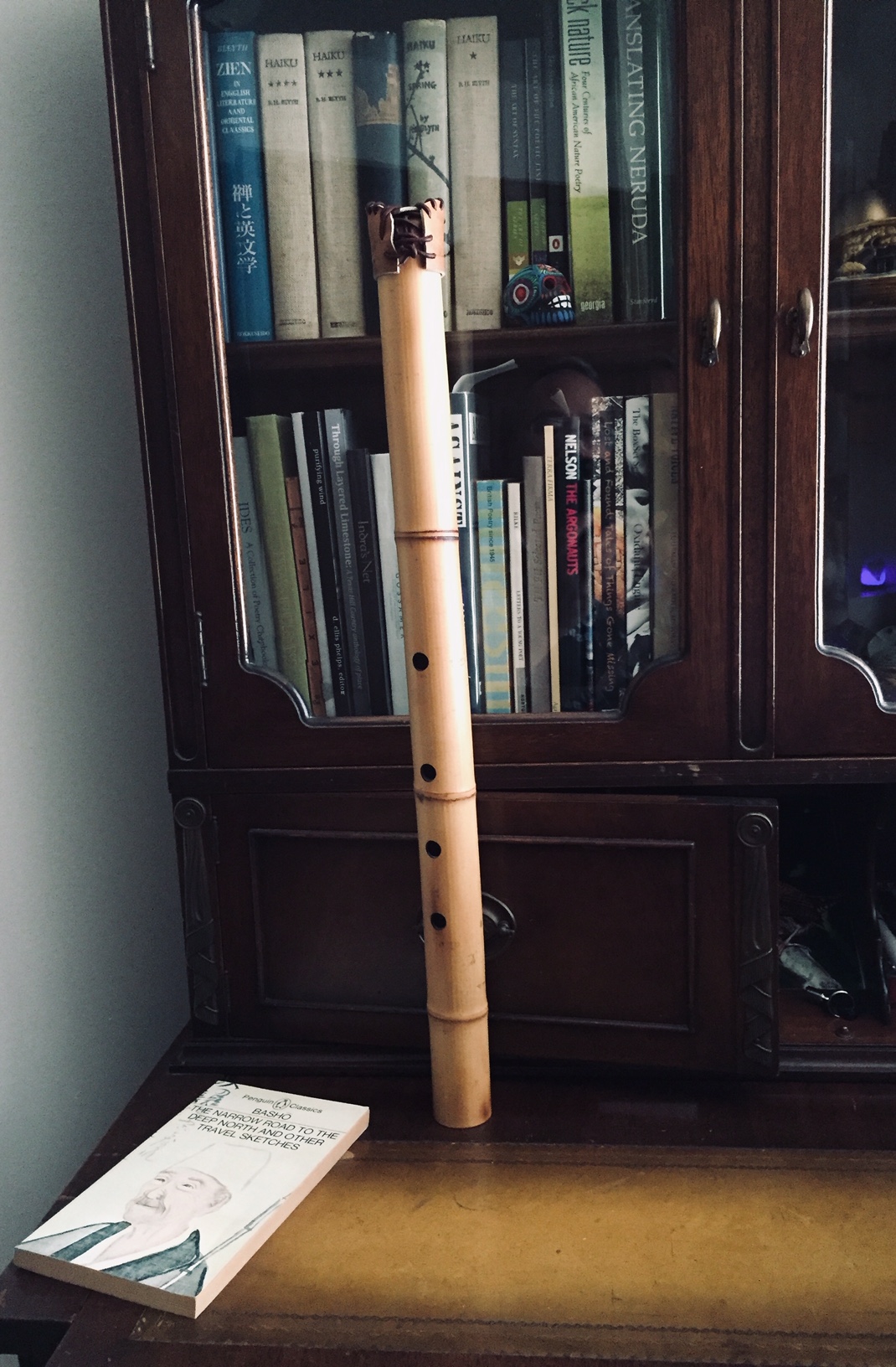
I’m delighted that four of my shakuhachi poems are up at As Above So Below, which also includes two poems by Stephanie L. Harper (one of which was written while under COVID-19’s breath-crushing grip) and pieces by Kate Garret, Sarah Law, Mark Tulin and others you might recognize. Many thanks to editor Bethany Rivers for taking these pieces.

Letter to a Ghost

box2


Letter to a Ghost

Had I not dreamed your death, I would have praised this day.
Your name rests in a wooden box on a desk

in a room far away and twice as old as we were then.
My penance in this phase: to continue.

I gather words close and refrain from admissions.
The clock on the wall seldom chimes,

like one whose vows circumvent convenience, or
a shade allowing the barest sliver of light

through the window. That tock preceding
a long silence. Snow blanketing the mounded earth.

Your scent never lingers past sleep, where you remain.
At last I no longer covet those sheets you’ve shared.

Your name rests in a box. I gather words and refrain.


ghost

“Letter to a Ghost” last appeared herein 2017.

I Live in My Winter


I Live in My Winter

Removed from the junipers’
fragrance, separated from
prickly pears gracing
the hill, limestone slabs
jutting from thin soil,
and smoke drifting from
a well laid fire on a cold
night. Old, today, I
call the clouds my
birthright, want only
to merge with them
and rain through
another black coffee
in this unfamiliar place,
this new home,
this welcome peace.

Awakened, He Turns to the Wall (Cento), with Recording

cell


Awakened, He Turns to the Wall (Cento) 

Then, everything slept.
Where were you before the day?

You see here the influence of inference,
whereby things might be seen in another light,

as if the trees were not indifferent, as if
a hand had suddenly erased a huge

blackboard, only, I thought there was
something even if I call it nothing,

like the river stretching out on its
deathbed. No one jumps off.


* * *

A cento is composed of lines from poems by other poets. This originated from pieces by: Larry Levis, Jacques Roubaud, Lorine Niedecker, Gustaf Sobin, Denise Levertov, Elizabeth Spires, William Bronk, Vicente Huidobro, Ingebord Bachmann

For further information and examples of the form, you might peruse the Academy of American Poets site: http://www.poets.org/poetsorg/text/poetic-form-cento


erase


Sault Ste. Marie


Sault Ste. Marie

Too often you see yourself and wonder
which bodies ancestors navigated

to gather such glorious scars and wrinkles
in one place, both noticeable and unseen,

little waves in a great lake of flesh.
The mirror is not unkind, you think,

with proper lighting — in candlelight
or late evening’s peppery glow,

after a few drinks. Then you recall
crossing the equator three decades

past, how the deck’s non-skid surface
scratched your knees as you scrubbed

the twists and currents that’d buffeted
you to that imagined line on the globe,

and later, the following points and clock
faces withering down the long queue

of jobs, the spilled beer and incomplete life
sentences. Even now, Superior washes

through its locks, filling, denying, allowing
one’s depths into another’s space with equal

regard, promoting passage, flooding past with
future, present with then, balancing tomorrow, now.


“Sault Ste. Marie” won LCk Publishing’s Spring Poetry Contest in April 2017.

Bonsai

Bild


Bonsai

no feature enhanced
but beauty of
the whole and

its container the
tree is not
deprived and grows

as it must
though slowly like
a wave which

gathers itself for
years there is
no completion only

process a lapse
which presumes the
most delicate design


Asia_tree240000

Originally published in Aileron in 1988, “Bonsai” first appeared on the blog in December 2014.