Jose Padua: Self-Portrait in the Form of a Chalk Outline on the Concrete Belly of America

Read this gift from Jose Padua!

Vox Populi's avatarVox Populi

Jose Padua is a dish best served cold with onions,
mushrooms and tomatoes in a light broth and
accompanied by a rich lager with subtle aftertones of lemon.
Jose Padua is Arnold Swartzenegger’s imagined tumor
in Kindergarten Cop right when his headache is
at its most painful and the students are ready to revolt.
Jose Padua is the citizen who doesn’t look like a citizen,
the American who doesn’t look like an American, the
human being who doesn’t look like a human being except
in the looming darkness between the last of the previews
and the beginning of the feature film, that precious time
when the prospect of being entertained puts us all
on what the industry calls “a level playing field.”
Jose Padua is a plastic container of air freshener
shaped like a cone that’s run out whatever makes
the almost but not quite pleasant smell that makes
a…

View original post 376 more words

RO

Ro

When this note fades
will it join you in that place
above the sky
or below the waves
of the earth’s plump
body? Or will it
circle back, returning to
my lips and this
hollow day
to aspire again?

Note: Ro designates the fingering required to produce a particular note on the shakuhachi, the traditional Japanese bamboo flute. In this case, closing all holes.

Requiem

file0001789222317(1)

Requiem

That it begins.
And like a wave which appears
only to lose itself

in dispersal, rising whole again
yet incomplete in all but
form, it returns.

Music. The true magic.

Each day the sun passes over the river,
bringing warmth to it. Such

devotion inspires movement: a cello in the
darkness, the passage of sparrows. Sighs.

The currents are of our own
making. If we listen do we also

hear? These bodies. These silent voices.

* * *

“Requiem” was written in the 80s, in response to a piece of music. It made its most recent appearance here in November 2016.

DSC02722

Ashes

file0001138262091

Ashes

To sweeten the dish, add salt. To bear the pain,
render the insoluble. She envied

the past its incursions, yet the past yields to all,
avoidance to acceptance, trees to smoke.

My mother brought to this country a token of her death to come.

Now it sits on my shelf bearing implements of music.
In her last days I played Sakura on the mandolin,

trusting that she might find comfort
in the blossoms fluttering through the failing notes,

a return to mornings
of tea and rice, of
warmth and paper walls and deep laughter.

Today the rain spells forgive

and every idea becomes form, every shadow a symptom,
each gesture a word, a naming in silence.

Scatter me in air I’ve never breathed.

* * *

“Ashes,” first appeared in Extract(s) in 2013, was reprinted on The Reverie Poetry Journal, and is included in my chapbook, If Your Matter Could Reform.

DSC_0206

The Resonance of No

dishes

 The Resonance of No

Yes, yes, we’ve heard. The dishwasher wastes less
and cleans better. But Kenk­ō believed in the beauty
of leisure, and how better to make nothing
while standing with hands in soapy water, thoughts
skipping from Miles Davis’s languid notes to the spider
ascending to safe shelter under the sill (after I blow
on her to amuse myself), washing my favorite knife
and wondering if I should hone it, not to mention
my skills on the six-string or the potato peeler.
And if I linger at the plates, even the chipped one,
admiring their gleam after hot water rinses away
the soap residue, who could question the quick gulp
of ale or the shuffle of an almost-but-not-quite
dance step-or-stumble while arranging them on the
ribbed rack, back-to-back, in time to Coltrane’s
solo. Then the forgotten food processor’s blade
bites my palm, and I remember that I’ve outgrown
the dark suit, the cut branches still need bundling
and none of the words I’ve conjured and shaped
over decades and miles will extend their comfort
when I stand at my father’s grave this week or next.

“The Resonance of No,” was published in December 2016 in Gravel, and is included in my chapbook, From Every Moment a Second.

Daniel Schnee wrote about this poem here.

Music Credit: Cool Vibes Kevin MacLeod (incompetech.com)
Licensed under Creative Commons: By Attribution 3.0 License
http://creativecommons.org/licenses/by/3.0/

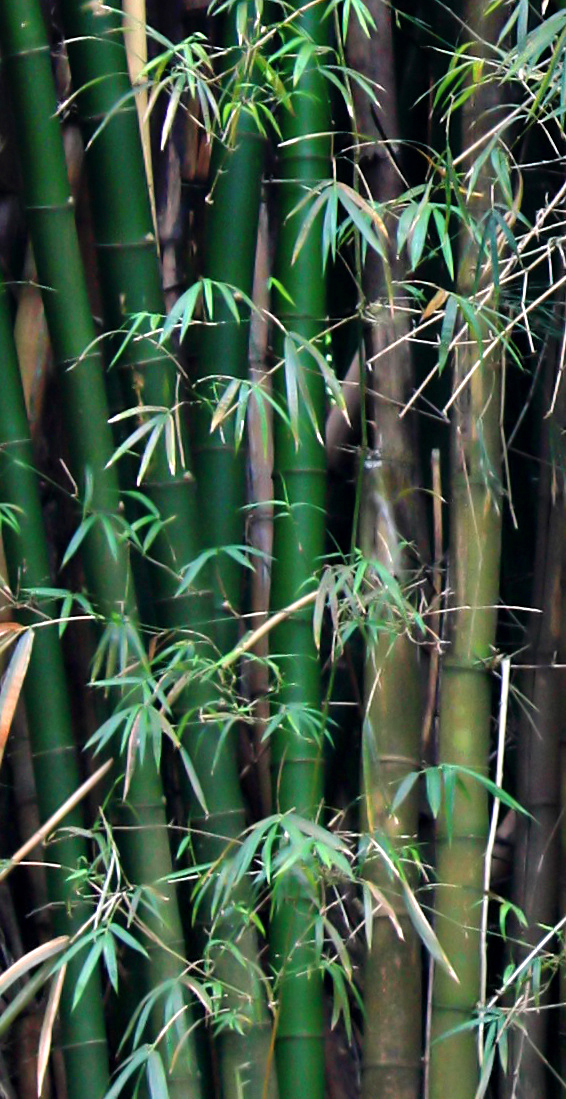
Bamboo


Bamboo

the ringing in
one’s ear is
not desire but

language the song
of another mouth
moving in a

different wind the
music is nothing
it is all

and has no
substance but that
shaped inside beyond

thought like growth
in a seed
there simply there

* * *

Something written in the 80s that seems to fit today’s mood. Funny how that is.

Review of Robert Okaji’s Chapbook, “From Every Moment A Second”

The first post-publication review of From Every Moment a Second!

UPS Dropped Off This Box Last Evening

Author copies of my chapbook From Every Moment a Second have arrived! These came directly from the printer, and according to Finishing Line Press the rest of the print run should soon be in their hands, and will be packed and shipped to buyers asap. So if you’ve ordered one, it really is on the way. Finally. Thank you for your patience!

From Left to Right I Ponder Politics and Poetry

From Left to Right I Ponder Politics and Poetry

In the evening I pour wine to celebrate
another day’s survival. My motions:
up to down, left to right. Glass

from cabinet, wine to mouth.
And then I return to the page.
The character for stone, ishi,

portrays a slope with a stone
at its base, and I take comfort
in knowing that as my knee aches

at the thought of climbing, ishi exists
in descent only. A volcano belches,
producing hi, fire, rising above the

cone, while earth, tsuchi, lies firm
beneath the shoots pushing up,
outward, and ame, rain,

consists of clouds and dotted
lines and the sky above. But if
wind is made of insects and

plums, do I assemble new meaning
without fact or wisdom, form
or assumed inflection, left to

down, up to right? Consider water,
its currents, its logic and needs.
Consider truth. This is how I think.

* * *

“From Left to Right I Ponder Politics and Poetry” appeared in Bonnie McClellan’s International Poetry Month celebration in February 2017.

Scarecrow Pretends

scarecrowfield

Scarecrow Pretends

How may I claim another’s earth for myself? My perpetual
stance invites occlusion of the senses and a certain disregard
for dignity; I flap in the breeze and bits of me scatter across
the fields. Sze asks if we know a bird’s name in ten
languages do we know any more about the bird. I say no,
but I am a species of stitched remnants and expectation,
a race of one. Genderless, my hollow name holds no secrets,
no history. If I called myself Hudson would anyone recognize
my stuffing for what it is not? What flows through my clothing
but rags, straw, the useless and unwanted. Insects and their feces.
The unearned, the unwarranted. The underclass. Folly. Design.
Gift by delusion. Does attracting more crows than I deter negate
my existence? And which am I? A river? A man? An effigy, one
perception, or another? I do not frighten, but welcome. Speak
louder, that we may ignore our insignificance, our true names.

“Scarecrow Pretends” was published in The Slag Review in January 2017, and a few months later was mentioned in an article in the Long River Review’s blog: “Scarecrow Pretends: Robert Okaji’s Metallurgy.