Elegy


Elegy  

1. Adrift

I count more graves than people in my sleep,
but nothing turns more quickly

than an empty wind
in a place whose memory has died.

And all manner of departure: What you have left is you
without you
. As if it could be different, as if decades

could withdraw and draft a blueprint of motive and action,
returning them, returning you, to that point

across the sea where the ship has not yet arrived.
If you ask she will say it does not matter. If you ask.


2. Parentheses

To be within, yet without, as in the unuttered phrase.

It is time the stone made an effort to flower,

to render the void clear and resolute, the diction of
separation divided by decades and your ocean.

The language of silence, drawn near.


3. From the Other Side

Sometime becomes never and steps around a desolate corner,
and all we have left is our field

awash in stone, remnants of the unspoken.
I have no memory of you. Nor you, of me,

but the strands do not lie, and unraveled,
expose the imperfect blends

that compose my love. A leaky roof. The last word.
A pity to put up at all

but there is rain.


4. Another Night

Of all the hours which were the longest?
The earth trembled around me

and I lay still, bearing witness to
the uncertain malice of its

shrug, shoulders brought to
fore, then returned,

and finally, released. If,
after this half-century, words

could reform in your mouth,
what denial would issue?

Ashes, washing ashore.


5. Bridge

And seeing you only as the shadow of an

ending whose voice lies
in an uncommon past, how
may we recognize the very shape we share?

The bridge’s fate is loneliness,
knowing that one side

decries the other’s
call, that separation affords new light:

they are between
comfort and space, between words and a smile,

between nothingness and sorrow,
two points, beginning and end,

reaching, in opposition, towards each other.


Notes:

“What you have left is you without you” is from Edmond Jabes’s “At the Threshold of the Book” in The Book of Questions: Volume I, translated by Rosemary Waldrop.

“It is time the stone made an effort to flower” is from Paul Celan’s poem Corona,” included in Poems of Paul Celan translated by Michael Hamburger.

“A pity to put up at all but there is rain” is from Basho’s Back Roads to Far Towns, translated by Cid Corman and Kamake Susumu.

Albert Huffsticklers poem “Bridges” which appeared in The Balcones Review in 1987, begins “They are between…”

“Elegy” first appeared on Underfoot Poetry in October 2017.
 

To the Light Entering the Shack One December Evening (with recording)


To the Light Entering the Shack One December Evening

No prayers exit here, nothing
limits you. I never knew
before.

The pear tree’s ghost shudders.

Water pools in the depression of its absence.

For years I have wandered from shadow to
source, longing. Now, at rest,
you come to me and fear
evaporates. I would like to count
the smallest distraction.
I would like to disturb.

You are the name
I whisper
to clouds.

Will you leave if I open the door?

A carnival germinates in my body.

You are not death, but its closest friend.

Darkness parts, folds around you.

I close my eyes and observe.


* * *

“To the Light Entering the Shack One December Evening” first appeared in Shantih in December 2016, and is included in my chapbook, From Every Moment a Second available  through Finishing Line Press and Amazon.com.

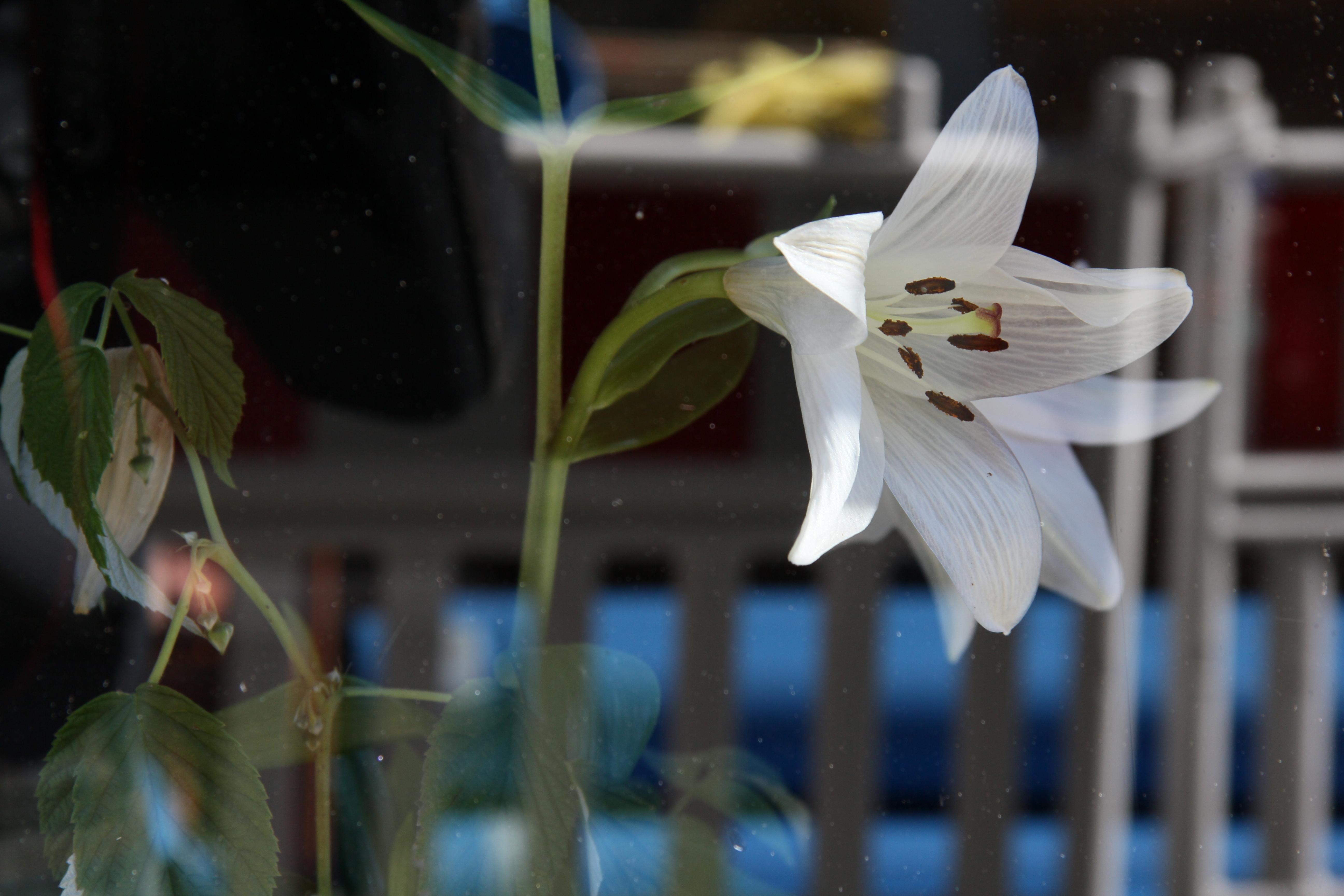
Meditation in White

lily


Meditation in White (Lilies)

Clouds pass my high window quickly, abandoning the blue.
Indefinite mass, indeterminate, impersonal

as only intimates may know.
Though you lay there, nothing remained in the bed.

Which is the blank page’s gift, the monotone
or a suggestion of mist and stripped bones.

The nurse marked the passage with pen on paper.
Renewal, departure. A rising.

I accept the ash of suffering
as I accept our destination, the morning

and its offerings, with you in synthesis,
complete and empty, shaded in contrast,

wilting, as another opens. Laughter eases the way.


***

page


This was first published in Shadowtrain, and made its first appearance here in March 2016.

Something Lost, Something Trivial

broom


Something Lost, Something Trivial

Another word, another bewildered
moment in transition: the phrase
barely emerges from your mouth
before crumbling back into a half-opened
drawer in the loneliest room of a house
that died seventeen years ago.

I nod as if in understanding, and stoop
to pick up a crushed drinking straw,
the kind with the accordion elbow
that facilitates adjustment.

From a rooftop across the street,
a mockingbird warbles his
early morning medley of unrelated
songs, and you say left oblique,
followed by matches, then
collapse on a bench,
winded. I sit next to you

and we both enjoy the warmth
and birdsong, though I know
this only through the uplifted
corner of your mouth, which
these days is how you indicate
either deep pleasure or

fear. I have to leave soon,
I say, and you grab my wrist
and stare into my eyes.
Broom, you reply. And more
emphatically, Broom!

Though I cannot follow you
directly, knowing both path
and destination, I pick my way
carefully through the years
stacked high like cardboard
banker’s boxes stuffed with
papers and receipts no one
will ever see. I know, I say.
I love you, too. Broom.


* * *

“Something Lost, Something Trivial” was published in January 2016 in the first issue of MockingHeart Review. Many thanks to founding editor Clare L. Martin, for her multiple kindnesses.

Morning Covers You

eye camera


Morning Covers You

1

We extract
light, bleeding
it out one

diamond-shaped
hole after
another.

Finger the results.
Remediation
in form

or placement
to best
advantage?

At night
loneliness cradles
our bones.

2

You arrange our bodies to greater effect,
presuming lesser horrors
to be less.

A list emerges.
Refuting one,
accepting another.

Choices fixed.
Ecstasies of failure
purged.

Morning covers you
like a blue
shroud, so pale.

So cold
and bitter.


This originally appeared in Boston Poetry Magazine in April, 2014, and on this blog in October 2015.

diamond fence


February 6, 2018


February 6, 2018

Today every song is a diary of lost dates,
moments cured in precision

and stowed away on a train to the next town,
always yearning the beyond, around that precious bend.

Or, a funeral for tomorrow, processing the improbable
present. Lights, flickering. The starling’s first peep.

All urgency dies. Outside, leaves float in the fog
as I drive away to a finite point.

Now, a whistle mourns the day’s broken
surge; never having said goodbye, you move on.


* * *

“February 6, 2018” was published in the North Dakota Quarterly in February 2019.


Flame


Flame 

Drifting, she passes through the frame.

Reshapes borders, edges.

The way smoke scribes a letter in the sky with
gases and particulates. Intractable. Impermanent.

But not like a risen corpse
yet to accept its body’s stilling, or
the flooded creek’s waters taking
a house and the family within. Some things

are explainable. This morning you drained
the sink, and thunder set off a neighbor’s alarm.

From every moment, a second emerges.

Picture a man lighting a candle where a home once stood.


* * *

“Flame” was published in Poppy Road Review in February 2019 and is included in my chapbook, From Every Moment a Second, available for order via Amazon.com and Finishing Line Press.

Take Away


Take Away

Take away the blackness,
what does night become?

Remove arugula’s bitterness,
the reddened prints on a slapped
cheek, or yeast from leavened bread.

The coroner’s mask denies emotion.

We possess no less now than we did then.
One hand holds the root, the other, a trowel.
Soil, compost. Ash. Water, dreams. Renewal.

The economy of dying continues.

One mother stands alone, cradling pain in
both arms. The second shares her shadow.


“Take Away” is included in my chapbook, From Every Moment a Second, available for order now via Amazon.com and Finishing Line Press.


Ikebana

leaf on stone


Ikebana (You without You)

Between frames, between presence and negation, authority.

If your body lies in the earth, why are you here?

Limits admired and sought: the way of the flower.

I pluck leaves from the lower half to achieve balance.

Shape and line detach, yet comprise the whole.

My father, awake in his chair, mourns quietly.

A naked twig forms one point of the scalene triangle.

Starkness implies silence, resonates depth.

Heaven, earth, man, sun and moon invoke your absence.

As you trickle through the interval’s night.


* * *

Ikebana is the art of Japanese flower arrangement.

chair

This first appeared on the blog in March 2016, and is included in my mini-digital chapbook, Interval’s Night, published by Platypus Press in December 2016, and available via free download.


Two Poems Up at Taos Journal of International Poetry & Art


My poems “Letter to Geis from This Side of the Glass” and “A Texas Goodbye” are live at the Taos Journal of International Poetry & Art. D.G. Geis was a friend, a larger than life  poet, and a fellow Texan. We were both finalists for the Slippery Elm poetry prize in 2017, and after learning that we didn’t win, decided to have a “losers’ lunch” in Bandera, Texas, the closest town to our respective rural properties. Much laughter ensued, and we made plans to get together for a beer in the coming months. Alas, that was not to be.