Onions

image

Onions

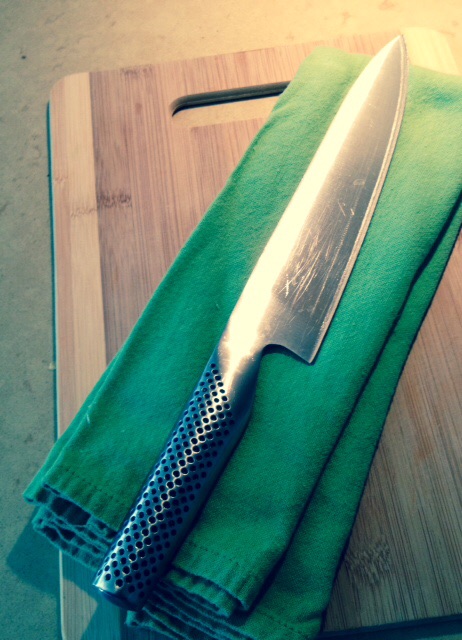
My knife never sings but hums instead when withdrawn from its block, a metallic whisper so modest only the wielder may hear it. Or perhaps the dog, who seems to enjoy the kitchen nearly as much as I. A Japanese blade, it’s a joy to hold, perfectly balanced, stainless steel-molybdenum alloy, blade and handle of one piece, bright, untarnished, and so sharp as to slide through, rather than awkwardly rupture and divide, its next task on the board.

We’ve never counted the chopped and rendered onions, the fine dice, slender rings and discarded skins, but if we could gather all the corpses we’ve produced together over the years, we’d form a monument to our work, cooperation of metal and man, a Waterloo mound in memory of the bulbs laid there, the planning involved, the missteps and serendipity, and the tears shed along the way.

The blade doesn’t care. It is. It works. It moves things, it lifts, it parts them, and in return is cleansed, and later, in the quiet room, maintains its edge with a silvery rasp, angled steel on steel in a circular motion, over and over, until finally it hums its way back into the block. But it never sings.

image

“Onions” last appeared here in October 2017. Hmm. This reminds me that I need to sharpen knives…

Wherein the Book Implies Source

book

Wherein the Book Implies Source 

And words form the vessel by which we traverse centuries, the river
stitched across the valley’s floor, easing access.

Accession by choice. Inorganic memory.

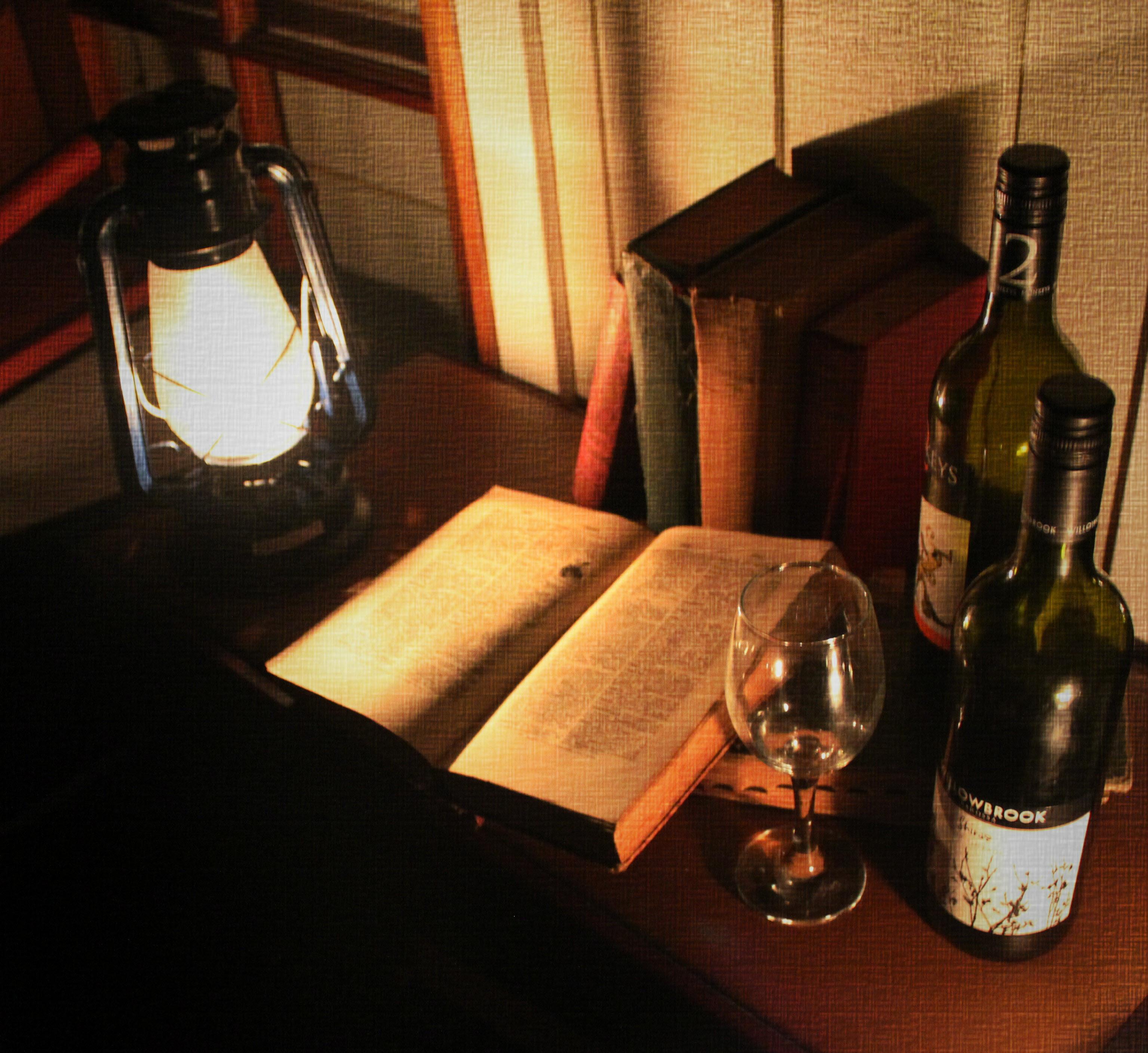
Vellum conveys its origin: of a calf.

How like an entrance it appears, a doorway to a lighted space.
Closed, it resembles a block of beech wood.

To serve as conveyance, to impart without reciprocity.

Framing the conversation in space, immediacy fades.

The average calfskin may provide three and a half sheets of writing material.
Confined by spatial limitation, we consider scale in terms of the absolute.

The antithesis of scroll; random entry; codex.

A quaternion equalled four folded sheets, or eight leaves: sixteen sides.

Reader and read: each endures the other’s role.
Pippins prevented tearing during the drying and scraping process.

Text first, then illumination.

Once opened, the memory palace diminished.

* * *
This originally appeared in April 2014 as part of Boston Review’s National Poetry Month Celebration, and is included in The Circumference of Other, my offering in the Silver Birch Press chapbook collection, IDES, published in 2015.

ides front cover 92915

Two Poems in Igxante: An Ontology

My poems “Ramekin” and “Windows: A Theology” have been published in the online anthology Igxante: An Ontology. I am grateful to editor Kate Morgan for taking these two pieces.

Spring Dawn (after Meng Haoran)

file4731293467677

This morning I slept through dawn
and the screeching birds, long
after last night’s wild wind and rain.
But who can count the fallen flowers?

The transliteration on Chinese-poems.com reads:

Spring sleep not wake dawn
Everywhere hear cry bird
Night come wind rain sound
Flower fall know how many

file7101237575173
This adaptation first appeared on the blog in November 2014.

Poet’s Pantry

file3911233869642

In my sliver of the world, poetry and cooking share many qualities. When I step into the kitchen, I often have only a vaporous notion of what’s for dinner. A hankering for roasted poblano peppers, the need to use a protein languishing in the refrigerator, the memory of an herbal breeze wafting down a terraced hill near Lago d’Averno, Hell’s entrance, according to Virgil, or even a single intriguing word, may spark what comes next. But the success of what follows depends upon the ingredients at hand, on how we’ve stocked the pantry. Good products beget better results. Let’s take my desire for roasted poblanos. What to do with them? Poking around, I uncover an opened package of goat cheese, a bit of grated grana padano and some creme fraiche, and I immediately think pasta! Looking further I spot arugula, a lemon, a handful of pecans, some cherry tomatoes. Dinner: Pappardelle with a roasted poblano and goat cheese sauce, garnished with toasted pecans, served with an arugula and cherry tomato salad dressed with a lemon vinaigrette. Simple, when you’ve stocked a solid base of quality components.

My writing employs a similar process. Anything – a vague sense of uneasiness, a particular word, the sunlight slanting through the unfortunate dove’s imprint on my window, articles or books I’ve read or perused on a myriad of subjects – may launch a poem. But what truly makes the poem, what bolsters, fills and completes, what ignites and catapults it arcing into the firmament? The pantry’s contents.

Everyone’s needs differ, and I wouldn’t presume to inflict my peculiar sensibilities on anyone, but if you cracked open my burgeoning poetry pantry’s door, you’d certainly unearth dictionaries and a thesaurus, fallen stars, books on etymology and language, curiosity, a guitar or mandolin, at least one window (sometimes partially open), conversations floating in the ether, various empty frames, wind, dog biscuits and dirty socks, a walking stick, sunlight and shadows, more books on such subjects as ancient navigation, the history of numbers, the periodic table, alchemy and olives. You might also spy reams of paper, unspoken words, coffee cups, a scorpion or two, scrawled notes on index cards, wandering musical notes, a pipe wrench, wood ear mushrooms and salvaged fragments of writing, failed ideas moldering in clumps on the floor, a few craft beers and empty wine bottles, a chain saw, and most important of all, a bucketful of patience.

(I cannot over-emphasize the bucket’s contents…)

This is just to say (no, I didn’t eat the plums) that the best equipped poets stock their pantries with the world and all its questions, with logic, with faith, persistence, emotion, science, art, romance and yes, patience. Line your kit with every tool you can grasp or imagine. Keep adding to it. Read deeply. Listen. Breathe. Listen again. Converse. Look outward. Further, past the trees, around the bend and beyond the horizon’s curve, where the unknown lurks. Look again. Don’t stop. Continue.

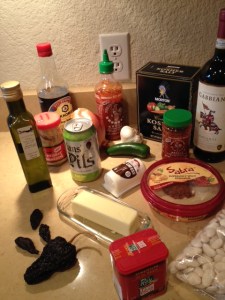
And if after all this you’re wondering what basks in my kitchen pantry:
photo(13)

This last appeared here in July  2017.

Something Lost, Something Trivial

broom

Something Lost, Something Trivial

Another word, another bewildered
moment in transition: the phrase
barely emerges from your mouth
before crumbling back into a half-opened
drawer in the loneliest room of a house
that died seventeen years ago.

I nod as if in understanding, and stoop
to pick up a crushed drinking straw,
the kind with the accordion elbow
that facilitates adjustment.

From a rooftop across the street,
a mockingbird warbles his
early morning medley of unrelated
songs, and you say left oblique,
followed by matches, then
collapse on a bench,
winded. I sit next to you

and we both enjoy the warmth
and birdsong, though I know
this only through the uplifted
corner of your mouth, which
these days is how you indicate
either deep pleasure or

fear. I have to leave soon,
I say, and you grab my wrist
and stare into my eyes.
Broom, you reply. And more
emphatically, Broom!

Though I cannot follow you
directly, knowing both path
and destination, I pick my way
carefully through the years
stacked high like cardboard
banker’s boxes stuffed with
papers and receipts no one
will ever see. I know, I say.
I love you, too. Broom.

* * *

“Something Lost, Something Trivial” was published in January 2016 in the first issue of MockingHeart Review. Many thanks to editor Clare L. Martin, for her multiple kindnesses. I am reading with Clare and Bessie Senette on Saturday, October 20, at 7:00 p.m. at Malvern Books in Austin.

Trains

file0001582779533


Trains

1

In the marrowbone of night,
your song parts the fog.

I never knew the secrets entrusted there.

I never knew that cinders and steel
could lie so passionately

and still believe that the watchman’s hours
would evaporate and leave us scratching for more.

I have stolen time.

The windows remain closed and shuttered.
Even the wind turns away.

The track narrows.

You call.

Again.

2

Sometimes song seems the only respite,
the rhythm of clashing cars

and moments stretched beyond the next bend
to that point where light winks out.

We both know this lonely tunnel.

Payment is due.

I have always exited alone.

3

Another evening, and red smoke completes the horizon.

Your ribs stretch for distance,
and while I cannot see their end,
I know by sound
their lot.

Sing for me.
It is not
too close.

“Trains” was originally published in Lightning’d Press (Issue 8) in Spring of 2014, was reprinted on Aubade Rising in April, 2015, and has appeared here several times. It is also included in my chapbook, If Your Matter Could Reform.

track

Self-Portrait with Blue

Blue

Self-Portrait with Blue

Darker shades contain black or grey. I claim
the median and the shortened spectrum, near dawn’s terminus.

In many languages, one word describes both blue and green.

Homer had no word for it.

The color of moonlight and bruises, of melancholy and unmet
expectation, it cools and calms, and slows the heart.

Woad. Indigo. Azurite. Lapis lazuli. Dyes. Minerals. Words. Alchemy. 

On this clear day I stretch my body on the pond’s surface and submerge.

Not quite of earth, blue protects the dead against evil in the afterlife, 
and offers the living solace through flatted notes and blurred 7ths.

Blue eyes contain no blue pigment.

In China, it is associated with torment. In Turkey, with mourning.

Between despair and clarity, reflection and detachment,
admit the leaves and sky, the ocean, the earth.

Water captures the red, but reflects and scatters blue.

Look to me and absorb, and absorbing, perceive.

This originally appeared in the Silver Birch Press Self-Portrait Series, and is included in The Circumference of Other, my offering in the Silver Birch Press chapbook collection, IDESpublished in October 2015.

ides front cover 92915

Recording of “Self-Portrait with Umeboshi”

file0001818876295(1)

Self-Portrait with Umeboshi

Our resemblance strengthens each day.

Reddened by sun and shiso,
seasoned with salt,

we preside, finding
comfort in failure. Or does
the subjugation of one’s flavor for another’s

define defeat? The bitter, the sour, the sweet
attract and repel

like lovers separated by distances
too subtle to see.
Filling space becomes the end.
What do you learn when you look through the glass?

Knowing my fate, I say fallen. I say earth.

Ah, simplicity! When I was a child my mother would occasionally serve rice balls in which a single mouth-puckering umeboshi rested at the center. These have long been a favorite, but I admit that umeboshi might be an acquired taste. Commonly called “pickled plums,” ume aren’t really plums but are more closely related to apricots. I cherish them.

“Self-Portrait with Umeboshi” first appeared in the Silver Birch Press Self-Portrait Series (August 2014), was included in the subsequent print anthology, Self-Portrait Poetry Collection, and also appears in my chapbook, If Your Matter Could Reform.

file0001977442406

Music: “Senbazuru” Kevin MacLeod (incompetech.com)
Licensed under Creative Commons: By Attribution 3.0 License
http://creativecommons.org/licenses/by/3.0/

The Sky Refutes East and West

nest

The Sky Refutes East and West

Here, the horizon lingers.
The open eye, the mouth’s shape.

A hoop, the circle without iris.

Does the screech owl acknowledge latitude and hemisphere?

The Semitic alphabet contained no vowels, thus O
emerged as a consonant with a pupil, morphing into a dotted ring,

and later, with the Greeks, an unembellished circle (which of course

they cracked open and placed at the end). The female lays eggs

on the remnants of earlier meals lining the bottom of her den.
If you listen at night you might hear the purring of a feathered

cat (the Texas screech owl’s call varies from that of its eastern cousins).

The difference between sphere and ball.

To pronounce the Phoenician word for eye, sing the lowest note possible,
then drop two octaves. They usually carry prey back to their nests.

Screech owls are limited to the Americas.

Coincidence and error, the circumference of other.

***

“The Sky Refutes East and West” was first published in Prime Number Magazine, and also appears in my chapbook The Circumference of Other, included in Ides: A Collection of Poetry Chapbooks (Silver Birch Press, 2015). It made its first appearance here in May 2016.

eastwest