Scarecrow Sees


Scarecrow Sees

Da Vinci maintained that sight relies on the eye’s
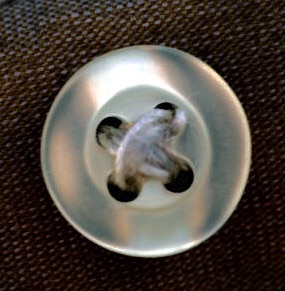
central line, yet the threads holding my
ocular buttons in place weave through four
holes and terminate in a knot. My flying friends
perceive light in a combination of four colors,
unlike the farmer, who blends only three. The
octopus knows black and white but blushes
to escape predators, while I remain fixed,
evading no one. Certainly my sense is more
vision than sight, and not the result of nerve
fibers routing light. Crows choose colors
when asked, but a certain shade of yellow
eludes them. And who would hear, above
the flock’s clamor, my claim to see this world
as it is? Grayscale, monochrome, visual
processing and perceptual lightness measures
mean little to one whose space accumulates
in uncertain increments – what is a foot to an
empty shoe? If I painted, which hues would
prefer my attempts, which would distract or
invade my cellulosic cortex, resulting in
fragmentation or blindness? Fear is not
limited to the sighted alone. I look out over
the field and perceive the harmonious
interaction of soil and root, leaf and sun,
the beauty of atmospheric refraction and
the wonder sprouting daily around me. Then
as one entity the crows explode into the blue,
leaving me alone with the shivering stalks,
questioning my place and purpose, awaiting
the next stray thought, a spark, a lonely
word creeping through this day’s demise.


This was written during the August 2015 Tupelo Press 30-30 Challenge, and was published by The High Window in December 2016.


 

Self-Portrait as Border


Self-Portrait as Border

Some rivers shift course, but
I stand firm, a nexus of rejection,
that line denoting separation of north
and good, evil and south, dark and
white. Welcoming no one, I stand
guard, opposing all with my flag
of diminishment. Squint, and you
still can’t see me. Your bare feet
won’t stir my dust. I am nowhere,
but remain here — that feeling of
prideful despair, strong, resolute,
inflexible foe to all who dare cross.


“Self-Portrait as Border” first appeared in October 2018 in Minute Magazine. Many thanks to the editors for taking my poem.


Self-Portrait as Question


Self-Portrait as Question 

Walking hand-in-hand with what,
who presupposes why, and when
huddles with where before skittering
off to its murky corner. Sometimes
I present myself as a shy minute
or a cloud’s effigy streaming across
a scruffy field. Few suspect the truth.
Answers ricochet from the limestone
wall, but no one nabs them. I react
quickly and offer the unknown, the
life I claim, my name, in return.


* * *

“Self-Portrait as Question” was first published in Rue Scribe in September 2018. Many thanks to Eric Luthi and the editors at Rue Scribe for accepting this piece and several others.

Greeting the Moon (after Li Po)

file0001288535990


Greeting the Moon (after Li Po)

Wine conceals the night’s approach,
while blossoms blanket my clothing.
Drunk, I stumble to the stream and greet the moon,
thinking of birds, so distant, and people, so few.


The transliteration on Chinese-Poems.com reads:


Amusing Myself

Face wine not aware get dark
Fall flower fill my clothes
Drunk stand step stream moon
Bird far person also few


file0002143220456

This adaptation first appeared here in September 2014.

The Simplest Coercion

image


The Simplest Coercion

Each portrait betrays a similar
attraction: faces

swallowed by the artist’s
eye, his sight being

beyond optic, that assumption
inherent in every expression

but one. Yet this, the self-
portrait, reveals a hint

of secrets – an unwillingness
to confront,

the simplest coercion.


* * *


Another piece from the 80s…

image


This first appeared on the blog in May 2015.

Spring Dawn (after Meng Haoran)

file4731293467677


This morning I slept through dawn
and the screeching birds, long
after last night’s wild wind and rain.
But who can count the fallen flowers?

The transliteration on Chinese-poems.com reads:

Spring sleep not wake dawn
Everywhere hear cry bird
Night come wind rain sound
Flower fall know how many


file7101237575173
This adaptation first appeared on the blog in November 2014.

Letter from Austin

perfection


Letter from Austin

Michael, when you say moons do you see
cold stone floating in the firmament
or phrases frayed in the mouth and spat on paper?
And does the Spanish moon simmer at a similar
pace to mine or yours? Which embers blush brighter?
But let’s turn to estuaries, to salt and clamor and gun-
running poets and interrupted words sold in stalls
between parenthetical gates, to incomparable cavas
and the deterioration of envy and intervening years.
Or perhaps mislaid passion – a friend claims love
is merely a bad rash, that we scratch and scratch
and inflame but never truly cure what ails us. Sounds like
politics to me. Or sports. And business. Or neighborhoods.
On my street people should cook and play music together,
laugh, raise chickens and read good books. They should
brew beer, swap tomatoes, recite each other’s poetry and sing
in tune. But we’re different here, preferring instead electronics
glowing in dimly lighted rooms. I reject this failure, as I also
reject the theory of centrifugal force spinning off the moon’s
body from the earth’s crust, preferring to imagine a giant
impact blasting matter into orbit around what morphed into the
earth, and somehow accreting the stuff into this orb we
sometimes worship. This, to me, is how good relationships
form: explosions of thought and emotion followed by periods
of accretion. But what I mean is I hope this finds you well
by the river of holy sacrament. Remember: brackish water
bisects our worlds. Turn. Filter. Embrace. Gotta run. Bob.


Originally published in Heron Clan 3, this first appeared on the blog in July 2015.

My friend Michael occasionally sends hand-written notes or letters to me, and I respond with poems. This is one. You might read some of his writing at Underfoot Poetry.

OLYMPUS DIGITAL CAMERA

Sometimes Love is a Dry Gutter


Sometimes Love is a Dry Gutter 

Or a restless leaf, a footprint.

Is fault on a blameless day,
scrawled on a washed-out sky.

My friend’s music orbits his home,
worms through the cracks
in the bluest lines, ever new

and permanent, staining even his hope
long after the lights stutter away.
And the rain’s attenuated sorrows?

They’re coming, he says. Like goats
through a fence. Like lava. Like tomorrow.


* * *

“Sometimes Love is a Dry Gutter” was first featured at Vox Populi in January 2017. I’m grateful to editor Michael Sims for supporting my work.


Who Will Know


Who Will Know

If I drip like snow from the roof who will know?
When I throw stones at dead men who will know?

The mother’s ghost rests in a razor-filled moat.
He purses his lips, laughs, says who will know?

You are the night sky above the red-cloud horizon.
When I fade like twilight, tell me who will know.

Which vein traces love, which proffers denial
as our blood starts flowing, and who will know?

Unanswered prayers line his frozen pockets.
When he unclenches his tiny hands, who will know?

This man’s tongue repels truth no matter the hour.
If we hear only what he allows, then who will know?


* * *

“Who Will Know” made its first appearance in May 2019 at The Local Train Magazine, a publication out of Bangladesh.


Sault Ste. Marie


Sault Ste. Marie

Too often you see yourself and wonder
which bodies ancestors navigated

to gather such glorious scars and wrinkles
in one place, both noticeable and unseen,

little waves in a great lake of flesh.
The mirror is not unkind, you think,

with proper lighting — in candlelight
or late evening’s peppery glow,

after a few drinks. Then you recall
crossing the equator three decades

past, how the deck’s non-skid surface
scratched your knees as you scrubbed

the twists and currents that’d buffeted
you to that imagined line on the globe,

and later, the following points and clock
faces withering down the long queue

of jobs, the spilled beer and incomplete life
sentences. Even now, Superior washes

through its locks, filling, denying, allowing
one’s depths into another’s space with equal

regard, promoting passage, flooding past with
future, present with then, balancing tomorrow, now.


“Sault Ste. Marie” won LCk Publishing’s Spring Poetry Contest in April 2017.