Letter to Geis from This Side of the Glass


Letter to Geis from This Side of the Glass

Dear Greg: I can’t help but think about windows, their
function, their meanings, intended and otherwise, how
they block some entities but allow others entrance. A
black vulture feather lies just on the other side of this
pane, but the laws of material and physics prevent me
from reaching through and claiming it. Maybe I’d
sharpen the end, dip it into squid ink and write letters.
Or not. Cephalopods are scarce in the hill country,
unlike carrion birds, wild hogs and scorpions, and frankly,
ballpoint pens require less maintenance. Lately, the
opaque has redirected my attention — no matter which
government agency speaks, I feel surrounded by their
pseudomorphs, those little indistinct clouds of mucus and
dark pigment released to confuse and numb me. A common
occurrence, I hear, and all the more frightening for it. I
think of where we’re headed, collectively and individually,
and even knowing that our destination remains unchanged
offers small comfort. One foot at a time, the steps matter,
and though it appears we won’t share those planned brews
in Bandera, I’ll chuckle over our last meeting there and
dream up a conversation about futility and compromise,
and yes, success. I’ve just spent twenty minutes trying to
help a yellow jacket escape. It wouldn’t leave the glass even
after I left the door ajar, allowing a fly to enter. Instead,
it gazed out at the hazy morning, seeking a way through
refraction’s oblique path. Finally, shepherded with my bare
hand, it reluctantly skittered to the jamb, and I coaxed it
the final few inches by pushing it with the door. Such
are my days. A little faith, some hope, luck and a great
unknowing. This window seems cloudy, or is it just
my eyes? I miss you, buddy, as do the hills and the sky
and everything nestled and bustling between.  Bob


This first appeared in May 2020 in the Taos Journal of International Poetry & Art. D.G. Geis was a friend, a larger than life  poet, and a fellow Texan. We were both finalists for the Slippery Elm poetry prize in 2017, and after learning that we didn’t win, decided to have a “losers’ lunch” in Bandera, Texas, the closest town to our respective rural properties. Much laughter ensued, and we made plans to get together for a beer in the coming months. Alas, that was not to be.


Texas Haibun

file000227150579


Texas Haibun

I dream of poetry in all its forms, rising and flowing and subsiding without end, much like ice shrugging within itself. Last winter a hard freeze split a valve on the downstream side of the cistern. Had it cracked even a few inches up-line there would have been no need to replace the valve.

captive rain recalls
its journey towards the ground
the garden returns

The well terminates at 280 feet. The water is hard, but cool, and tastes of dark limestone and ancient rains.

Even the gnarled live oaks have dropped their leaves. Grass crunches underfoot and smells like dead insects and dried herbs. Mosquitoes have vanished. Only the prickly pears thrive. Their flowers are bright yellow and bloom a few days each year.

sauteed with garlic
nopalitos on my plate
their thorns, forgiven

I wipe sweat from my forehead with the back of the glove, and wonder how many ounces of fluid have passed through my body this year, how the rain navigates from clouds through layers of soil and stone, only to return, how a cold beer might feel sliding down my throat.

stoking the fire
winter rain whispers to me
forget tomorrow


* * *

Originally posted in February, 2014, this was my first attempt at a haibun.


photo(15)


My Essay “Thirty-Five Years Later, I Raise My Hand” is featured on Alison McGhee’s excellent Words by Winter podcast.

I’m delighted to report that this essay is featured in Alison McGhee’s Words by Winter podcast.

If you haven’t listened to Alison’s podcasts, you’re in for a treat! Yes, they focus on poetry, but there’s much more. Spend some time with her.

Thirty-Five Years Later, I Raise My Hand

In spring 1983 I enrolled in a poetry writing course thinking it might help improve my short fiction. I was a history major by default, had never taken a course in poetry, but believed, with absolutely no evidence, that I could write fiction. At the time I would have been hard-pressed to name five contemporary poets, even counting my professor. To be honest, the class struggled to hold my attention. Only about a quarter of the students seemed interested in writing, and the instructor was a bit, uh, tired. But for the first time in my life I read, really read, poetry. I fell in love with Galway Kinnell, Ai, James Wright and Carolyn Forche, to name just a few of my early enthusiasms. I wanted to write like them. So I wrote. And wrote. And wrote. Most of it was laughably bad, but somehow I managed to win an undergraduate poetry contest, which suggested that hope existed. Maybe someday, I thought, one of my poems will be published. This radical idea had never occurred to me before. Publication seemed to be the privilege of special people, and a lifetime of gathered fact revealed that I was unequivocably nothing special.

Early on in the semester, perhaps even in the first class, the professor asked how many of us thought we’d still be writing poetry in twenty years. I didn’t raise my hand. I didn’t know where I’d be in six months, much less what I’d be doing in twenty years. Since I’d realized late in the game that teaching was not for me, I had no job prospects, and few marketable skills, despite experience in chugging beer, manning sound-powered phones on a ship’s helicopter tower, scraping barnacles and bending rules. The world was limited. The world was limitless.

Another gray day

dividing the old and young

Oh, this aching hip!

* * *

All the Little Pieces

broken-glass


All the Little Pieces

How to rewind
broken,

the subtle shift of shard
and floor

laid between night’s
fall

and the morning’s first
glow. Take this

lantern. Set it
on the wall. Remove

the glass. Do not
light the candle.

Wait.


lantern


Black Lilies


Black Lilies

Flensing words, slicing deeper: all, nothing,
red to redder. Their skin, paling to nothing.

I speak today but you hear yesterday.
Black lilies in the chill of nothing.

Drifted apart, the two halves reconcile.
Yellowed, whitened. Older. Both stitched in nothing.

How many words have we lost to morning? Shredded
syllables sparring for sound. The nothing of nothing.

A coated voice, turquoise and calm, spreading across the room.
Buttered light. Pleasantries, unfolding. You, being nothing.

The language of night sleeps unformed in my bed.
I remember your hand on my cheek; flesh forgets nothing.


* * *

A near-ghazal, “Black Lilies” first appeared in ISACOUSTIC* in January 2018.

Flinch

spade


Flinch

Set it aside, regret, heal. Grieve
till the soil’s ebony heart  
devours your secrets. Believe,
in agony, what falls apart,
disintegrates at your feet. Art
rends your flesh: nervous I transmit
false signals, flinch when I should start,
weep when I should wave, counterfeit
my life’s lessons. Mosquitoes flit
through the unscreened window. Do I
ever claim this life as misfit,
as hopeful dupe? Watch the man lie
and conspire. Swat at the bugs. Lift
the mottled spade. Accept this shift.


* * *


“Flinch” first appeared  in Grand Little Things, a publication that “embraces versification, lyricism, and formal poetry,” in July 2020.

Thank you, editor Patrick Key, for taking this piece.

Onions

image

Onions

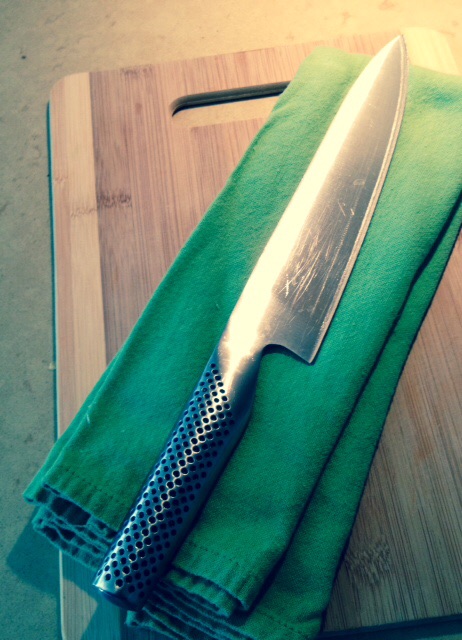
My knife never sings but hums instead when withdrawn from its block, a metallic whisper so modest only the wielder may hear it. Or perhaps the dog, who seems to enjoy the kitchen nearly as much as I. A Japanese blade, it’s a joy to hold, perfectly balanced, stainless steel-molybdenum alloy, blade and handle of one piece, bright, untarnished, and so sharp as to slide through, rather than awkwardly rupture and divide, its next task on the board.

We’ve never counted the chopped and rendered onions, the fine dice, slender rings and discarded skins, but if we could gather all the corpses we’ve produced together over the years, we’d form a monument to our work, cooperation of metal and man, a Waterloo mound in memory of the bulbs laid there, the planning involved, the missteps and serendipity, and the tears shed along the way.

The blade doesn’t care. It is. It works. It moves things, it lifts, it parts them, and in return is cleansed, and later, in the quiet room, maintains its edge with a silvery rasp, angled steel on steel in a circular motion, over and over, until finally it hums its way back into the block. But it never sings.

image

“Onions” last appeared here in December 2019. Hmm. This reminds me (again) that I need to sharpen knives…

Alas, my bout with COVID-19 has rendered me incapable of, or unwilling to, cut into onions. Parosmia has reared its ugly head, and now onions, garlic, bacon, peppers, arugula and hoppy ales among other beloved foods emit odors resembling a mix of raw sewage, mildewed peat moss and burnt wood. Ah, 2020!

Sault Ste. Marie


Sault Ste. Marie

Too often you see yourself and wonder
which bodies ancestors navigated

to gather such glorious scars and wrinkles
in one place, both noticeable and unseen,

little waves in a great lake of flesh.
The mirror is not unkind, you think,

with proper lighting — in candlelight
or late evening’s peppery glow,

after a few drinks. Then you recall
crossing the equator three decades

past, how the deck’s non-skid surface
scratched your knees as you scrubbed

the twists and currents that’d buffeted
you to that imagined line on the globe,

and later, the following points and clock
faces withering down the long queue

of jobs, the spilled beer and incomplete life
sentences. Even now, Superior washes

through its locks, filling, denying, allowing
one’s depths into another’s space with equal

regard, promoting passage, flooding past with
future, present with then, balancing tomorrow, now.


“Sault Ste. Marie” won LCk Publishing’s Spring Poetry Contest in April 2017.

Awakened, He Turns to the Wall (Cento), with Recording

cell


Awakened, He Turns to the Wall (Cento) 

Then, everything slept.
Where were you before the day?

You see here the influence of inference,
whereby things might be seen in another light,

as if the trees were not indifferent, as if
a hand had suddenly erased a huge

blackboard, only, I thought there was
something even if I call it nothing,

like the river stretching out on its
deathbed. No one jumps off.


* * *

A cento is composed of lines from poems by other poets. This originated from pieces by: Larry Levis, Jacques Roubaud, Lorine Niedecker, Gustaf Sobin, Denise Levertov, Elizabeth Spires, William Bronk, Vicente Huidobro, Ingebord Bachmann

For further information and examples of the form, you might peruse the Academy of American Poets site: http://www.poets.org/poetsorg/text/poetic-form-cento


erase


Vesuvius


Vesuvius

When the earth shrugs,
some warnings are better
heeded. A little

smoke, some ash.
A knife point held to the chin.

Why listen at all?
The man in the big house hides in its vastness.
Surrounded, he walks alone.
People speak, but he hears only himself.

Meanwhile,
the mountain
belches

and the birds fly north
seeking firm ground
upon which to land.


* * *

“Vesuvius” was first published in The Big Windows Review in December 2017. I’m grateful to editor Thomas Zimmerman for accepting this piece.