Candice Louisa Daquin was born in France, and has also lived in England, Canada and America. Daquin has worked in dance, publishing, as a psychotherapist and more recently she divides her time between teaching, editing and writing. Daquin is the author of five collections of poetry and numerous poems and reviews in magazines, websites and periodicals. Daquin was co-editor of We Will Not Be Silenced (2018) an anthology of poetry in response to the #metoo movement. This Is What Love Looks Like – Poetry by Women SMITTEN With Women is her first poetry Anthology as lead editor, and is due out October 2019 (Published by Indie Blu(e).
So what’s this Anthology all about?
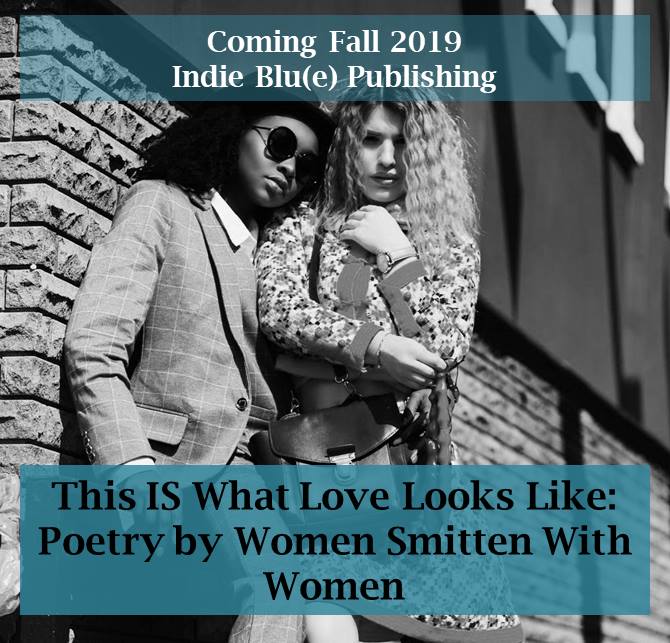
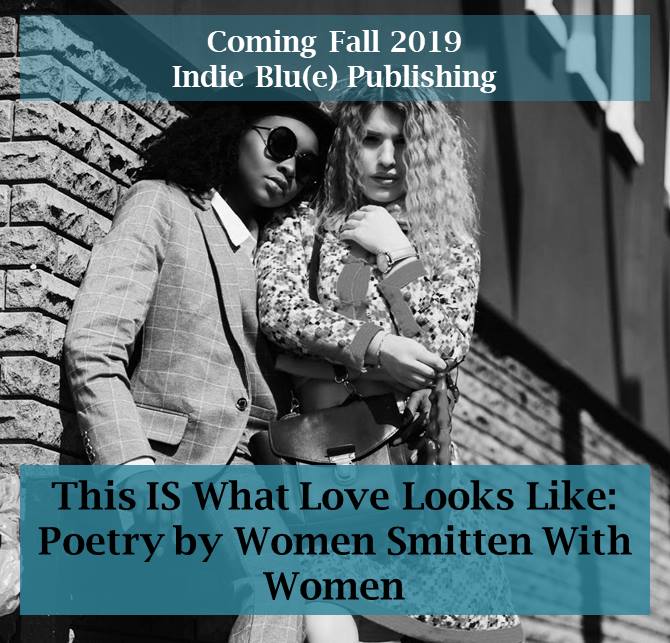
This is What Love Looks Like – Poetry by Women SMITTEN with Women (SMITTEN for short) came about after Indie Blu(e) had published We Will Not Be Silenced, which was an anthology of poets throughout the world writing in response to the #metoo movement and the then Judge Kavanaugh hearings. It was the right time and the anthology went on to be an Amazon best seller.
There was something so powerful and such an incredible energy working on an anthology for the first time. Shortly afterward Indie Blu(e) asked me to work with them and I now do part time on some of their poetry publishing. I had been so positively affected by reading all these poems from writers throughout the world I wanted to see if it were possible to create another anthology but this time for women who loved women.
As a lesbian, I felt that lesbians were increasingly marginalized and invisible by the co-opting of the LGBTQ movement and I wanted to find a poetic medium to express lesbian voices that was not erotica (which many lesbian themed poetry collections were). Fortunately Indie Blu(e) backed my idea and we put the call out.
Truly I did not expect the response we received, it was so galvanizing and breathtaking to see how many women submitted and the quality of some of the work. Our youngest poet is 14 and our oldest, 87. I think that speaks volumes about the need for collections of poetry on various subjects and how it brings voices together and keeps poetry relevant and alive.
SMITTEN is due out October 2019 and we’re so excited to be part of this, because it’s already begun a really necessary poetic dialogue about the representation of emotions in poetry. For anyone, there is something lasting and beautiful to be found in this collection and it is my hope as many heterosexuals read it as lesbians and bisexuals.
Please tell us how or why you turned to writing poetry?
I wrote as a kid when I felt emotions I couldn’t put into prose. I think for the very young there is a natural doorway into poetry that sometimes we lose as adults. Poetry should be emphasized more, as once it was thought as the highest form of expression and I can see why. Having worked in publishing, teaching and psychotherapy it was always part of my life to write.
Would you offer up some of your influences – poetic and otherwise. What draws you to that work?
Shamefully I am less influenced by others than perhaps I should be. There is so much value to reading a wonderful poet for any creative and I’m sure it does permeate and percolate through to our creative sub-conscious. I tend however to write without direct influence so it’s hard to harness the exact mechanisms involved. Typically I am drawn to work that I find honest and brave. I think for me, as an ex-dancer, I find dance my greatest influence, and like music, it can produce poetry in me when I listen to and watch it. Likewise, reading a psychology book will often inspire me.
Would you mind sharing a bit about your background?
I’ve been around the world a bit and finally settled in America. I wouldn’t say it’s been easy fitting in, I think shyness and difference are a little more accepted in my native France but despite that, I love the landscape and breadth of this country, and the dreams of its people.
My family are of Egyptian/French/Jewish decent so I’m quite a mixed bag and this has influenced my perspective(s) considerably. Being a queer writer, obviously my battles with equality come into play in my writing, and I am a big advocate of equal rights for all.
If you were a poetic form, which would you be?
I’m ashamed to say, I’m not personally big on poetic forms. I did take classes as a young person and began a MA in Poetry/Writing before switching to Psychotherapy (which led me to practice as a therapist for a number of years) but I think the structure and attention to form is what put me off. As much as anything if I’m honest, this could be an impatience on my part with the feelings of a poem. I think there are two types of poets; A technical/form poet and a free verse poet. Neither are better than the other, though it might be said, knowledge of both is optimum. So I’d have to say free-verse or confessional 😊 bit of a cliché I know. That said, I deeply appreciate others who write using forms.
What is the relationship of your environment, your daily surroundings, to your writing?
Not as good as it should be. I work too much and never have enough time. Ideally I’d create a haven for writing and devote myself more stringently to the relationship between my environment and writing. Like many of us, I juggle multiple jobs and tasks and am lucky to get any time. Maybe if I retire in 35 years time I may have these things and I expect that is why some poets who are older are such consistently good writers. Working on SMITTEN I loved hearing the varied voices, different parts of the world, different ethnicities and cultural backgrounds, even different ways of loving. That has so much value.
What themes or traits will readers find in your work? What will they not find?
They will not find acceptance or tolerance of inequality or bigotry. As much as I may find something of value in the Bukowski and Billy Childish poets of the world, I would never embrace that inequity toward a group of people (women) and I feel strongly as a woman about being unapologetic and very honest. SMITTEN is part of this legacy, it’s lending a voice to those who usually aren’t heard very loudly.
List three favorite poets, an admirable animal, and your go-to beverage.
Oh dear! I’m terrible at listing ‘favorites’ because honestly, it changes all the time. I read a LOT of poetry so for today I can say, Anne Sexton is always up there, I recently re-read a lot of Tennyson and he’s always influential and lastly, I love the Metaphysical poetry movement of the 20’s and just finished a book on those authors – too numerous to mention. In SMITTEN I was absolutely blown away by our 14 year old’s poem. It gave me faith. That poetry has a real future. Equally, I loved that a woman who is 87 is still writing and has an entire history in her words. We also have three Native American poets, who are absolutely superb. Can I put those instead of the admirable animal and go-to-beverage? 😉 (Whale/Tonic Water).
And your creative process? Could you offer us a glimpse into how your poems develop from first glimmer to fully realized piece? Do you follow a regular writing routine? Do you listen to music while writing? Write in public or in solitude?
Let me talk instead about SMITTEN. Imagine having the honor of collating poetry from all around the world, written sometimes with the greatest emotion, sometimes the first time it’s been public, or admitted. I found such a brevity and depth to the poems we received and it was truly hard to not want to publish most of them. Obviously we had to turn a lot down in order to make a manageable collection, so we endeavored to seek the truest, starkest and most honest. At times they were not all ‘well written’ as a professor may grade, (having taught for many years I can attest to this!) but technique came second to message. Sometimes there is value in the message even if the technique is a little lacking. That was my approach and I’m proud of it. Many times people with poor technique never improve because they are not given a chance to flourish. I believe everyone can grow and improve, and giving them confidence is half the battle. Obviously a well written poem is like nothing else, and I literally read some whilst holding my breath. Ideally to have both a message and technique is the goal and this was about allowing voices of women who love women to come to the foreground and SPEAK. That was my process. I’ve spent literally hours on this project and I feel only pride for the courage and conviction of these authors. I’m a big believer in helping others, and one way to do that is give them a platform. That’s my greatest achievement. It’s so much bigger than me and I love that. I think I’m a very self-effacing writer and I get so much more from editing/publishing others (which I used to do in Europe) than simply promoting myself.
SMITTEN is due out October 2019. It will be available via all good booksellers.