Awakened, He Turns to the Wall (Cento)

cell

Awakened, He Turns to the Wall (Cento) 

Then, everything slept.
Where were you before the day?

You see here the influence of inference,
whereby things might be seen in another light,

as if the trees were not indifferent, as if
a hand had suddenly erased a huge

blackboard, only, I thought there was
something even if I call it nothing,

like the river stretching out on its
deathbed. No one jumps off.

* * *

A cento is composed of lines from poems by other poets. This originated from pieces by: Larry Levis, Jacques Roubaud, Lorine Niedecker, Gustaf Sobin, Denise Levertov, Elizabeth Spires, William Bronk, Vicente Huidobro, Ingebord Bachmann

For further information and examples of the form, you might peruse the Academy of American Poets site: http://www.poets.org/poetsorg/text/poetic-form-cento

erase

This last appeared here in February 2017.

Journal Publications (September – November 2017)

Links to my publications for September – November 2017:

This Island is a Stone, Mockingheart Review, September, 2017.

That Number Upon Which the Demand Lieth. Posit, September, 2017.

Pleasure in Absence of Ending (Enso). Posit, September, 2017.

At Work I Stand Observing My Diminished Self. Posit, September, 2017.

N is Its Child. Reservoir, October 2017.

Better Than Drowning. Underfoot, October, 2017.

Ghost, with a Line from Porchia. Underfoot, October, 2017.

Elegy. Underfoot, October, 2017.

Some Answers You Never Considered. Underfoot, October, 2017.

As Blue Fades. Underfoot, October, 2017.

River Carry Me. Underfoot, October, 2017.

The Three Disappointments of Pedro Arturo, Main Street Rag, October 2017. Print only.

Snails.Vox Populi, October 2017.

Letter to Schwaner from the Toad-Swallowed Moon, Hamilton Stone Review, October 2017.

Yellow, Lost. Wildness, October 2017.

Happy Circuitry.Figroot Press, October 2017.

If You Drop Leaves. Bad Pony, November 2017.

Danez Smith Reading “Say It with Your Whole Black Mouth”

This poem makes me despair that other human beings have to write poems such as this.

This poem makes me despair that I’ll never write anything so true.

Read the poem. Listen to the recording. Celebrate Danez Smith and his words.

https://www.poets.org/poetsorg/poem/say-it-your-whole-black-mouth-0


Recording of “Yellow, Lost”

Yellow, Lost

The forgotten poem, existing in title only: Yellow.

Which is a bruise at three weeks, or memory’s shade in autumn.

In what black folder does it hide? In which blinding light?

I take comfort in primaries, lose sleep at the edges.

Where fraying begins and annotation dwindles to scrawled lines.

Above the bones and flesh of the Egyptian gods. Above my books.

Within these lost minutes. Those moons, bereaved. The hours.

Desire germinates even after our rainless decades. Yellow, again.

The color of sulfur (the devil’s realm) or the traitor’s door.

Of cowardice and warning. Of aging and decay.

How to recover what’s sifted away, the residue of our loves?

Each day more bits break off, never to be reattached.

But you, I blend with the sky, perfecting trees, the grass.

* * *

“Yellow, Lost” was published in wildness, Issue no. 10, in October 2017. wildness is an imprint of Platypus Press, which published my work Interval’s Night, a mini-digital chapbook, in December 2016 in their 2412 series. If you’re not familiar with wildness, check it out. In fall 2016 Poets & Writers named it in their article Nine New Lit Mags You Need to Read.

NPR Interview with Jane Hirshfield

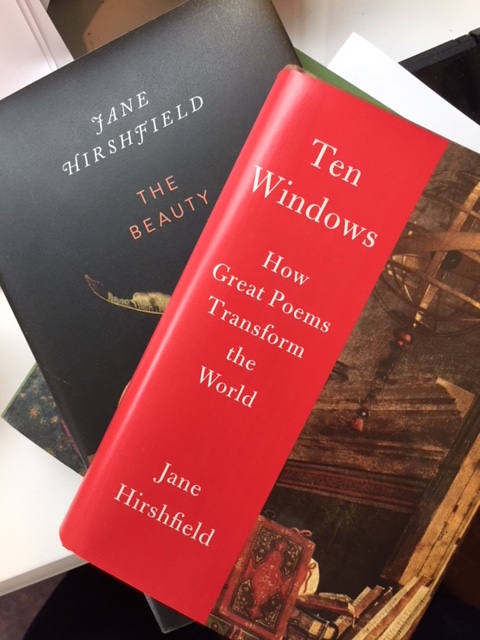
In this interview, Jane Hirshfield reads her poem  “My Eyes” from The Beauty, and discusses the “window moment” in poetry. I can’t remember when I first fell in love with her poetry (2000? 2001?), but she remains one of those writers essential to my life.

Yellow, Lost

Yellow, Lost

The forgotten poem, existing in title only: Yellow.

Which is a bruise at three weeks, or memory’s shade in autumn.

In what black folder does it hide? In which blinding light?

I take comfort in primaries, lose sleep at the edges.

Where fraying begins and annotation dwindles to scrawled lines.

Above the bones and flesh of the Egyptian gods. Above my books.

Within these lost minutes. Those moons, bereaved. The hours.

Desire germinates even after our rainless decades. Yellow, again.

The color of sulfur (the devil’s realm) or the traitor’s door.

Of cowardice and warning. Of aging and decay.

How to recover what’s sifted away, the residue of our loves?

Each day more bits break off, never to be reattached.

But you, I blend with the sky, perfecting trees, the grass.

* * *

“Yellow, Lost” was published in wildness, Issue no. 10, in October 2017. wildness is an imprint of Platypus Press, which published my work Interval’s Night, a mini-digital chapbook, in December 2016 in their 2412 series. If you’re not familiar with wildness, check it out. In fall 2016 Poets & Writers named it in their article Nine New Lit Mags You Need to Read.

At Work I Stand Observing My Diminished Self

At Work I Stand Observing My Diminished Self

1 (reflection)

Six iterations, alike but lessened in sequence, and always in pairs:
front and back, oblique, the two mirrors becoming four, then six.

A perfect mirror reflects and neither transmits nor absorbs light.

Tilting my chin, I accept reflectance according to its distribution.

Retina as transducer, producing neural impulses.

The images consume no space but the effect is of distance.

Vision is not simply the retina’s translation
but counts inference and assumption among its influences.

The sum and product of its parts: 1 + 2 + 3, or, 1 x 2 x 3.

Angles achieve distinctions apparent at each adjustment.

Turning slightly, I detect movement in each replica.

A six-door cubic cage depicting the bondage of sense and elements.

It is possible to withdraw from this frame.

2 (answers)

Does the weaker eye perceive less.
Who conceals the shadow’s death.
Is a distal truth a lie or merely implication.
How do you rid the mirror of its ghosts.
What resonates in the echo’s decline.
Did the light switch subvert the blackened image.
Apparition, projection or visual representation.
When do waves not disturb.
At what point does belief transmute sight.
What fixes the mirror’s image.
Who closed his eyes and saw light.

3 (prosopagnosia)

I sip coffee and gaze out the second-floor window.

More light enters my neighbor’s office than mine.

Calculate the difference between illumination and glare.

Looking ahead, I claim no face and recognize no one.

The eye converts a signal from one form of energy to another.

Accepting light from external objects, I perceive reflection as the true arbiter.

The dissected path impairs transduction.

Face as identifier: to make, to do.

Translation: imperfection: diminishment.

Blink.

* * *

“At Work I Stand Observing My Diminished Self” was published in Posit in October 2017.

I May be a Genius

Thanks to Margaret Langstaff, I’ve learned that despite all evidence to the contrary, I may indeed be a genius. Read her “Einstein’s Desk and Mine: A Sort of Comparative Analysis.”

In Response to My 13 Year-Old Daughter’s Letter

Read this stunning poem. Then read the rest of the book! You won’t regret it.

stephanielharper's avatarSLHARPERPOETRY

Starlight 01 Cameren at age 4, taken Mother’s Day 2005
In Response to My 13 Year-Old Daughter’s Letter

Apologize? For regretting your birth?

That the white dove of sarcasm
has officially fledged from your belly
alit on the canopy     & uncaged its crystal trill
comes to me as no surprise

But neither of us could have foreseen the power
your brooding would conceive of pencil & ire
before the moment you spat out   crumpled     & hand delivered
my saltwater baptism

Your own tears     now dried for hours     blaze for me
from the gold heart in your gray-green eyes
willing my belief that you truly didn’t realize
I’ve been there your whole life

At sundown     I’m the one always stumbling through the wood
like some sort of village idiot     brandishing my dim lantern
at the giant pines     as if I might catch them in the act
of uprooting themselves     & slinking away

Though you flit…

View original post 255 more words

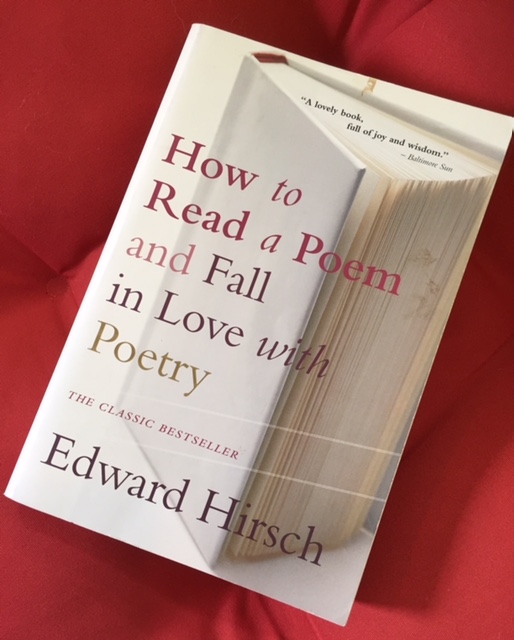
Edward Hirsch’s How to Read a Poem and Fall in Love with Poetry

In a nod to National Poetry Month, the Poetry Foundation has posted the first chapter of Edward Hirsch’s superb How to Read a Poem and Fall in Love with Poetry. One of my favorite all-time reads. If you haven’t read this book, dip into the first chapter now.