Water Witching, We Hear
The rattle of stalks
along dirt roads,
whispery days
sifting through
parched
light,
you say
patience, my
friend, and again,
patience.
“Water Witching, We Hear” first appeared on the blog in April 2017.

Water Witching, We Hear
The rattle of stalks
along dirt roads,
whispery days
sifting through
parched
light,
you say
patience, my
friend, and again,
patience.
“Water Witching, We Hear” first appeared on the blog in April 2017.

Awakened, He Turns to the Wall (Cento)
Then, everything slept.
Where were you before the day?
You see here the influence of inference,
whereby things might be seen in another light,
as if the trees were not indifferent, as if
a hand had suddenly erased a huge
blackboard, only, I thought there was
something even if I call it nothing,
like the river stretching out on its
deathbed. No one jumps off.
* * *
A cento is composed of lines from poems by other poets. This originated from pieces by: Larry Levis, Jacques Roubaud, Lorine Niedecker, Gustaf Sobin, Denise Levertov, Elizabeth Spires, William Bronk, Vicente Huidobro, Ingebord Bachmann
For further information and examples of the form, you might peruse the Academy of American Poets site: http://www.poets.org/poetsorg/text/poetic-form-cento

This last appeared here in February 2017.

Dark Rain Ahead, Hummingbird
The black-chinned hummer buzzes my flowered shirt,
bringing to mind the letter H, its history of an inferior life among
letters, and a Phoenician origin signifying fence.
An aspirate dependent upon others, or a line strung between posts,
even whispered, H does not contain itself.
Disconsolate or annoyed, the bird moves on.
Do names depend upon the power of symbols, or do they power the symbols?
In the 6th century A.D., Priscian disparaged H, saying it existed only to accompany.
Clouds shade the way.
The black-chin extends its grooved tongue at a rate of 15 licks per second.
Alone, the H’s voice is barely audible.
Through the trees, across the crushed rock driveway and beyond the barbed wire
and chain link, I hear deadfall snapping under hooves.
At rest, its heart beats an average of 480 beats per minute.
Modern Greek denies its existence.
Say khet, say honor and where. Say hinge, sigh and horse. Say depth.
Originally published in Prime Number Magazine, one of my favorite online literary journals, in 2013, it subsequently appeared here in June 2015.

Palinode (translation, passway, glass)
(translation)
What falters in translation? The dove’s silhouette resides
on the window three months after the sudden refusal. I
observe wingprints, the skull’s curve, a history of assumptions
angled in the moment of impact. And after, residue. Light’s
incident rests. One body whispers another’s shape and the
next rumbles through the narrowing passway. Traitorous,
I call it fact. I name it truth, and naming it, reverse the coat.
(passway)
I name it truth, but considered denial, root of the renegade’s
term. I have a bird to whistle and I have a bird to sing. Misperception
in flight. Betrayal’s gate, unhinged. What comes next? Sunlight
slants through the window each morning, and departs, bending
in reversal. Stones all in my pass. Dark roads. Another naming,
another transition. Trials waged in the grammar of refraction.
The deflected word.
(glass)
The deflected word reciprocates and the sky opens, outlining
its missing form. I have pains in my heart, they have taken my
appetite. Derived from wind, from eye, from hole. Once through,
what then? Mention archetype, and my world dims. Mention
windows, and I see processions and enemies lined along the way.
Boys, please don’t block my road. We select certain paths, others
choose us. Wingprints on glass.
* * *
Notes: italicized selections are from Robert Johnson’s “Stones in My Passway.”
This piece first appeared, in slightly different form, in ditch, in January 2014, and last appeared here in July 2016.

N Is Its Child
If darkness produces all, from where do we obtain nothing?
As a line becomes the circle, becomes a mouth, becomes identity.
In mathematics, n signifies indefinite; in English, negation.
The no, the non, the withdrawal, the taking away.
A heart with trachea represented zero in Egyptian hieroglyphs.
My mouth forms the void through the displaced word.
Conforming to the absent, the missing tongue serves soundlessness.
Aural reduction, the infinite unclenched: n plus n.
Shiva, creator and destroyer, defines nothingness. As do you.
One and one is two, but zero and zero is stasis.
Pythagoreans believed that all is number, and numbers possess shape.
The letter N evolved from a cobra to its present form.
One may double anything but zero.
Unspoken thought, disorder. The attenuated voice swallowing itself.
* * *
“N Is Its Child” was first published in Issue 4 of Reservoir. I am grateful to editor Caitlin Neely for accepting this piece.
Numbers numbers numbers: NINE
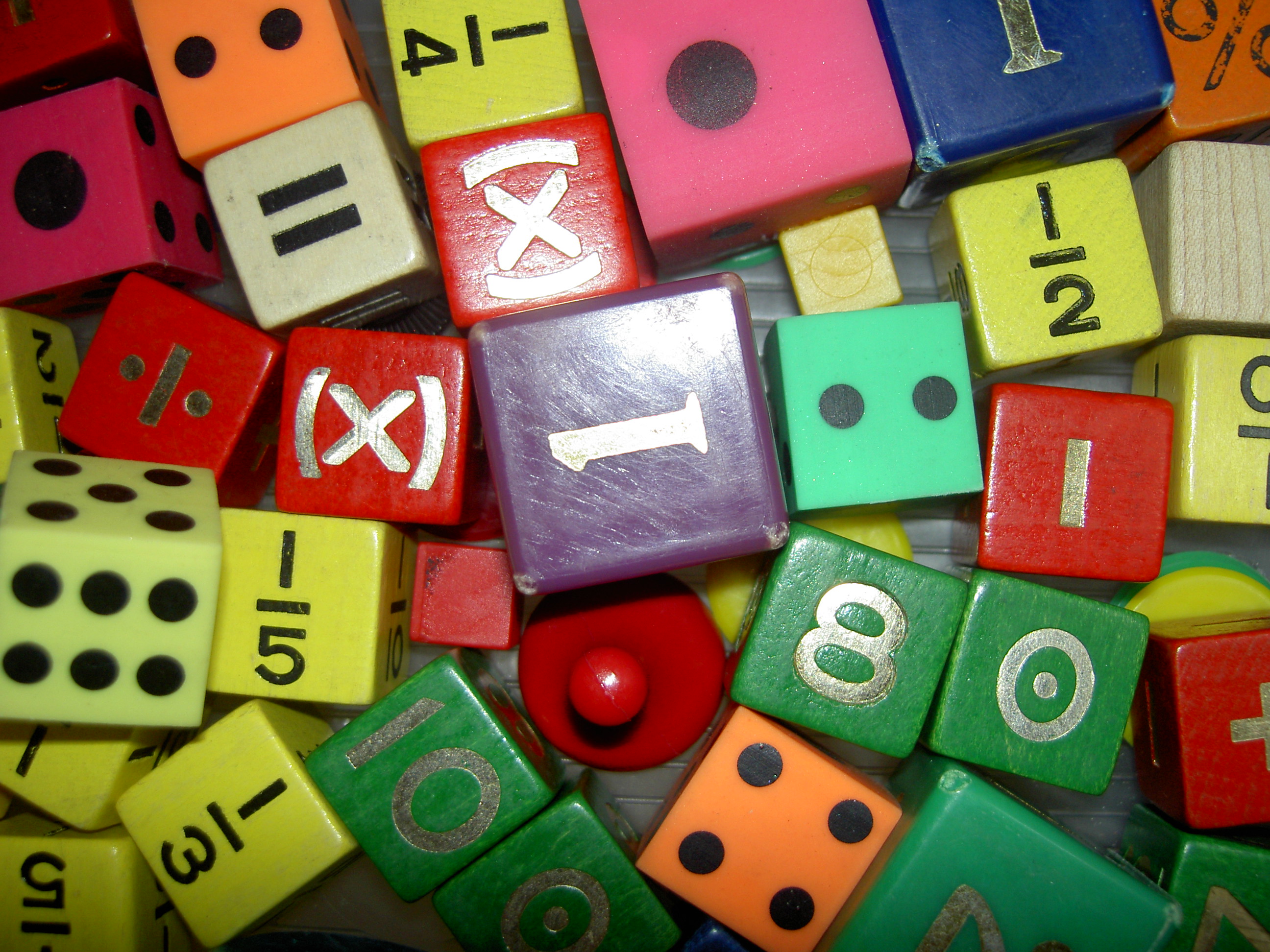
Early on in my other life I was hand-picked and hired to assist with budgets, to work with numbers. One of the higher-ups remarked that my spelling score was quite good for a “numbers person.” This amused me to no end, as I’d no inkling that a) anyone in the world considered me fluent with numbers, or b) that the mundane labor that comprised my livelihood had been noticed, much less evaluated, by someone beyond my small, three-person office (certainly no one noticed the writing I’d produced and published). More than a quarter century later, I’m still amused. And still working with numbers, which even now remain mysterious, magical, and even inspiring.
Take the number nine. Multiply it by two, and you get 18. Add the two digits that comprise 18, one and eight, and you get 9. Multiply it by three: 27. Total the two digits forming 27, and you get, yes, 9. Multiply it by four, by five, by six, by seven, eight or nine. Add the digits that comprise the sum and you return to nine. Interesting, no?
It appears everywhere. In Islamic cosmology, the universe is built of nine spheres. In Ancient Mexico, the netherworld consisted of nine layers. The magic square consists of nine parts. Beijing was designed as a center with eight streets. Hindu temple foundations contain jewels and nine distinct grains. The human body has nine openings. The number also appears in both sacrificial and healing rites. The River Styx bends nine times. I could go on (we haven’t scratched the surface), but will refrain.
And if this piece piques your curiosity, you might find this poem inspired by zero (a truly fascinating subject) of interest:
http://www.cladesong.com/okaji.withtheseninefigures.html
Or this one, “That Number upon Which the Demand Lieth,” which takes up the number three.

In the Place of Cold Doors
We have a word for everything,
or seven for nothing. Soon
you’ll enter and I’ll talk
on the other side,
watch for signs in every
dropped crumb,
every nailhead and
embedded phrase remembered
in another’s voice. The light
will dim and I’ll look for rain and
go on speaking. My words will wander
unnoticed. You hear only yesterday.
“In the Place of Cold Doors” first appeared in Gossamer: An Anthology of Contemporary World Poetry, published by Kindle Magazine in Kolkata, India. I was thrilled to have several poems included in the anthology.
Irretrievable
How we grieve the simplest
truth: we are
the scatterings,
relics of
the mind’s
erosions,
less than the sum
of our bodies. I cannot see
the word
but it smokes like
the color green
burning, but not of
flame, and once
the knife enters
you must avoid
its secretion
and peel the flesh
to reveal
what hides within:
the stem’s
purchase, pith,
seeds,
the irretrievable
shape
of a word
my lips cannot
form.
***
“Irretrievable” first appeared in a slightly different form in Vayavya, in December 2013, and subsequently appeared here in April 2016..

I cull and offer this and this,
and these last definite whorls
or later star or flower, such
rare dark in another world,
outdistancing us, madness
upon madness, the crest
and hollow, the lift and fall,
ah drift, so soft, so light,
where rollers shot with blue
cut under deeper blue as the
tide slackens when the roar of
a dropped wave breaks into it,
and under and under, this
is clear—soft kisses like bright
flowers— why do you dart and
pulse till all the dark is home?
I am scattered in its whirl.
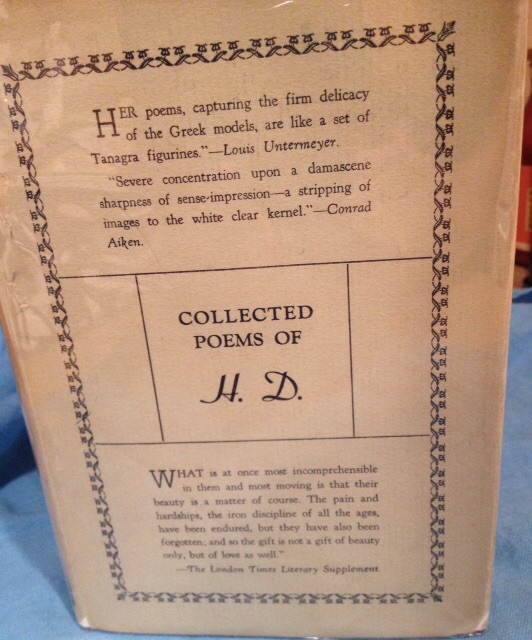
This cento last appeared here in October 2016, and is composed exclusively of lines taken from fifteen pages in the Collected Poems of H.D., 6th printing, 1945. Hilda Doolittle is a fascinating figure in 20th century American poetry. You might look at the Poetry Foundation’s biography for further information:
http://www.poetryfoundation.org/bio/h-d

That Number upon Which the Demand Lieth
Overcoming duality, yet binding: the trinity.
Beyond the contrast of two, it initiates the concept of many.
Albertus Magnus claimed that three lives in all things.
Becoming; being;
disappearing.
In Old Saxon, the month of May is named trimilki, season of three milkings.
Number as quality depends upon the visual field.
The ancient Egyptian sign for the plural requires three strokes.
Points; lines;
angles.
Lao-tzu said the triad produces all.
Acronyms, sports, and traffic lights reflect our ternary culture.
The devil may appear in the form of a three-legged hare.
Witness; testament;
tribute.
Representing the unknowable: I, you, and the beyond.
The figure of completion, the number of the cube.
A Sumerian number sequence began “man, woman, many.”
Curse; liturgy;
blessing.
The scale as a succession of thirds.
Imperfection implies the concealment of perfection.
Shiva’s number, his eyes, his braids, his place.
Root; third;
fifth.
The triangle in Euclidean space.
I walk the three roads to the commonplace, preferring rhetoric.
Three to through, it penetrates the personal, unhinges that door.
The law; the land;
the world to come.
“That Number upon Which the Demand Lieth” was published in Posit: A Journal of Literature and Art in September 2017. I am grateful to editor Susan Lewis for taking this piece.
 O at the Edges