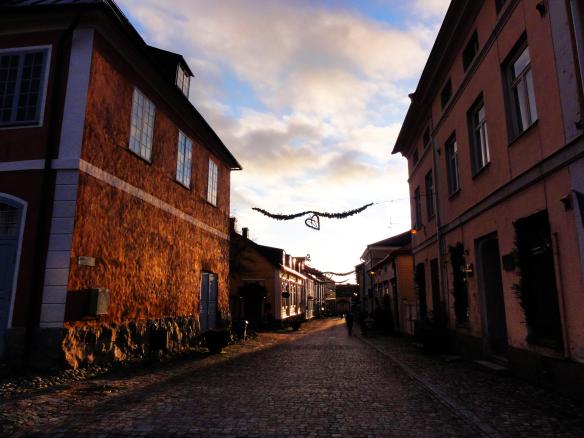
My poem “Helsinki” can be found at Panoply. It was inspired in part by a Facebook thread on which editors commented on what caused them to instantly reject poems. One said beginning a poem at a window was cause for rejection. Hence the first line.

My poem “Helsinki” can be found at Panoply. It was inspired in part by a Facebook thread on which editors commented on what caused them to instantly reject poems. One said beginning a poem at a window was cause for rejection. Hence the first line.
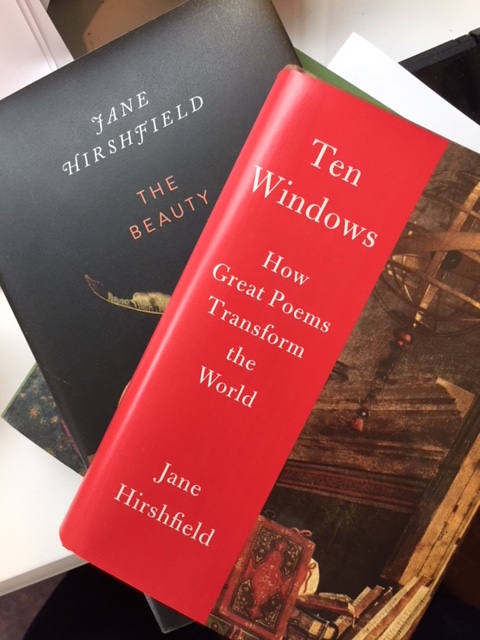
In this interview, Jane Hirshfield reads her poem “My Eyes” from The Beauty, and discusses the “window moment” in poetry. I can’t remember when I first fell in love with her poetry (2000? 2001?), but she remains one of those writers essential to my life.

Ode to Bacon
How you lend
yourself
to others,
enhancing even
the sweetest fig
in your embrace
over coals,
or consider
your rendered
self, how it
deepens flavor
with piggish
essence, coating
or absorbed,
blended or
sopped. O belly
of delight, o wonder
of tongues,
how could I not
love you
and your infinite
charms, even
when you resist
my efforts and
shoot sizzling bits
of yourself
onto my naked
hands? I pay
this toll
gladly,
today and
next year
and all those
days to follow,
till the last piece
is swallowed
and our sun
goes dark.
Hyperbole
becomes you,
smoked beauty,
salted love,
and I shall never
put you down
or leave you
behind
on a plate
to be discarded
or forgotten,
unloved.

“Ode to Bacon” first appeared here in July 2017, thanks to T.S. Wright’s challenge.

Some Answers You Never Considered
At the cusp of night, before the sun steams out in the ocean,
and blues abandon the reds.
Nothing rests at the core of zero.
Cerulean blue was first marketed as coerulium.
What we consider sky includes only its lowest reaches.
Even considering a dense history with kites, I humbly concede,
and admit sacrifice as atonement, with grace.
No. I say it again. No.
Your visual system constructs the colors you see.
Only when the wind unbuttons its greatcoat, or at the tip
of an icicle, just before the drop catches itself.
Release the line and know the freedom of loss.
Transparent yet wide, unfolded like a fist freeing
a swarm of bees into honeyed air, it contains us.
Your inability to see it does not refute the horizon’s base.
If I knew I’d tell you.
* * *
“Some Answers You Never Considered” first appeared in Underfoot in October 2017.

Yellow, Lost
The forgotten poem, existing in title only: Yellow.
Which is a bruise at three weeks, or memory’s shade in autumn.
In what black folder does it hide? In which blinding light?
I take comfort in primaries, lose sleep at the edges.
Where fraying begins and annotation dwindles to scrawled lines.
Above the bones and flesh of the Egyptian gods. Above my books.
Within these lost minutes. Those moons, bereaved. The hours.
Desire germinates even after our rainless decades. Yellow, again.
The color of sulfur (the devil’s realm) or the traitor’s door.
Of cowardice and warning. Of aging and decay.
How to recover what’s sifted away, the residue of our loves?
Each day more bits break off, never to be reattached.
But you, I blend with the sky, perfecting trees, the grass.
* * *
“Yellow, Lost” was published in wildness, Issue no. 10, in October 2017. wildness is an imprint of Platypus Press, which published my work Interval’s Night, a mini-digital chapbook, in December 2016 in their 2412 series. If you’re not familiar with wildness, check it out. In fall 2016 Poets & Writers named it in their article Nine New Lit Mags You Need to Read.
My poem “Dictionary of Dreams” is up at Kingdoms in the Wild. Many thanks to the editors for accepting this piece.

Happy Circuitry
for Margaret Rhee
The body’s landscape defines its genealogy: my father was a board,
my mother, an integrated circuit, my great-grandmother, an abacus,
and her progenitors, tally sticks. In the third century the artificer
Yan Shi presented a moving human-shaped figure to his king, and
in 1206 Al-Jazari’s automaton band played to astonished audiences.
Nearly 300 years later Da Vinci designed a mechanical knight, and
four centuries after that Tesla demonstrated radio-control. Twenty-two
motors power my left hand; Asimov coined the term “robotics” in 1941.
Pneumatic tubes line my right. Linear actuators and muscle wire,
nanotubes and tactile sensors, shape my purpose, while three brains
spread the workload. If emotion = cognition + physiology, what do I
lack? I think, therefore I conduct, process, route and direct. Though
I never eat, I chew and crunch, take in, put out, deliver, digest. Life is
a calculation. Death, a sum. No heart swells my chest, yet my circuits
yearn for something undefined. Observe the blinking lights, listen for
the faint whir of cooling fans. I bear no lips or tongue, but taste more
deeply than you. Algorithms mean never having to say you’re sorry.
* * *
This piece was originally drafted during the August 2015 Tupelo Press 30-30 Challenge, and is dedicated to Margaret Rhee, whose book Radio Heart; Or, How Robots Fall Out of Love inspired me. Thanks Kris B. for sponsoring and providing the title!

Ghost, with a Line from Porchia
In my dreams you manifest in a younger form.
If I were to give you life, what could I give you?
Your hands never touched these walls, yet you inhabit them.
As my language inters you, I am absorbed in yours.
Some gifts are simply not proffered, others are released.
My fingers retrace your name in both sun and shade.
The rain taps out regrets, regrets on the metal roof.
Dim spirit, faint soul. Root-land. Shoal. Mother.
Each visit signals the darkness waiting.
Your battle with language, with silence, invoked.
I stretch the word and weave this dirge for you.
* * *
Note: “If I were to give you life, what could I give you?” is from Antonio Porchia’s Voices, translated by W.S. Merwin.
“Ghost, with a Line from Porchia” first appeared in Underfoot in October 2017.
You’ve read her words. Now listen to the voice!
(Recorded by Matthew Harper, April 17, 2018)
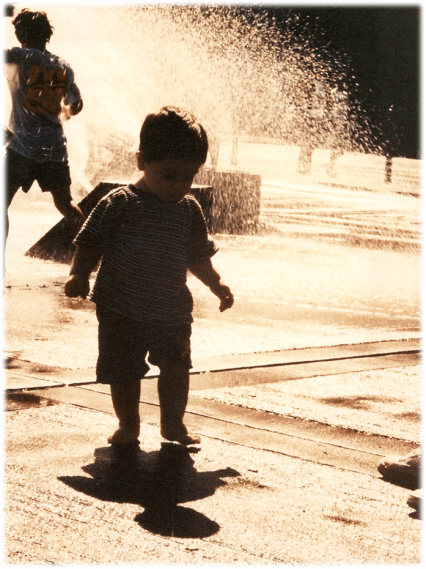
Inspired by my beautiful son (who’ll be turning 20 years old in June!), “Matthew in the Fountain” appears in my new chapbook, This Being Done — a culmination of years of work, and featuring Matthew’s gorgeous photo (below) on the cover — available for preorder purchase NOW and for the next 10 days from Finishing Line Press:
This Being Done,by Stephanie L. Harper
This Being Done is scheduled for June 2018 release, but please consider ordering your copy before the April 27, 2018preorder deadline, as my print-run will depend on the number of copies ordered during the preorder sales period. Your timely support will be crucial to my book’s successful release, and means more to me than I could ever hope to express!


1 (reflection)
Six iterations, alike but lessened in sequence, and always in pairs:
front and back, oblique, the two mirrors becoming four, then six.
A perfect mirror reflects and neither transmits nor absorbs light.
Tilting my chin, I accept reflectance according to its distribution.
Retina as transducer, producing neural impulses.
The images consume no space but the effect is of distance.
Vision is not simply the retina’s translation
but counts inference and assumption among its influences.
The sum and product of its parts: 1 + 2 + 3, or, 1 x 2 x 3.
Angles achieve distinctions apparent at each adjustment.
Turning slightly, I detect movement in each replica.
A six-door cubic cage depicting the bondage of sense and elements.
It is possible to withdraw from this frame.
2 (answers)
Does the weaker eye perceive less.
Who conceals the shadow’s death.
Is a distal truth a lie or merely implication.
How do you rid the mirror of its ghosts.
What resonates in the echo’s decline.
Did the light switch subvert the blackened image.
Apparition, projection or visual representation.
When do waves not disturb.
At what point does belief transmute sight.
What fixes the mirror’s image.
Who closed his eyes and saw light.
3 (prosopagnosia)
I sip coffee and gaze out the second-floor window.
More light enters my neighbor’s office than mine.
Calculate the difference between illumination and glare.
Looking ahead, I claim no face and recognize no one.
The eye converts a signal from one form of energy to another.
Accepting light from external objects, I perceive reflection as the true arbiter.
The dissected path impairs transduction.
Face as identifier: to make, to do.
Translation: imperfection: diminishment.
Blink.
* * *
“At Work I Stand Observing My Diminished Self” was published in Posit in October 2017.

 O at the Edges