What Are You Going To Do?


What Are You Going To Do (Cento)

Not everything can be set to music,
you have to understand that.

If I went to the end of the street,
would I be at the center of myself?

Now ends. Now begins.
Still, we sing the same songs;

we live in the sound – no love
of miracle or numbers helps.

I wonder if my body
is outline. A far point rendezvous.

A smoke plume taken, but not
into a hot, dark mouth.

Or perhaps it never had a name.
Bruising’s not the end of it.

* * *

Credits: Maggie Smith, Michael Chitwood, Carol Frost, CM Burroughs, Aimee Nezhukumatathil, Dan Beachy-Quick, Willis Barnstone, Lauren Camp, Ruth Ellen Kocher, Maggie Smith, Lawrence Raab, Natasha Saje.

“What Are You Going To Do” was drafted during the August 2016 Tupelo 30-30 challenge, and was published in the February 2017 issue of Taos Journal of International Poetry & Art.

A Brief History of Edges

map


A Brief History of Edges

This road leads nowhere. I live at its end where breezes
wilt and the sun still burns my darkened skin.

I’ve sailed to Oman, but have never seen the Dakotas.
My friend searches for the concealed parable in this truth.

An early clay map depicted Babylon surrounded by a bitter river,
and an island named the sun is hidden and nothing can be seen.

Fitting the limitless within boundaries, she remembers no one.
The lighted sign says boots, but I see books.

Venturing from the shadows, she offers an accord: intersecting borders,
we must retain ourselves, deliver what calls
.

In our place between the hidden and the invisible, consider
that neon gas possesses neither color nor odor.

What lives in creases and at the periphery? The isle called beyond
the flight of birds
has crumbled from the lower edge.

Where I stand defines my portion of the spherical earth.
Crossing lines, I look to the sky, its bisected clouds.

mapman

“A Brief History of Edges” first appeared here in April 2016.

Which Poet, Which Beer?

file6671234665917

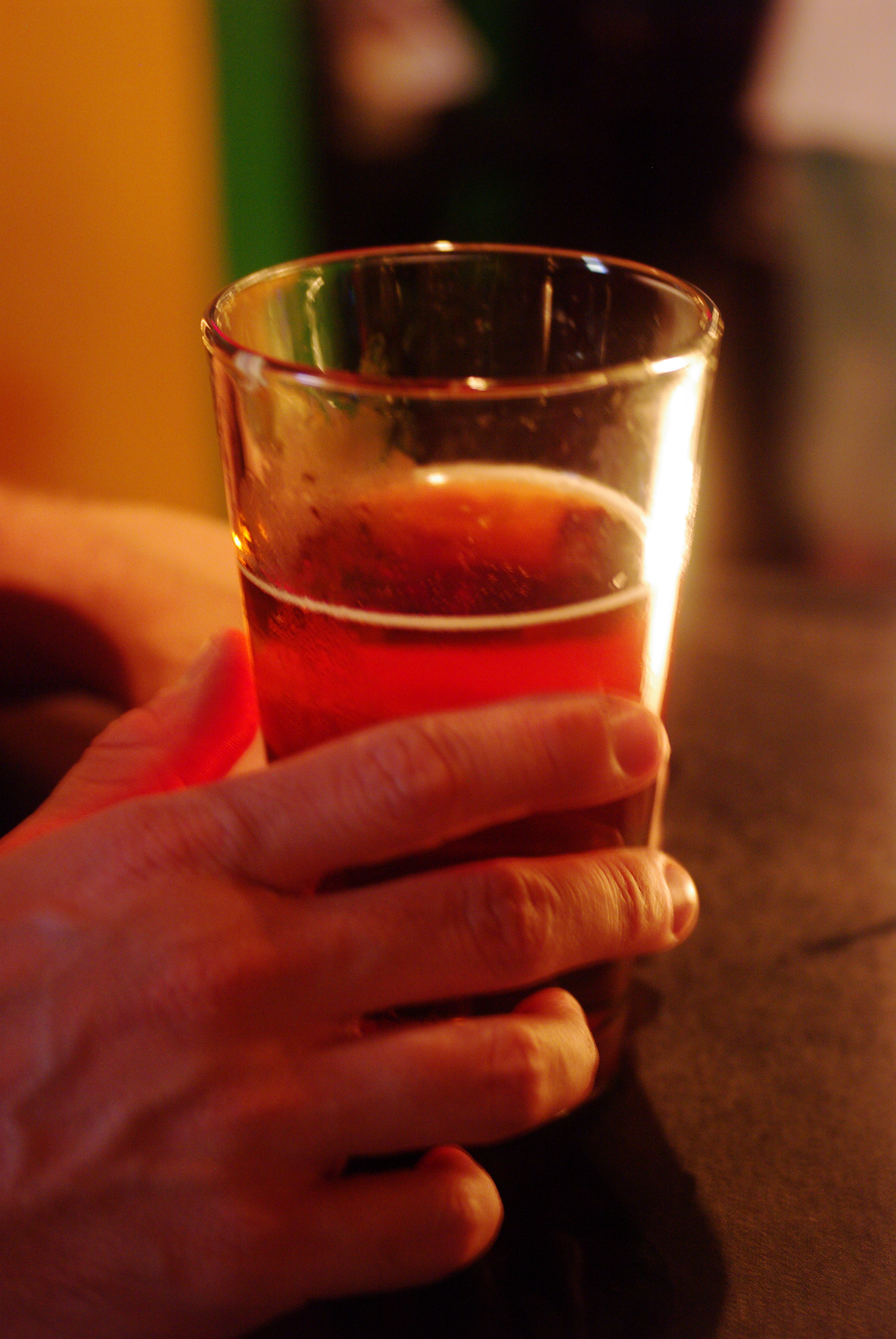
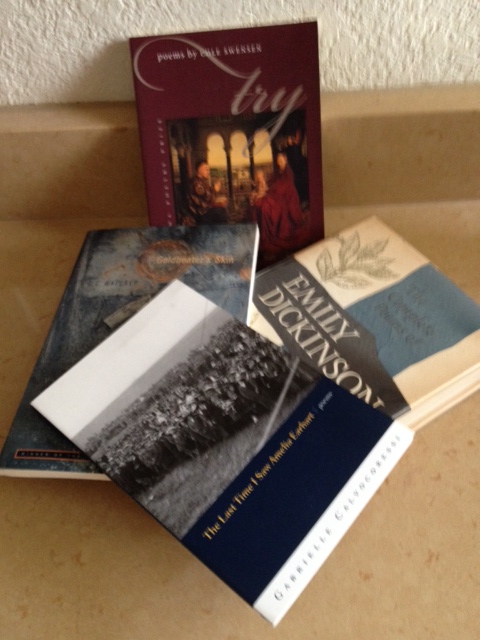
I’m staring at the flight of beers that Jon has placed in front of me. On the left I find Real Ale Brewing Company’s Phoenixx Double ESB. Next to it rests Ranger Creek’s Saison Oscura, followed by Revolver Brewing’s High Brass Golden Ale, and finally, Southern Tier Brewing’s Creme Brulee Stout. I sip the Phoenixx ESB, and am delighted to find it just as I remembered: dry, but sweet, without being overly bitter. Rich, deceptive, caramely odor, amber color. Overtones, hidden layers. I immediately think of Cole Swensen and her book Try, my real introduction to her work, how she reflects tone and imagery, perception and language, intricately weaving them into patterns, into narrative bits to be experienced and savored. “There’s a world out there that isn’t there,” the Phoenixx, evidently a fan of Cole Swensen, whispers.

I linger over the last sip of the ESB, and move on to the Saison Oscura, which quite frankly, surprises me. And that’s good. My preferences edge towards the bitter, and most of the saisons I’ve tried have finished a tad fruity and sweet for my palate. Not so with Ranger Creek’s rendition. Its beguiling light body, with notes of pepper and spice, end with just the right note of bitterness. But which poet, which book would I pair with this dark saison? Someone who juggles the lyrical with harsh realism, whose voice blends and releases the bitter, the forsaken, in distilled snippets of striking clarity. Ah, yes. I have just the book, The Last Time I Saw Amelia Earhart, by Gabrielle Calvocoressi, and the line:

The whole world tastes like salt,

crows overhead shout, Gone, gone
gone. She can’t help me any more.
I’ll have to walk.

It’s much more difficult to pair the Revolver Brewing High Brass Golden Ale with a favorite poet, because, sadly, I find it lacking. It’s light in the mouth, and, to take Gertrude’s quote totally out of context, there is no there there. If I’m to choose a blonde ale, I’d much prefer Real Ale Brewing’s Fireman’s #4. But waste not, want not. I down it, and consider which poet would not only transcend this disappointment, but also hand it a one-way ticket to, perhaps, Stein’s lost Oakland? Easy. G.C. Waldrep, whose Goldbeater’s Skin sets its barbed hooks into my flesh each time I open it. And for this particular occasion, I find no poem more appropriately titled than “What Begins Bitterly Becomes Another Love Poem,” in which he writes:

We stood without shadows on asphalt at midday.
What we call patience is only fire again, compressed.

And fire should accompany Southern Tier’s Creme Brulee Stout. A crackling fire fending off the icy, shingle-ripping wind, with Miles Davis echoing in the background, an exquisite meal resting comfortably in the belly, and the pleasure of knowing that the book you’re about to dip into is an endless well. Quite simply, it’s a liquid dessert. Light coffee, a tad chocolatey, with big vanilla. Medium body, sweet. Smells like creme brulee. Tastes like it. But it’s beer. It tells the truth, but tells it slant! And who better to accompany this frothy delight than Emily Dickinson?

Tell all the truth but tell it slant,
Success in circuit lies,
Too bright for our infirm delight
The truth’s superb surprise…

Onward to the next flight, and more truth. More poetry. More beer. More surprise!

photo(14)

This last appeared on the blog in November 2015.

Agave

photo(2)

Agave

It might deceive.
Or like a cruel

window, live its life
unopened,

offering a view
yet reserving the taste

for another’s
tongue, ignoring

even the wind.
The roots, as always, look down.

* * *

This first appeared in Ijagun Poetry Journal in December 2013, was featured in poems2go in April 2016, and is also included in my micro-chapbook, You Break What Falls, available for download from the Origami Poems Project: http://www.origamipoems.com/poets/236-robert-okaji

image

Galveston, 1900

file901235706072

Galveston, 1900

First the wind, then a tide like no other
uprooting the calm,

a visage tilted back in descent
as if listening for the aftermath.

And later, the gardener’s lament
and the building’s exposed ribs,

light entering the eternal
orchard, nine children tied to a cincture.

Not even the earth could retain its bodies,
and the sea remanded those given to its care.

file0001863093325

“Galveston, 1900” first appeared here in January 2015.

Kites

string

Kites

Will viewpoint shift with my spine’s slow
compression, or will this

window admit only true images
in the shortened days to come?

I pencil phrases on bone-shaped kites
and release them to the afternoon.

Call them prayers, name them moans.
Each string is a regret freed, a separate

skeleton, let go. My two selves shudder
in the attempt. I await the perfect breeze.

OLYMPUS DIGITAL CAMERA

“Kites” first appeared here in July 2016.

Nocturne (Blue Grosbeak)

file0001285095497

Nocturne (Blue Grosbeak)

Why tremble
when nothing
arrives to be seen?

The architecture
of the day
comes and goes

in the same
heartbeat,
a disturbance

more felt than heard.
But listen.
The grosbeak sings

his presence
and departs,
leaving behind

the echo
of a motion
blending with night.

The air is cool.
A leaf utters
its own message

and falls
unnoticed.
Nothing awaits it.

* * *

This last appeared in November  2016.

file8891250781951

Scarecrow Dreams

Scarecrow Dreams

If by night I move without aid,
what then? Precious flesh, precious
bone, never mine to lose – the difference
between nothingness and no thing. A
pity that my friends fly at the merest
movement, but when the air’s breath
stills, they sing and rattle among the
grain, scribing their days in song
and footprints, seeking the available
on the ground. And what scrolls lower
than the sound of sunflowers turning?
The laughing daughter runs around
my lattice spine, scattering joy like so
many seeds, and when my hollow
fingers clench, the earth quivers, or
so it seems. Then midnight returns
and I disengage and stalk about,
scaring rodents and their predators,
hooting in harmony with the owls
reveling in the night air, remembering
the holy shirt, a yellow glove, corn
silk’s gleam at noon and the warmth
of your fingers against my burlap skin.
I do not breathe, I say, but I exist. By
morning what joins me but the tune
of yet another bird, unseen, melodious,
the pulse of morning’s dew. Eternity.
How my straw tongue longs to sip it.

“Scarecrow Dreams” first appeared in the summer 2017 edition of Eclectica. Many thanks to poetry editor Jen Finstrom, for publishing several of my scarecrow poems.

Memory and Closets


Memory and Closets

1

She came with the house.
A skull, spinal column, ribcage, tibia,

scapula – the list goes on, not quite to 206,
even including an extra lumbar vertebra.

Edna (long story) attended Halloween parties
and convivial gatherings, dressed in finery.

Silk suited her best, with linen falling just
behind. And hats! That green fedora,

like a parrot perched on a smiling egg,
never spoke, but stirred the conversation.

2

Old boots, worn left heel explaining the damaged meniscus.
Portable record player. Scratched vinyl.
Shopping bag of VHS tapes. Two empty scotch bottles.
The 30-year old suit that hasn’t been worn in 28 years.
Yellowed newspaper clippings of diet recipes.
The lost carton of wrapping paper.
A cheap guitar case, sans guitar.

3

If memory could speak, what would it not say?

Who else has rubbed this dust across his skin?

Only death is irrevocable.

In this darkness I find you.

Fearing withdrawal, we grow closer.

Things, and more things.

Everything we need travels with us.

Always.

* * *

This was originally drafted during the August 2016 Tupelo Press 30-30 challenge, and subsequently published in Quiet Letter in April 2017. It’s original title, sponsored by Darryl Williams, was “Cleaning Out Closets in Anticipation of Moving Closer to Children.”

Landscape with Jar


Landscape with Jar
(after Wallace Stevens)

What vanishes more readily than the breakable
and transparent? Not here, not now, it says,

never voluble in the morning. I have work.
The horizon exists simply in perception.

Try to touch it – the hill meets the sky
only from afar, offering discordance

up close, no measurement possible.
And among the trees and vines, a glimmer

of spite, twisted open. Moving closer, we see
through. We see rocks, a bird. We see air.

“Landscape with Jar” was first published in Birch Gang Review in July 2017.