Poems in Purifying Wind (a vulture anthology)


I have four poems included in Purifying Wind (available through Amazon), an anthology of pieces about or mentioning vultures. I’m proud to have these poems published alongside those of fellow poets Sudhanshu Chopra, Stephanie L. Harper and Jim LaVilla-Havelin, among others. Thank you, d. ellis phelps, for taking these poems.


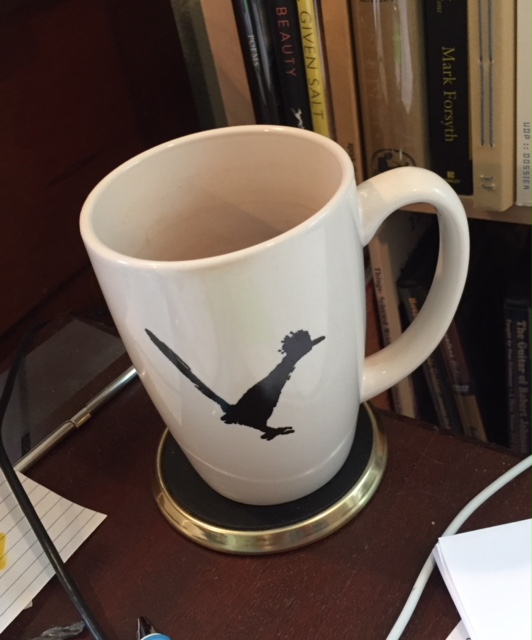
Empty Cup


I wrote this two years ago, a week after my father died. Many of us are mourning today, with more to follow. COVID-19 doesn’t care.


Empty Cup

I set down my cup, pour
tea and think this day, too,
may never end.

With what do we quantify love? How does grief measure us? Nine days ago I wrote “My father is dying and I’m sipping a beer.” More words followed, but I did not write them, choosing instead to let them gather where they would – among the darkening fringe at light’s edge, in that space between the shakuhachi’s notes, in the fragrance of spices toasting in the skillet. In unwept tears. Everywhere. Nowhere.

Seven days ago I wrote “My father is dead.” Again, I chose to let the unwritten words gather and linger, allowing them to spread in their own time, attaching themselves to one another, long chains of emptiness dragging through the days.

If experience reflects truth, sorrow’s scroll will unravel slowly for me, and will never stop. I feel it beginning to quiver, but only the tiniest edge emerges. I am nothing, I say. I am voice, I am loss, I am name. I am memory. I am son.

I have fifty-nine years
and no wisdom to show for it.
Never enough. Too much.


* * *


Tell it Slant: How to Write a Wise Poem, essay by Camille Dungy

OLYMPUS DIGITAL CAMERA


Few essays on writing poetry grab me by the collar, slam me against the wall, and say “Listen, dammit!” But this one did.

Camille Dungy’s words sear through the fog. She tells it slant. She tells it true. She explains how some masters have done it. If you’ve not read her poetry, seek it out. You’re in for a treat. If you have the good fortune to attend a lecture or reading by her, do so. She’s energetic, wise and kind. She knows.

http://www.poetryfoundation.org/article/247926

FIrst posted here in 2014..


Thirty-Five Years Later, I Raise My Hand

Thirty-Five Years Later, I Raise My Hand

In spring 1983 I enrolled in a poetry writing course thinking it might help improve my short fiction. I was a history major by default, had never taken a course in poetry, but believed, with absolutely no evidence, that I could write fiction. At the time I would have been hard-pressed to name five contemporary poets, even counting my professor. To be honest, the class struggled to hold my attention. Only about a quarter of the students seemed interested in writing, and the instructor was a bit, uh, tired. But for the first time in my life I read, really read, poetry. I fell in love with Galway Kinnell, Ai, James Wright and Carolyn Forche, to name just a few of my early enthusiasms. I wanted to write like them. So I wrote. And wrote. And wrote. Most of it was laughably bad, but somehow I managed to win an undergraduate poetry contest, which suggested that hope existed. Maybe someday, I thought, one of my poems will be published. This radical idea had never occurred to me before. Publication seemed to be the privilege of special people, and a lifetime of gathered fact revealed that I was unequivocably nothing special.

Early on in the semester, perhaps even in the first class, the professor asked how many of us thought we’d still be writing poetry in twenty years. I didn’t raise my hand. I didn’t know where I’d be in six months, much less what I’d be doing in twenty years. Since I’d realized late in the game that teaching was not for me, I had no job prospects, and few marketable skills, despite experience in chugging beer, manning sound-powered phones on a ship’s helicopter tower, scraping barnacles and bending rules. The world was limited. The world was limitless.

Another gray day

dividing the old and young

Oh, this aching hip!


* * *

A song from that time:


Ghost, with a Line from Porchia


Ghost, with a Line from Porchia

In my dreams you manifest in a younger form.

If I were to give you life, what could I give you?

Your hands never touched these walls, yet you inhabit them.

As my language inters you, I am absorbed in yours.

Some gifts are simply not proffered, others are released.

My fingers retrace your name in both sun and shade.

The rain taps out regrets, regrets on the metal roof.

Dim spirit, faint soul. Root-land. Shoal. Mother.

Each visit signals the darkness waiting.

Your battle with language, with silence, invoked.

I stretch the word and weave this dirge for you.


* * *

Note: “If I were to give you life, what could I give you?is from Antonio Porchia’s Voices, translated by W.S. Merwin.

“Ghost, with a Line from Porchia” first appeared in Underfoot in October 2017.

Palinode (Hands, Hours, Light)

xhand

P A L I N O D E ( H A N D S , H O U R S , L I G H T)

Consider the hand, its breadth, its history in mathematics and limitation. 27 bones, two strokes. Distal phalanges spanning gaps.  You turn and wave at the winnowed tunnel and the drops feathering the glass. The sinister endures tasks of life; right blesses power and assuages guilt. Presuming inflection, I use both hands to tally the absent. Later as we drive through the checkpoint, our way greased by fluency in the language of coin, heaven’s oblique arch recedes and I praise the passage of hours.

I praise the passage of hours measured in terms unknown to some: beyond two, many. Returning, we see streets guided by lampposts, bent trees and the uneven drizzle of sidewalk mendicants blurring through their days. A hanged man’s dessicated hand (pickled in salt and the urine of man, woman, dog and mare) forms the Hand of Glory, unlocking any portal the bearer desires opened: a direct tool of consciousness. Lacking the fat of a gibbeted felon, I cannot properly light the way.

I cannot properly light the way, but we  observe facets in differing terms: the hand, lips, and mouth claim more neural innervation than the rest of the body combined, perhaps a consequence of the primacy of making and sounding. Candles smolder and yield to shadow through dancing hand stories. The wave of acknowledgment, a finger across the lips, the open hand proclaiming innocence, expressing, grasping, creating, constraining, releasing. Extinguishing.

* * *

This first appeared in Hermeneutic Chaos, Issue 11.


OLYMPUS DIGITAL CAMERA


Palinode (salt, mask, descent)

mask


Palinode (salt, mask, descent)

Tracing the map to the swaying places, she rises
through the interior world, garnering peace by
syllable. Water, clouds and sand mark her ascent.
The expectation is return, renewal. My friend did not
awaken this morning, and tonight I praise her
passage with drink and song. Matter into spirit,
mountain into sky, redemption, freedom. We bathe in
light, reclaiming the liminal. Our tears evaporate,
leaving salt and untrod paths in our wake.

The paths in our wake delimit the future, but
everything falls. Which do we desire more, the grasp
or its release? That instant preceding fear defines a
yearning particular to its course, a cycle of regression
and progress: ancestors descend into human or
animal form, die, depart to the heavens, and return
anew. Distilled power, a bridge to the spirits, the
mask unshutters and conceals the conscious mind.
Opening my eyes, I release the sun.

I release the sun and observe the results. From sky
to soil, from above to below, to solidity. Spirit
acquires matter, disperses and regroups. Rain and
alluvion, flooded homes, the dark night of childish
laughter. Each to her own path, each to an end. Muting
the string, I touch the harmonic into the world, linking
civility to proportion, lowering dissonance. Everything
falls. Everything. From curve to angle, we resist and
rejoice. In this design parabola, she descends.


* * *

“Palinode (salt, mask, descent)” was first published in Otoliths in slightly different form, and is included in my chapbook, I Have a Bird to Whistle (7 Palinodes).

ascent


Fossil Egg


Fossil Egg
The secrets that contain you.

Like what fills
the center of the fossil egg,

a never-developed
word or the crimson bud wormed black.

Repetition lends force to lies but can’t create truth.
The halogen bulb remains dark without electricity
even in the light of day.

But how to enter that space?

The yolk hardened to stone.
A man’s forgotten name.
The unmentioned flower.

Every day looming in possibility.

***

Fossil Egg first appeared in September 2019 at Recenter Press. Many thanks to the editors for taking these pieces.


Self-Portrait as Smudge


Self-Portrait as Smudge

Being this cloud on the otherwise
transparent pane, I resist removal,
smearing myself in thinner layers,
still shrouding the angry sky
or the fence post’s sagging
doubt, which is to say
my appearance may lessen
but spread, that you may rub me
out, but I’ll return, always,
beginning with that one small
and delicious obscure point.


“Self-Portrait as Smudge” first appeared in October 2019 in Backchannels. Many thanks to the editors for taking this piece.


The Body Gives (with recording)


The Body Gives

Sometimes the body gives too much.
A tendon frays, the heart mumbles
and no one sees the damaged parts.

Ignoring pain, we continue climbing ladders,
sandpaper breath rasping the morning light.

Little bits of us crumble all the time,
yet we stumble on, pretending.

Then the body kills us with its enthusiasm.

Cells duplicate wildly, plaque explodes.
This enmity within? Defensive maneuvers.

Working alone, I wonder where I might end.

On the floor. In a field. Atop the bed.
Under the surface of a rippling pond
or drifting with smoke

through a snow-clad afternoon
at eight thousand feet. Among
the grocery’s tomatoes and squash
approaching the end of a long list.

At the bar, glass in hand, or in a truck
at a four-way stop, the radio blaring.

Time enough for speculation, they say.
But I wonder: when I jump,

does the earth always rise to greet me?


* * * *

“The Body Gives” first appeared in The New Reader Magazine, in March 2018.