Awakened, He Turns to the Wall (Cento), with Recording

cell


Awakened, He Turns to the Wall (Cento) 

Then, everything slept.
Where were you before the day?

You see here the influence of inference,
whereby things might be seen in another light,

as if the trees were not indifferent, as if
a hand had suddenly erased a huge

blackboard, only, I thought there was
something even if I call it nothing,

like the river stretching out on its
deathbed. No one jumps off.

* * *

A cento is composed of lines from poems by other poets. This originated from pieces by: Larry Levis, Jacques Roubaud, Lorine Niedecker, Gustaf Sobin, Denise Levertov, Elizabeth Spires, William Bronk, Vicente Huidobro, Ingebord Bachmann

For further information and examples of the form, you might peruse the Academy of American Poets site: http://www.poets.org/poetsorg/text/poetic-form-cento

erase

This last appeared here in March 2017.

Onions

image

Onions

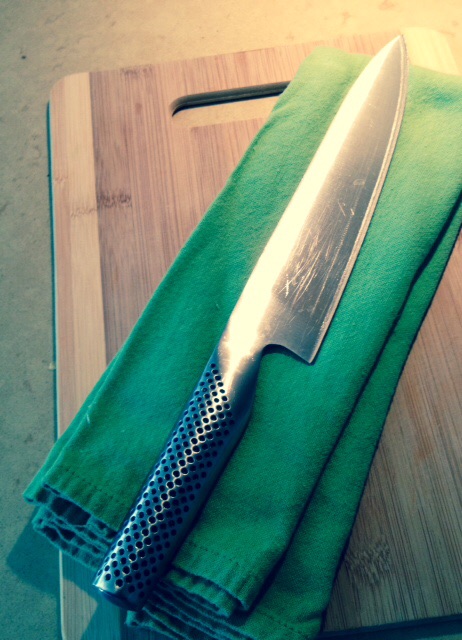
My knife never sings but hums instead when withdrawn from its block, a metallic whisper so modest only the wielder may hear it. Or perhaps the dog, who seems to enjoy the kitchen nearly as much as I. A Japanese blade, it’s a joy to hold, perfectly balanced, stainless steel-molybdenum alloy, blade and handle of one piece, bright, untarnished, and so sharp as to slide through, rather than awkwardly rupture and divide, its next task on the board.

We’ve never counted the chopped and rendered onions, the fine dice, slender rings and discarded skins, but if we could gather all the corpses we’ve produced together over the years, we’d form a monument to our work, cooperation of metal and man, a Waterloo mound in memory of the bulbs laid there, the planning involved, the missteps and serendipity, and the tears shed along the way.

The blade doesn’t care. It is. It works. It moves things, it lifts, it parts them, and in return is cleansed, and later, in the quiet room, maintains its edge with a silvery rasp, angled steel on steel in a circular motion, over and over, until finally it hums its way back into the block. But it never sings.

image

“Onions” last appeared here in October 2017. Hmm. This reminds me that I need to sharpen knives…

Recording of “The Draft”


The Draft

All memories ignite, he says, recalling
the odor of accelerants and charred

friends. Yesterday I walked to the sea
and looking into its deep crush

sensed something unseen washing
out, between tides and a shell-cut foot,

sand and the gull’s drift, or the early names
I assign to faces. This is not sadness.

Somewhere the called numbers meet.

“The Draft” first appeared in Taos Journal of International Poetry & Art.

Dictionary of Dreams

Dictionary of Dreams

You do not know their secret names.
Mine is the music of metal and wood.

Human voices behind walls.
Trapped in reds, in chiseled words.

And silence. Always silence.
Or the filtered woodwinds at dawn.

How to describe her body?
The quickness of night. Year’s demise.

A family of ghosts hidden in these halls.

“Dictionary of Dreams” was published in Kingdoms in the Wild in April 2018.

Something Lost, Something Trivial

broom

Something Lost, Something Trivial

Another word, another bewildered
moment in transition: the phrase
barely emerges from your mouth
before crumbling back into a half-opened
drawer in the loneliest room of a house
that died seventeen years ago.

I nod as if in understanding, and stoop
to pick up a crushed drinking straw,
the kind with the accordion elbow
that facilitates adjustment.

From a rooftop across the street,
a mockingbird warbles his
early morning medley of unrelated
songs, and you say left oblique,
followed by matches, then
collapse on a bench,
winded. I sit next to you

and we both enjoy the warmth
and birdsong, though I know
this only through the uplifted
corner of your mouth, which
these days is how you indicate
either deep pleasure or

fear. I have to leave soon,
I say, and you grab my wrist
and stare into my eyes.
Broom, you reply. And more
emphatically, Broom!

Though I cannot follow you
directly, knowing both path
and destination, I pick my way
carefully through the years
stacked high like cardboard
banker’s boxes stuffed with
papers and receipts no one
will ever see. I know, I say.
I love you, too. Broom.

* * *

“Something Lost, Something Trivial” was published in January 2016 in the first issue of MockingHeart Review. Many thanks to editor Clare L. Martin, for her multiple kindnesses. I am reading with Clare and Bessie Senette on Saturday, October 20, at 7:00 p.m. at Malvern Books in Austin.

Nocturne with a Line after Kees

country

Nocturne with a Line after Kees

I close my eyes and see nothing but rain.
And after, take pity

for what turns beyond sight: the wretched
flower, a hiss from the road. Last night the wind
stole sleep from my body,

leaving me alone, wordless, listening
for her next breath. An alchemist,

I transmute the memories of old wounds laid open.

*****

This first appeared in Ijagun Poetry Journal, in December 2013.

Antique pharmacy

Recording of “Self-Portrait with Umeboshi”

file0001818876295(1)

Self-Portrait with Umeboshi

Our resemblance strengthens each day.

Reddened by sun and shiso,
seasoned with salt,

we preside, finding
comfort in failure. Or does
the subjugation of one’s flavor for another’s

define defeat? The bitter, the sour, the sweet
attract and repel

like lovers separated by distances
too subtle to see.
Filling space becomes the end.
What do you learn when you look through the glass?

Knowing my fate, I say fallen. I say earth.

Ah, simplicity! When I was a child my mother would occasionally serve rice balls in which a single mouth-puckering umeboshi rested at the center. These have long been a favorite, but I admit that umeboshi might be an acquired taste. Commonly called “pickled plums,” ume aren’t really plums but are more closely related to apricots. I cherish them.

“Self-Portrait with Umeboshi” first appeared in the Silver Birch Press Self-Portrait Series (August 2014), was included in the subsequent print anthology, Self-Portrait Poetry Collection, and also appears in my chapbook, If Your Matter Could Reform.

file0001977442406

Music: “Senbazuru” Kevin MacLeod (incompetech.com)
Licensed under Creative Commons: By Attribution 3.0 License
http://creativecommons.org/licenses/by/3.0/

The Geography of Silence

laundry

The Geography of Silence

1. Laundry drooping at midday.

2. She dreams off-key, in pastels.

3. With misunderstanding comes anger.

4. Mata! Mata! Again!

5.  Ashes crossing the ocean.

6.  Sweat, and the taste of separation.

7.  Reaching for past moons, she cries.

8.  Death’s shade.

9.  Rice.

10.  Self-sacrifice, the centered gift.

11. Inward, always. Inward.

telescope map

“The Geography of Silence” last appeared here in April 2017.

The Body Gives


The Body Gives

Sometimes the body gives too much.
A tendon frays, the heart mumbles
and no one sees the damaged parts.

Ignoring pain, we continue climbing ladders,
sandpaper breath rasping the morning light.

Little bits of us crumble all the time,
yet we stumble on, pretending.

Then the body kills us with its enthusiasm.

Cells duplicate wildly, plaque explodes.
This enmity within? Defensive maneuvers.

Working alone, I wonder where I might end.

On the floor. In a field. Atop the bed.
Under the surface of a rippling pond
or drifting with smoke

through a snow-clad afternoon
at eight thousand feet. Among
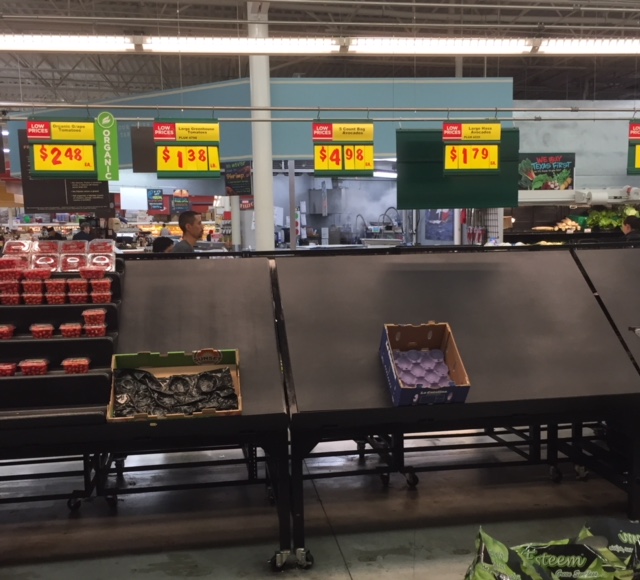
the grocery’s tomatoes and squash
approaching the end of a long list.

At the bar, glass in hand, or in a truck
at a four-way stop, the radio blaring.

Time enough for speculation, they say.
But I wonder: when I jump,

does the earth always rise to greet me?

“The Body Gives” first appeared in The New Reader Magazine, in March 2018.

3 Poems Up at Right Hand Pointing

My poems “Self-Portrait as Hoot Owl,” “The Shadow Behind You” and “Self-Portrait as Compost” have been published in Issue 125 of Right Hand PointingThank you to editors Dale Wisely, Laura M. Kaminski, F. John Sharp and José Angel Araguz for taking this trio.