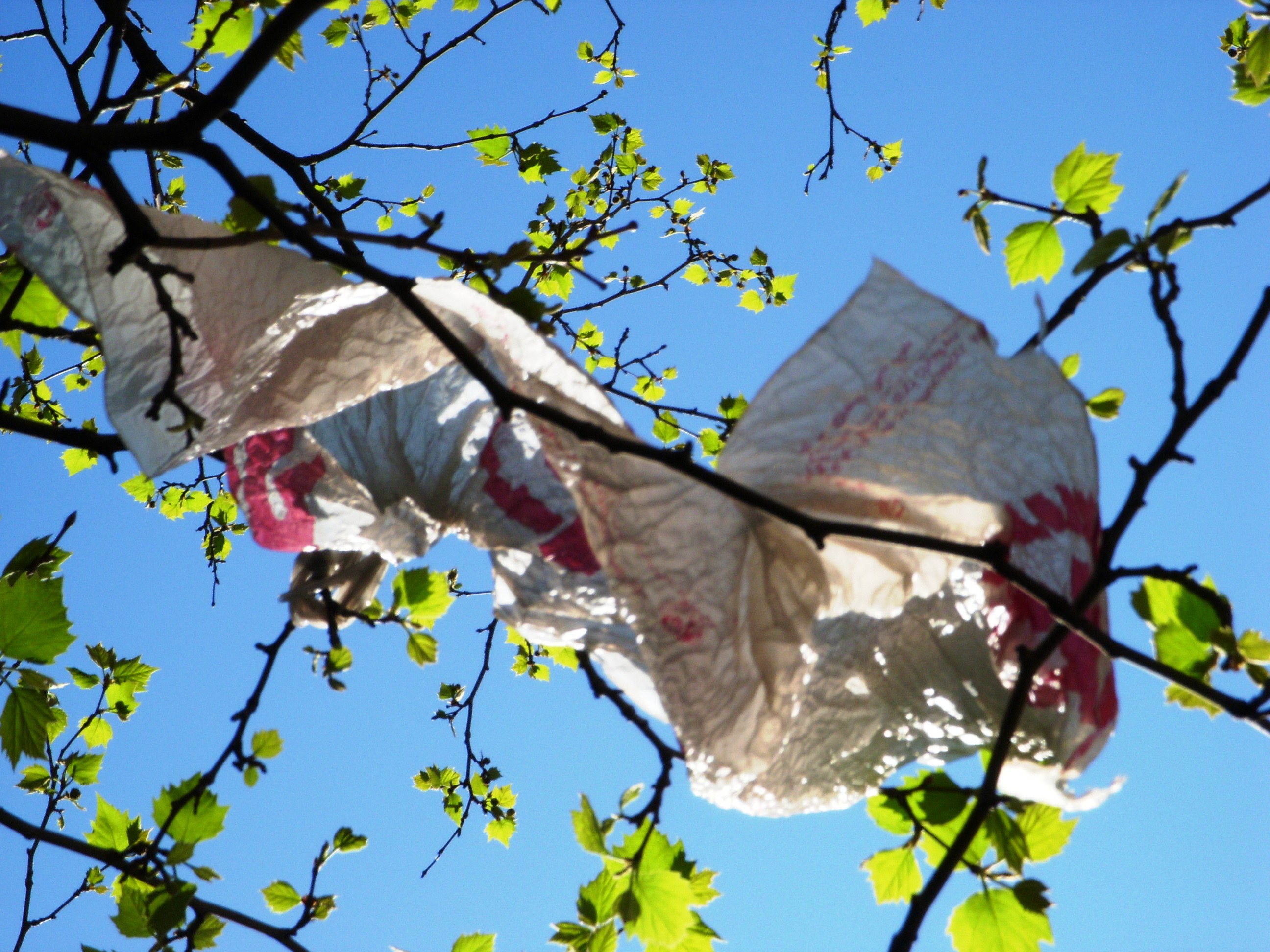
Driving without Radio

trash-in-tree


Driving without Radio

One minute you’re sipping coffee at the stoplight,
and the next you find yourself six miles

down the road, wondering how you got there,
just two exits before the French bakery

and your favorite weekday breakfast taco stand.
Or while pondering the life of mud,

you almost stomp the brakes when a 40-year old
memory oozes in — two weeks before Thanksgiving,

the windshield icing over (inside), while most definitely
not watching the drive-in movie in Junction City, Kansas,

her warm sighs on your neck and ear, and the art
of opening cheap wine with a hairbrush. How many

construction barrels must one dodge to conjure these
delights, unsought and long misfiled? You turn right

on 29th Street and just for a moment think you’ve seen
an old friend, looking as he did before he died,

but better, and happier, and of course it’s just a trash bag
caught in a plum tree, waving hello, waving goodbye.


“Driving without Radio” was published at Split Rock Review in November 2016. Many thanks to editor Crystal Gibbins for providing a home for this one.
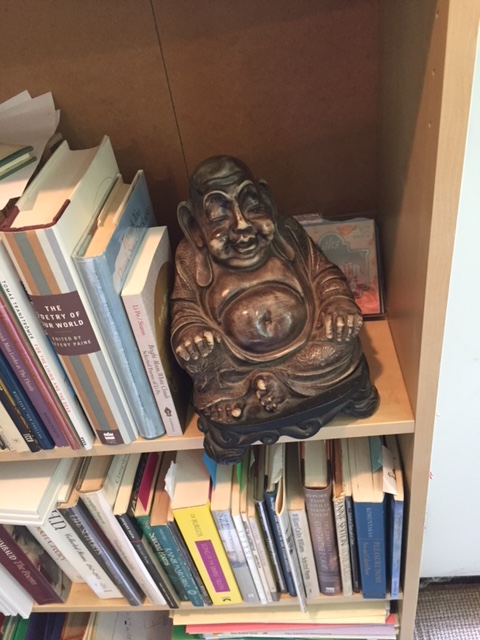
 

Buddha’s Not Talking


Buddha’s Not Talking


He looks out from the shelf while I consider
manure, sharp knives and the hagfish’s second
heart, or whether odors differ in texture when a dog

retraces his steps through the park, and do they really
lose themselves or just quickly shed their pasts,
forever moving towards now. Sometimes I say hello,

but truthfully we seldom interact, unless I bump his
shoulder when retrieving one of the books leaning
against him, and then it’s only a quick “sorry” on my

part, and a stare on his, perhaps a slight nod if
I’ve not yet had coffee. I fear I’ll never grasp
the difference in having and being, that my true

nature has splattered on a trail and the dogs will
sniff it and lift their legs in acknowledgment,
or perhaps acceptance of the infinite, with wisdom

far beyond my reach, before moving on to disquisitions
about soil and fragrance and the need to justify art
with decimal points. Yesterday I roasted chicken, moved

books, sipped ale. Today I’ll sweep, discard papers and
wonder if I’ll become what I think, whether reincarnation
will be cruel or kind. Either way, Buddha’s not talking.


* * *

“Buddha’s Not Talking” first appeared in July 2017 at Blue Bonnet Review.
With gratitude to editor Cristina Del Canto for taking this piece.

Tuning the Beast


Tuning the Beast

I prepare contingencies for all outcomes. No.
I’ve prepared for this: a body. A key. As if

that cloth draped a leg. Not a leg
but the representation of a limb.

Another fragment, brought forth and opened.
Not a limb, an arrow, perhaps, pointing to the sea.

An oar, brought inland and unrecognized
for its purpose, directed or aimless. No, not an oar.

A neck, polished, and a chamber, with strings.
Repetition, fixation. Position. Intent.

I pluck and strum, pick and stroke, maintaining
space, steel above wood, bending notes,

moving sound in time, purposefully, from
this place to that, the left hand, creating,

conversing. The right, reasoning, controlling,
burning its past to the present, allowing,

preventing, rendering beat, consistent
motion, shaping only this moment, this now.


“Tuning the Beast” was drafted during the August 2015 Tupelo Press 30-30 Challenge, thanks to Sunshine Jansen’s sponsorship. It subsequently appeared in The Blue Nib in September 2016.


Apricot Wood (with recording)

clouds


Apricot Wood

I built a frame of apricot
wood. This was for you. The clouds float
through it even as I sleep. You wrote
once of wild herbs gathered and brought
to a lovely girl, an offering not
of passion but of some remote
desire to hear a word from the throat
of the Lord Within Clouds. I thought
of this as I chiseled the wood.
Last night it rained. I listened to
it from my bed by the open
window, hoping that the clouds would
not leave. This morning two birds flew
by. It is raining again.


file8641239202119


Originally penned in the 1980s, “Apricot Wood,” is included in my 2015 chapbook, If Your Matter Could Reform. It was first published in 1986, in SPSM&H, a publication devoted to sonnets, and was featured on Autumn Sky Poetry Daily in March 2015. It’s interesting to look at my writing from this period. Some pieces seem to have been written by a stranger, long ago and far, far away. This one somehow seems closer. 


A Brief History of Babel

image


A Brief History of Babel


Borders, windows.
Sound.

Trudging up the steps, I am winded after six flights,
my words smothered in the breathing.

The Gate of God proffers no favors.
When the spirit gives me utterance, what shall I say?

Curiously, no direct link exists between Babel and babble.

A collective aphasia could explain the disruption. One’s
inability to mouth the proper word, another’s
fluency impeded by context.

A stairway terminating in clouds.

Syllable by twisted syllable, dispersed.

Separated in symbols.
And then,
writing.

To see the sunrise from behind a tree, you must face
east: higashi, or, a discrete way of seeing
the structure of language unfold.
Two characters, layered. One
thought. Direction.
Connotation. The sun’s
ascent viewed through branches
as through the frame
of a glassless
window.

Complexity in simplicity.
Or the opposite.

I have no desire to touch heaven, but my tongues reach where they will.

Who can know what we say to God, but God?

And the breeze winding through, carrying fragments.


* * *


My poem, “A Brief History of Babel,” was drafted during the August 2015 Tupelo Press 30-30 challenge, and was subsequently published at Bonnie McClellan’s International Poetry Month celebration in February 2017.


My Mother’s Ghost Scrubs the Floor at 2 a.m.


My Mother’s Ghost Scrubs the Floor at 2 a.m.

Even in death she scraps the easy path, choosing thorns and rocks
over blossoms and a groomed walkway. On hands and knees,
scouring the floor with ghost water and a scrub brush made of ancient

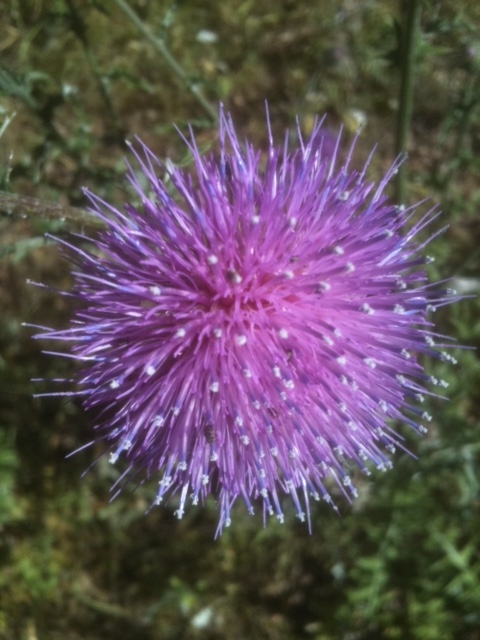
thistles, her pale figure flares yellow in the kitchen. Mom, you don’t
have to do this, I say. You’re dead, and besides, I have a swiffer
in the garage. I can almost hear her humming a Ray Charles

song from an album back in the sixties, and I notice that the water
in the transparent bucket remains clear and at the same level no matter
how often she dips into it. What do you say to one who never replies?

We’ve long splashed through that puddle of contention, and though
wary of repetition’s erosive qualities, I resort to ritual, drop a piece of
kombu into a pot of water, bring it to a boil, remove it from the heat,

sift in a handful of dried bonito flakes and a few drops of soy sauce,
stirring it a few times. Then I strain the liquid, spoon in some miso,
add chopped green onion and a few cubes of tofu. I ladle this into two

black and red laquer bowls and set them on opposite sides of the table.
Hours later, the glow from the kitchen has faded, but I fidget and lie
awake, pain pulsing from hip to knee, and wonder if surgery is impending,

whether I should hire someone to temporarily mow the grass. How do
we reconcile reality with desire, with emotional drought and flood-swollen
creeks and the inability to draw together those things we desire most?

In the morning the floor is still dirty and the soup is where I’d left it,
at the sharp edge separating table from space, another stuttering symbol,
cold and unappetizing, smelling faintly of fish and muddy water.


“My Mother’s Ghost Scrubs the Floor at 2 a.m.” first appeared in The Indianapolis Review, and was subsequently nominated for a Pushcart Prize.


Poems in Purifying Wind (a vulture anthology)


I have four poems included in Purifying Wind (available through Amazon), an anthology of pieces about or mentioning vultures. I’m proud to have these poems published alongside those of fellow poets Sudhanshu Chopra, Stephanie L. Harper and Jim LaVilla-Havelin, among others. Thank you, d. ellis phelps, for taking these poems.


Empty Cup


I wrote this two years ago, a week after my father died. Many of us are mourning today, with more to follow. COVID-19 doesn’t care.


Empty Cup

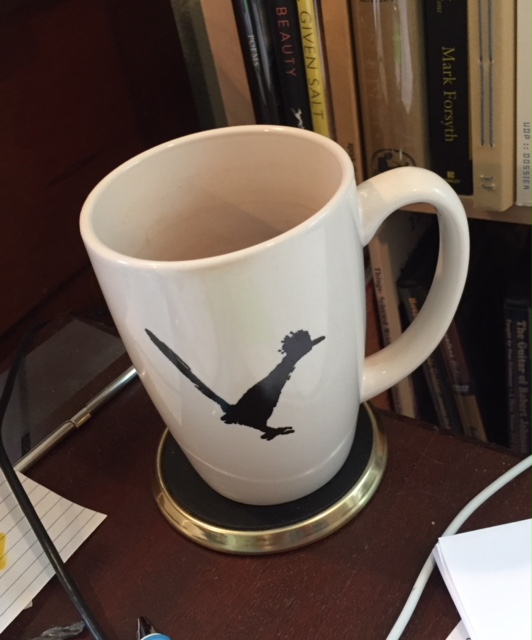
I set down my cup, pour
tea and think this day, too,
may never end.

With what do we quantify love? How does grief measure us? Nine days ago I wrote “My father is dying and I’m sipping a beer.” More words followed, but I did not write them, choosing instead to let them gather where they would – among the darkening fringe at light’s edge, in that space between the shakuhachi’s notes, in the fragrance of spices toasting in the skillet. In unwept tears. Everywhere. Nowhere.

Seven days ago I wrote “My father is dead.” Again, I chose to let the unwritten words gather and linger, allowing them to spread in their own time, attaching themselves to one another, long chains of emptiness dragging through the days.

If experience reflects truth, sorrow’s scroll will unravel slowly for me, and will never stop. I feel it beginning to quiver, but only the tiniest edge emerges. I am nothing, I say. I am voice, I am loss, I am name. I am memory. I am son.

I have fifty-nine years
and no wisdom to show for it.
Never enough. Too much.


* * *


Tell it Slant: How to Write a Wise Poem, essay by Camille Dungy

OLYMPUS DIGITAL CAMERA


Few essays on writing poetry grab me by the collar, slam me against the wall, and say “Listen, dammit!” But this one did.

Camille Dungy’s words sear through the fog. She tells it slant. She tells it true. She explains how some masters have done it. If you’ve not read her poetry, seek it out. You’re in for a treat. If you have the good fortune to attend a lecture or reading by her, do so. She’s energetic, wise and kind. She knows.

http://www.poetryfoundation.org/article/247926

FIrst posted here in 2014..


Thirty-Five Years Later, I Raise My Hand

Thirty-Five Years Later, I Raise My Hand

In spring 1983 I enrolled in a poetry writing course thinking it might help improve my short fiction. I was a history major by default, had never taken a course in poetry, but believed, with absolutely no evidence, that I could write fiction. At the time I would have been hard-pressed to name five contemporary poets, even counting my professor. To be honest, the class struggled to hold my attention. Only about a quarter of the students seemed interested in writing, and the instructor was a bit, uh, tired. But for the first time in my life I read, really read, poetry. I fell in love with Galway Kinnell, Ai, James Wright and Carolyn Forche, to name just a few of my early enthusiasms. I wanted to write like them. So I wrote. And wrote. And wrote. Most of it was laughably bad, but somehow I managed to win an undergraduate poetry contest, which suggested that hope existed. Maybe someday, I thought, one of my poems will be published. This radical idea had never occurred to me before. Publication seemed to be the privilege of special people, and a lifetime of gathered fact revealed that I was unequivocably nothing special.

Early on in the semester, perhaps even in the first class, the professor asked how many of us thought we’d still be writing poetry in twenty years. I didn’t raise my hand. I didn’t know where I’d be in six months, much less what I’d be doing in twenty years. Since I’d realized late in the game that teaching was not for me, I had no job prospects, and few marketable skills, despite experience in chugging beer, manning sound-powered phones on a ship’s helicopter tower, scraping barnacles and bending rules. The world was limited. The world was limitless.

Another gray day

dividing the old and young

Oh, this aching hip!


* * *

A song from that time: