Patterns

dead-dahlia(1)


Patterns

For one who moves in uncertainty, this
flower, the petals of which

gently fade, as if reason
is found in the decline of beauty
and its comforts.

But all you touch remains
touched. If silence reveals the body

of music, what can be said of darkness? Words
appear motionless until they blossom, a
pattern seldom seen yet carried to us in

all manner of conveyance. Listen,
for there is no purer voice.

Let the earth speak.


file6581268573240

“Patterns” first appeared here in March, 2015, and again in June 2016. I wrote it 30-some years ago, placed it in a folder and promptly forgot it.


This Turning

turning


This Turning

what one says
depends not on
words the wind

begins it does
not end but
lends itself to

an end this
turning may be
an answer the

sound of intent
so concealed a
word displayed is

only a word
not an end
nor the beginning


magnets

Another oldie from the eighties. It seems that even my poetry was thinner then.

Ghazal of the Bullwhip


Ghazal of the Bullwhip

Who hears braided tongues lashing the glare still?
The language of pain writhing through white air, still.

Or herding cattle you pop and crack above the horizon,
pastoral and flowing. But sharp, a sonic nightmare, still.

You ask how love blossoms through decades and more.
That look, a caress, the perfect words – all quite rare, still.

Oh to be a larks head knot, strengthening when used.
Delicious hitch, unmoved water, tight square, still.

I fall, you fall. We fall together in pleated silence.
The inevitable loop of the captive’s bright snare, still.

No gods today, but voices trickling through my skull:
Bob, Bob, they say. Not again. Even you should care. Still!


* * *

In response to a comment, Daniel Schnee dared/challenged me to write a poem about a bullwhip. To make it interesting I decided to combine his theme with my latest enthusiasm, the ghazal form.


This first appeared on the blog in September 2017.


The Theory and Practice of Rebellion

arrows


The Theory and Practice of Rebellion

Such small lives we’ve led,
diffident, quiet, until
provoked.

Remove our words,
we become steel
and sharp stone,
fletched softwood
splitting the air,
string reverberating,
singing resist,
resist
.

Fear not
who we are now.

Consider tomorrow.


“The Theory and Practice of Rebellion,” first appeared in Outcast Poetry, and was reprinted on Vox Populi. Many thanks to editor Sean Lynch for originally taking this piece, and for Michael Simms for reprinting this and other pieces. I am truly grateful for his support.

Year’s End

OLYMPUS DIGITAL CAMERA


Year’s End

If I lose myself in breathing,
will the air forgive my forgetfulness?

This oak, too, will stand long after
the last train exits the tunnel.

I worry that my friend may never
clamber past his lowest ambition.

Different and unabated, our words
now stumble over themselves.

Every night forms a morning somewhere:
each year, combined in our shared darkness.


* * *

“Year’s End” is included in my micro-chapbook Only This, available via free download from Origami Poems Project. Many thanks to editor Jan Keough for taking the mini-chap and offering this opportunity to so many.

night

Celestial Navigation


Celestial Navigation

Even dung beetles
know the stars,

how they shape
destination.

Motion ceases with arrival.

This body attracting
that. The heart

losing itself
to the moon’s

pull, another wave
falling.

Does light descend
or rise?

Subtle yet observant.

Like truth, like
destiny shivering

through the coldest hour,
saying Welcome, welcome!


“Celestial Navigation” was first published in Nine Muses Poetry in July  2019.


Poet’s Pantry

file3911233869642


In my sliver of the world, poetry and cooking share many qualities. When I step into the kitchen, I often have only a vaporous notion of what’s for dinner. A hankering for roasted poblano peppers, the need to use a protein languishing in the refrigerator, the memory of an herbal breeze wafting down a terraced hill near Lago d’Averno, Hell’s entrance, according to Virgil, or even a single intriguing word, may spark what comes next. But the success of what follows depends upon the ingredients at hand, on how we’ve stocked the pantry. Good products beget better results. Let’s take my desire for roasted poblanos. What to do with them? Poking around, I uncover an opened package of goat cheese, a bit of grated grana padano and some creme fraiche, and I immediately think pasta! Looking further I spot arugula, a lemon, a handful of pecans, some cherry tomatoes. Dinner: Pappardelle with a roasted poblano and goat cheese sauce, garnished with toasted pecans, served with an arugula and cherry tomato salad dressed with a lemon vinaigrette. Simple, when you’ve stocked a solid base of quality components.

My writing employs a similar process. Anything – a vague sense of uneasiness, a particular word, the sunlight slanting through the unfortunate dove’s imprint on my window, articles or books I’ve read or perused on a myriad of subjects – may launch a poem. But what truly makes the poem, what bolsters, fills and completes, what ignites and catapults it arcing into the firmament? The pantry’s contents.

Everyone’s needs differ, and I wouldn’t presume to inflict my peculiar sensibilities on anyone, but if you cracked open my burgeoning poetry pantry’s door, you’d certainly unearth dictionaries and a thesaurus, fallen stars, books on etymology and language, curiosity, a guitar or mandolin, at least one window (sometimes partially open), conversations floating in the ether, various empty frames, wind, dog biscuits and dirty socks, a walking stick, sunlight and shadows, more books on such subjects as ancient navigation, the history of numbers, the periodic table, alchemy and olives. You might also spy reams of paper, unspoken words, coffee cups, a scorpion or two, scrawled notes on index cards, wandering musical notes, a pipe wrench, wood ear mushrooms and salvaged fragments of writing, failed ideas moldering in clumps on the floor, a few craft beers and empty wine bottles, a chain saw, and most important of all, a bucketful of patience.

(I cannot over-emphasize the bucket’s contents…)

This is just to say (no, I didn’t eat the plums) that the best equipped poets stock their pantries with the world and all its questions, with logic, with faith, persistence, emotion, science, art, romance and yes, patience. Line your kit with every tool you can grasp or imagine. Keep adding to it. Read deeply. Listen. Breathe. Listen again. Converse. Look outward. Further, past the trees, around the bend and beyond the horizon’s curve, where the unknown lurks. Look again. Don’t stop. Continue.

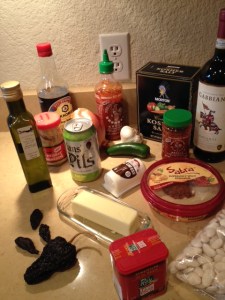
And if after all this you’re wondering what basks in my kitchen pantry:
photo(13)

This last appeared here in November  2018.

Parting from Wang Wei (after Meng Haoran)

P1010508


Parting from Wang Wei (after Meng Haoran)

These quiet days are ending
and now I must leave.

I miss my home’s fragrant grasses
but will grieve at parting – we’ve

eased each other’s burdens on this road.
True friends are scarce in life.

I should just stay there alone, forever
behind the closed gate.


* * *

“Parting from Wang Wei” is included in my micro-chapbook, No Eye But The Moon’s, available via free download at Origami Poems Project.

The transliteration on Chinese-poems.com reads:

Quiet end what wait
Day day must go return
Wish seek fragrant grass go
Grieve with old friend separated
On road who mutual help
Understanding friend life this scarce
Only should observe solitude
Again close native area door

file5971307479422

Poem Up at Panoply


My poem “My Mother’s Ghost Knits a Scarf of Chain,” has been published in Issue 14 of Panoply along with work by such luminaries as Vivian Wagner, Megan Wildhood and Robert Nisbet. I’m thrilled to have a poem in this issue!


Sheng-yu’s Lament (after Mei Yao-ch’en)

DSC_1243


Sheng-yu’s Lament (after Mei Yao-ch’en)

First heaven took my wife,
and now, my son.
These eyes will never dry
and my heart slowly turns to ash.
Rain seeps far into the earth
like a pearl dropped into the sea.
Swim deep and you’ll see the pearl,
dig in the earth and you’ll find water.
But when people return to the source,
we know they’re gone forever.
I touch my empty chest and ask, who
is that withered ghost in the mirror?


* * *

“Sheng-yu’s Lament” is included in my micro-chapbook, No Eye But The Moon’s, available via free download at Origami Poems Project.

The transliteration on Chinese-poems.com reads:

Heaven already take my wife
Again again take my son
Two eyes although not dry
(Disc) heart will want die
Rain fall enter earth in
Pearl sink enter sea deep
Enter sea can seek pearl
Dig earth can see water
Only person return source below
Through the ages know self (yes)
Touch breast now ask who
Emaciated mirror in ghost


SAM_0841