Scarecrow Dreams


Scarecrow Dreams

If by night I move without aid,
what then? Precious flesh, precious
bone, never mine to lose – the difference
between nothingness and no thing. A
pity that my friends fly at the merest
movement, but when the air’s breath
stills, they sing and rattle among the
grain, scribing their days in song
and footprints, seeking the available
on the ground. And what scrolls lower
than the sound of sunflowers turning?
The laughing daughter runs around
my lattice spine, scattering joy like so
many seeds, and when my hollow
fingers clench, the earth quivers, or
so it seems. Then midnight returns
and I disengage and stalk about,
scaring rodents and their predators,
hooting in harmony with the owls
reveling in the night air, remembering
the holy shirt, a yellow glove, corn
silk’s gleam at noon and the warmth
of your fingers against my burlap skin.
I do not breathe, I say, but I exist. By
morning what joins me but the tune
of yet another bird, unseen, melodious,
the pulse of morning’s dew. Eternity.
How my straw tongue longs to sip it.


“Scarecrow Dreams” first appeared in the summer 2017 edition of Eclectica. Many thanks to poetry editor Jen Finstrom, for publishing several of my scarecrow poems.

Bent


Bent

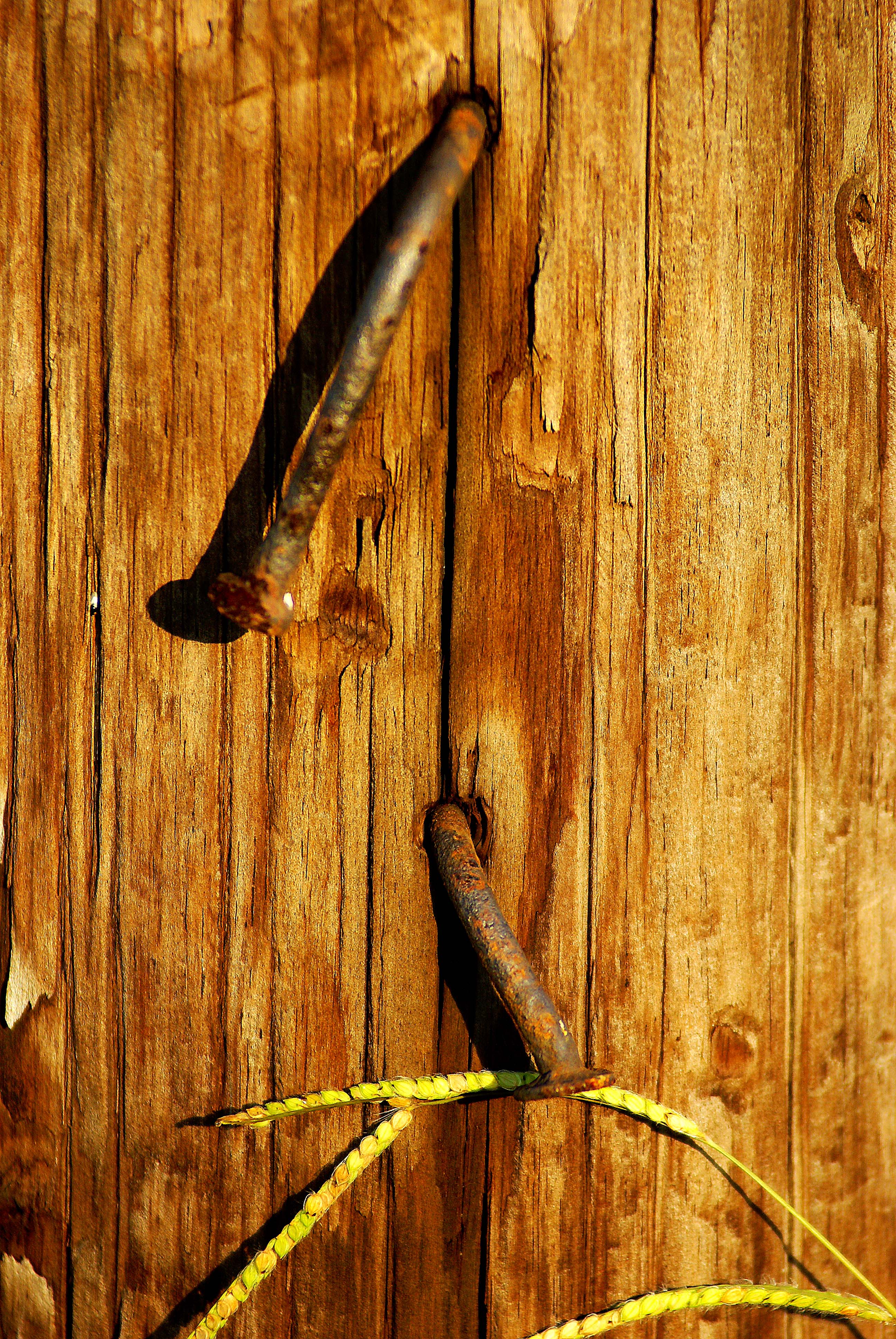
We’ve seen some version of the nail
curled over, the head angled at 90 degrees
or parallel to its body, just above

the penetration point. Three years ago
a tornado powered a single straw stem
through the oak’s bark and into its trunk,

illustrating the Old English beonet, for
“stiff grass,” and sadly conjuring the image
of a blade affixed to a firearm’s muzzle, the

etymology of which lies elsewhere, in Gascony.
And when we consider mental inclination,
signifying deflected, turned, or not straight,

we might also include an earlier past participle
meaning “directed in course.” But even the
tree’s armor could not deter the twister’s

wrath, and the hammer, no matter my aim
or purpose, seems intent upon glancing off
the nail, twisting it, leaving us, again, bent.


“Bent” first appeared in the print publication Ristau: A Journal of Being in January 2018.


Boxcar

boxcars


Boxcar

Whose voice lingers
among the gathered stones,

raised then lowered as if
to ensnare followers?

This is not the issue.
Nor should we speak of paper

shuddering in the wind
and the dense glare of shovels

in the night underfoot.
Pray that the road continues

beyond the next curve
or increment of time.

Trust in motion,
the reticence of trees.


paper leaf

“Boxcars” first appeared here in November 2015. It had been moldering in a folder for three decades when I uncovered it. I have no idea what originally sparked it.

Awakened, He Turns to the Wall (Cento), with Recording

cell


Awakened, He Turns to the Wall (Cento) 

Then, everything slept.
Where were you before the day?

You see here the influence of inference,
whereby things might be seen in another light,

as if the trees were not indifferent, as if
a hand had suddenly erased a huge

blackboard, only, I thought there was
something even if I call it nothing,

like the river stretching out on its
deathbed. No one jumps off.


* * *

A cento is composed of lines from poems by other poets. This originated from pieces by: Larry Levis, Jacques Roubaud, Lorine Niedecker, Gustaf Sobin, Denise Levertov, Elizabeth Spires, William Bronk, Vicente Huidobro, Ingebord Bachmann

For further information and examples of the form, you might peruse the Academy of American Poets site: http://www.poets.org/poetsorg/text/poetic-form-cento


erase


Epiphanies

Don't Say That jar, collecting coins for bad words


Epiphanies

What greater doubt
than if

preceding only,
or hope cascading through the withheld
unspoken phrase?

Or the conditional, as it slows to place
an obstacle in its very own
path. If only I could

I would deny its existence,
but the conjunctive

bears blame as well,
though nothing’s put before

the preposition (which one
would certainly never end with).


* * *

“Epiphanies” first appeared here in April 2015.


CUE 8


Heroes

splash


Heroes

And the rain, again, takes up our day,
folds it into threes, and watches
as the world wraps up its gift,
first at the edges, then centered,
with more confidence and force
than justified. Who will forget
the hollow horse and its stifled
coughs, the stench of men too
long unbathed and drenched
in fear. Or the small girl running
naked, arms outstretched, skin
peeling, her life become a litany
of pain embroidered across
the unfeeling sky. Do not thank me
for your freedom, the mortgage
and its tax breaks, your designer
shoes. We didn’t bleed for you.


“Heroes” first appeared in Blue Fifth Review. Many thanks to editor Sam Rasnake for accepting this piece.


To the Light Entering the Shack One December Evening (with recording)


To the Light Entering the Shack One December Evening

No prayers exit here, nothing
limits you. I never knew
before.

The pear tree’s ghost shudders.

Water pools in the depression of its absence.

For years I have wandered from shadow to
source, longing. Now, at rest,
you come to me and fear
evaporates. I would like to count
the smallest distraction.
I would like to disturb.

You are the name
I whisper
to clouds.

Will you leave if I open the door?

A carnival germinates in my body.

You are not death, but its closest friend.

Darkness parts, folds around you.

I close my eyes and observe.

* * *

“To the Light Entering the Shack One December Evening” first appeared in Shantih in December 2016, and is included in my chapbook, From Every Moment a Second available  through Finishing Line Press and Amazon.com.

This Oak


This Oak

Never rooted in Tibet,
has not watched a whale breach
a November Pacific dusk, or guzzled
bitter beer near Vesuvius. Nor has it
absorbed the warmth of a loved one’s
hip on a frozen morning long after
the embers’ glow has greyed
and the windows blossomed
white. It cannot know the beauty
of disparate instruments playing
in joyous harmony. It will whisper
no incantations, does not smile,
won’t ever feel the anticipation
of a first kiss after a complicated
courtship. The bouquets of Bordeaux
elude it, as do tears or the benefits
of laughter. Why, then, do I envy it so?


“This Oak” was published in Slippery Elm (print only) published by Findlay University in Findlay, Ohio, in spring 2019. As luck would have it, I, along with four others, am reading at Findlay University tonight, Tuesday, October 15. Who would have thought this backyard Texas poet would be reading in Ohio?


Letter to Wright from Between Gusts

pickles


Letter to Wright from Between Gusts

Dear Tami: The wind here speaks an undiscovered language:
diffident, it lurks in the background, stuttering, fingering
everything, shifting directions, mocking us, barely noticeable
until it gets pissed off and BLOWS! Then, shit happens. Pickle
jars appear in purses. Love notes remain unwritten. Shingles
flap across the lawn and idiots are elected to office (nothing new,
I know). When I was a kid I marveled at those fortunates who
lived under the same roof for years, for decades, entire lives, while
my family rolled around the globe, collecting vaccination scars
like postcards or nesting dolls. How interesting, I thought then,
to know and be known, to avoid the perpetual newcomer’s
path. Having shared this house with my wife and various dogs,
birds, rodents, insects and arachnids for thirty-three years, I now
know this – home is not a stationary edifice. No cornerstone
defines it any better than fog rubbing the juniper’s tired back,
or courting mayflies announcing warmth’s arrival in their brief
pre-death interludes. Desire is a feckless mistress; after obtaining
the prize, we miss the abandoned and wonder what might have
been. When you arrive at your new town remember this: no one
is stranger to you than yourself. I speak from experience, having
absorbed differences at one end only to watch them emerge
hand-in-hand at the other, like newborn twins or nearly forgotten
reminders of an uncle’s kindness in a year of typhoons and sharp
replies and rebuilt lives. Home is a smile, a lover’s sleepy touch
at 3 a.m., or the secret knock between childhood friends reunited
after decades. It lives in soft tissue, not steel, and breathes water
and air, flame and soil and everything between. But it can’t exist
without your mind and body lugging it around. I would like to
tell you what the wind is saying, but it’s singing different tunes
these days, and my translation skills begin and end in that still
place between gusts, floating in the twilit air like so many empty
pockets. These are the only words I have. Not much to hang a hat
on, and I apologize for my shortcomings and inability to expound
with clarity. I speak in poetry, but mean well. May your moons
be bright and your winds wild yet gentle, even if you can’t fathom
their meaning. I’ll keep trying if you will. All the best, Bob.

* * *

“Letter to Wright from Between Gusts” was first published in The Lake in August 2017, and is also included in Volume 2 of Oxidant/Engine’s BoxSet Series, as part of my 10-poem collection titled “The Language of Bread and Coffee.”


Ramekin


Ramekin

I speak when you speak,
say nothing to your everything.

The world is a ramekin filled with bits of ourselves.

It is a recipe for error,
a list of adorations and illusion.
You take my hand and say when I’m gone
there will be others.

The ingredients include vinegar and salt, but no honey.

You hear what I hear, only more.
Teach me to breathe.

Empty this dish.

Tell me.


“Ramekin” was first published in the online anthology Igxante: An Ontology. I am grateful to editor Kate Morgan for taking this piece.