
Which Poet, Which Beer (3)

beer

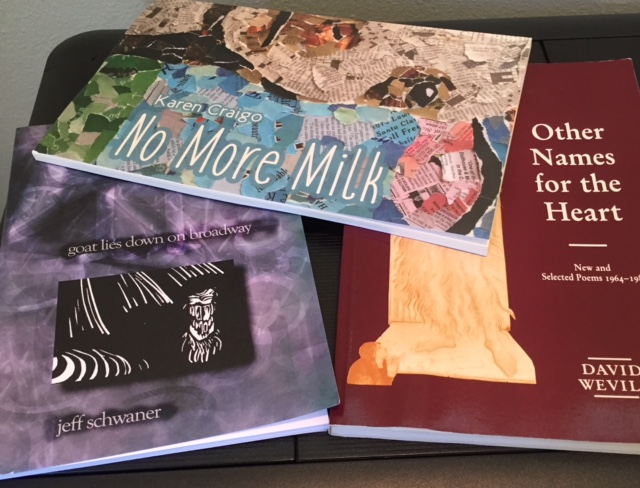
Nebraska Brewing Company’s Melange a Trois, a strong Belgian-Style Blonde ale, aged for six months in French Oak Chardonnay barrels, carries a good bit of the wine, with citrus and a hint of vanilla. A little musty, with an excellent frothy head, which, I believe, could describe me most mornings. But I digress. Deceptively strong (11+ ABV) with a pleasant bitterness. I would pair this with a plate of cured meat and David Wevill’s Other Names for the Heart: New and Selected Poems 1964-1984.

He writes in “Grace”:

… Sometimes lately

a bird you can’t identify has flitted close
and sung from the branches of his hands.

He leaves us touching ourselves.

Over the past thirty years, much of Wevill’s writing has left me with unrequited questions, with an itch to branch out, to learn more, to delve deeper into what makes us human.

But there are those days when introspection flies out the back door into the overgrown backyard, and all you want to do is sit back, watch the football game, relax, be entertained, escape. On those days I’ll break out a few cans of Austin Beerworks Pearl Snap, a German-style pilsner, moderately malty, straw-colored, with citrusy hops evident. A clean, palate-cleansing drink, good with nachos or chips, or hell, even with a Greek salad (heavy on the feta and olives, please). And if you’re like me and can’t devote yourself fully to the game, multitask – dip into Jeff Schwaner’s Goat Lies Down on Broadway, and absorb “Goat Reads the Signs”:

The sun rises like music
every morning. Wind goes
around the world and comes
back in a week or two. Goat
waits on top of a hill, judging…

As do we. Don’t stop there. Continue. Turn off the tube – one team will win, the other will lose. But Goat never wins. Goat never loses. Goat befriends Jerry Falwell. Goat eats Jerry’s tie. Goat ingests Sartre. Goat dies. “Goat is never dead.” A lively read, to say the least.

And speaking of lively, Independence Brewery’s Lupulust is a traditional Belgian-style tripel with a touch of modern hoppiness. It pours with a big head and spicy, floral notes, with a dry finish, reminding me of Karen Craigo’s No More Milk, in which she speaks of life – ordinary life – which, in her hands, becomes like that floral scented, big, hoppy beer. In “Scat with Mourning Dove” the narrator wakes “to syncopated song” and marvels at the bird’s jazz refrains from her place in bed with “a body warm against mine,” celebrating

how God made us, made jazz,
made an instrument of a dove.

Sip this book. Share it with friends. Take it to bed with a glass of warm milk. Savor it.
no-more-milk

“Which Poet, Which Beer (3)” appeared here in September 2016.

Martín Espada’s “Letter to My Father”

I was fortunate enough to hear Martín Espada read this poem live last week. It’s a powerful piece to read, but listening to him perform was especially sublime. You can do both at The Poetry Foundation.


Dog

photo(18)

Dog

Not away, but after
or contrary,

the reversal indicative
and untoward: scratching,

she spirals to the perfect
spot between us, touching both,

then sighs. In comfort, in ecstasy,
in contentment, who can say?

But we sigh in response.

SONY DSC

“Dog” first appeared on the blog in October 2014. The photo is of Apollonia, aka Apple.

Call for Submissions: Poems for Peace: Anthology

The deadline is fast approaching.

August 1, 2018 deadline!

poems for peace: an anthology to uplift encourage & inspire

This anthology, poems for peace (forthcoming, fall 2018), is the love-child of a group of poets and listeners who have been gathering quarterly in San Antonio, Texas since Nov. 11, 2017 in association with the San Antonio peaceCENTER.  This anthology will be published as a peaceCENTERbook, with all proceeds going to support the CENTER.

While we are aware that many horrors occur in our world and that, as a people, we seem to be in turmoil and conflict on many fronts, our aim is to provide respite from the apparent problems and to purposefully turn our attention to the good, the Whole, the Holy, that which is full of peace and comfort.

For this inaugural issue of poems for peace, we seek work that is metaphysical, celebratory, fun, funny, lighthearted, playful, thoughtful, warm, tender, beautiful, compassionate, heart-opening, or spiritual without proselytizing, nostalgic without being overly sentimental, empowered without being politically charged and rich with imagery and story but not with graphic insensibility or dealing with overtly, hot topics that may trigger anxiety or anger in the listener (like abuse issues, natural disasters, or tragedy in general).

Rather, we seek work that uplifts, encourages and inspires.  We are especially interested in the metaphysically broad; we look for the profound, real, fearless, gender-inclusive, curious voice.

Guidelines:

Please send 3-5 previously unpublished poems of up to ten pages in length and in any form in a single Word document, making sure that no identifying information appears within the document.  Include a brief, bio (100 words or less) in your cover letter.  Submissions are being hosted by Moon Shadow Sanctuary Press via Submittable only (see link below).

The book will be perfect bound and available online through the  peaceCENTERbook link and other online venues plus locally in bookstores TBA.  Poets included in the anthology may be invited to participate in future poets for peace events.  For more information or to ask questions about poets for peace or submissions, look for us on Face Book, or send us a message here:  fb.me/poetsforpeaceSA

Deadline: August 1, 2018

Click here to submit: https://moonshadowsanctuarypress.submittable.com/submit

Poem Up at Vox Populi

My poem “Letter to Marshall from the Scarecrow’s Pocket” is live at Vox Populi, paired  with an analysis of Putin’s payoff on his financial investments in Trump’s career.

Thank you, Michael Simms, for supporting and featuring my poetry.

Night Journey (after Tu Fu)

IMGP3335

Night Journey (after Tu Fu)

Wind bends the grass along the road.
A lonely truck passes by.
Stars reach down to touch these hills
and the moon drifts behind.

No one will ever know my poems.
I am too old and ill to work.
Circling, floating, who am I
but a vulture looking down.

First posted in March, 2014.

This is not a translation, but rather a version, my “take” on a famous Tu Fu poem. I claim no abilities in translation, neither speak nor read Chinese, and instead depend upon the skills of those who have ventured into these difficult reaches. This is where the poem carries me, a middle-aged Texas hill county dweller, in the Year of the Horse, 2014.

“Night Journey” is included in my micro-chapbook, No Eye But The Moon’s, available via free download at Origami Poems Project.

Here’s the transliteration on chinese-poems.com:

Nocturnal Reflections While Traveling

Gently grass soft wind shore
Tall mast alone night boat
Stars fall flat fields broad
Moon rises great river flows

Name not literary works mark
Official should old sick stop
Flutter flutter what place seem
Heaven earth one sand gull

My goal was to retain the mood, as I understand it, of the original, and to place it into my personal context. An interesting exercise.

Henry Lee Remembers Grandmother’s Garden

Trigger Warning: This poem, from the viewpoint of a serial killer, is the creepiest thing I’ve ever written. After reading it, my wife said “I’m not sure I want to share a bed with the man who wrote this.”

Henry Lee Remembers Grandmother’s Garden

I smile and recall the sparrows,
wings separated from their torsos
and nailed to the cedar fence

like so many unachieved desires,
an occasional feather ruffling
in the breeze, simulating flight,

their power now all mine to savor.
Art begins in the heart’s
crotch, compresses through the ribcage

and up the vertebrae, drills through
the skull, directly behind the eyes,
emerging as idea, as will or compulsion.

Or release. I loved those birds,
pulling them apart, arranging their
pieces by odor. How, rising from

dirty little mounds, their outstretched
feet squeezed the air from my
lungs, sharp bursts scattering

into the sun’s evening gore. I have
attained no higher state in the years
since that day. While the flies and one

lone wasp buzzed happily around me,
proof that wings claim neither heaven
nor earth, that godness lies within,

I lay there in the splendor
of the torn and detached, among
heads and crops, my fingers caked

black and stiff, wondering which
treasures, what other
sweetness the week would bring.

* * *

“Henry Lee Remembers Grandmother’s Garden” first appeared in Taos Journal of International Poetry & Art in February 2017. I’m grateful for editors Catherine Strisik and Veronica Golos for featuring my work in their journal.

I’d read an article on what not to write about – reminiscences of grandmothers, gardens, birds and so forth – and couldn’t resist inserting those elements into a poem. The editor who wrote the article rejected an earlier draft of the poem…

The Underbelly of This Seam


The Underbelly of This Seam

Slides beneath your gaze, unnoticed,
but the joining satisfies that particular

urge, combining two separates
into one whole, creating this new

piece. I thumb the string on every fourth
beat, anchor the cloth, pull it taut, and stitch.

What better material than air and silence?
Yesterday’s tune, tomorrow’s silk?

A fine breath zigzagged down the edge – frayed
lines, beneath, on the other side, testifying

to the struggles of the unseen. I exhale,
strike another note. You hum something new.

* * *

“The Underbelly of This Seam” was drafted during the August 2016 Tupelo Press 30/30 Challenge. Many thanks to Ursula, who sponsored the poem and provided the title.

Roast Chicken (recording)

roast-chicken

“Roast Chicken” was first published in Kindle Magazine in December 2015, and also appeared in Gossamer: An Anthology of Contemporary World Poetry. 

Roast Chicken

Contemplating the afterlife of birds,
I empty the carcass. My wife
offers rosemary sprigs,

which I stuff into the cavity
with whole garlic cloves
and seared lemon halves,

and then I compact it by tucking
the wings under and pushing
one leg through a slit in the other,

lessening the surface. One might
debate the shape of a bird’s
soul, the sanctity of structure

and limitation, of ritual and
the weight of fire’s gifts in
human brain development,

but trussing is essential
to the goal of proper
temperature attainment.

I pat it dry, sprinkle kosher salt
on the skin, put it in the oven,
set the timer for an hour, pour wine.

Following custom, we eat
without saying grace.
Piece by tender piece, it descends.

Aftermath


Aftermath 

   rust. Being one phase of corruption, a matter of
resolve. When I surrender, the implication is of giving
over, moving above, allowance. Delivering despite
the steady flaking away at what colors me intact.
The quiet evening had lulled me to this inevitability:
when oxides subsume the original metal, the expansion
may result in catastrophe. Yesterday’s arc, tomorrow’s
trial. Failure’s bloom.

* * *

“Aftermath” first appeared in the print publication Sheepshead Review. Thank you to Audrey Schultz and staff for taking this poem.