I’m pleased to offer this Q&A with poet Lynne Burnett:

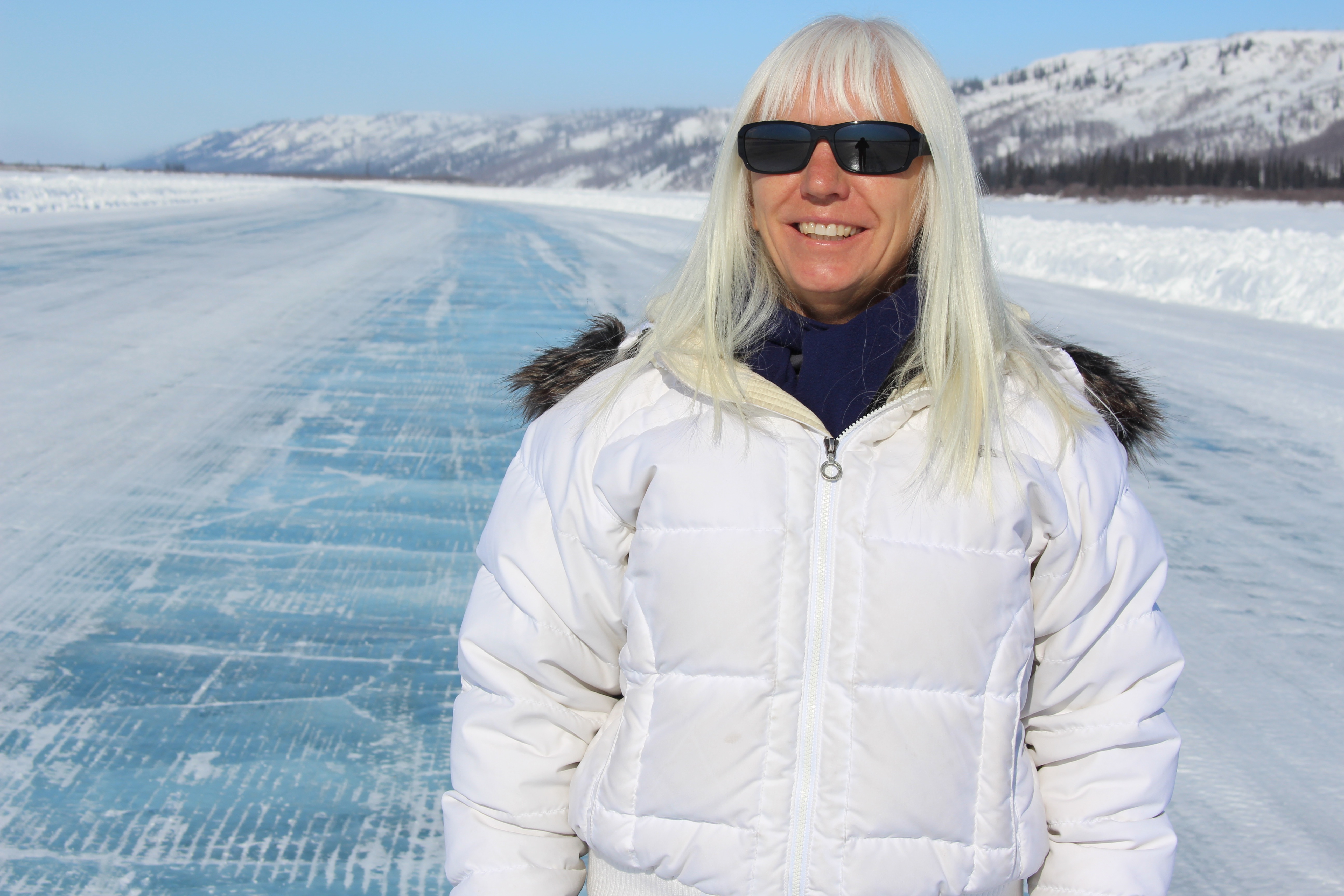
Lynne Burnett on the old Ice Road (Mackenzie River) between Inuvik and Tuktoyaktuk (inside the Arctic Circle).
Your chapbook, Irresistible, has recently been published. Can you tell us something about it?
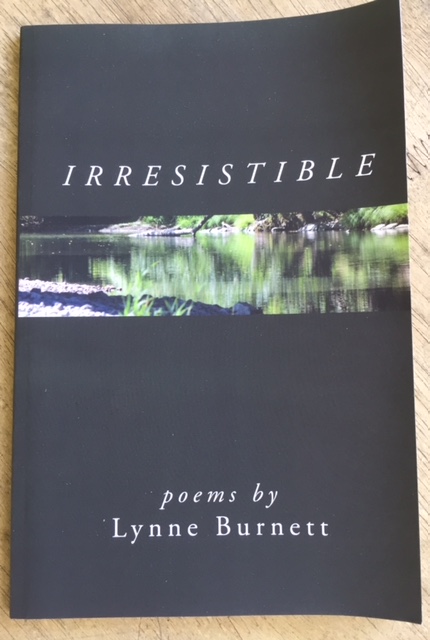
The poems in this book have transitions in common – from death and dying, whether accidental or planned, to milestones such as a son leaving home etc. There’s love palpably felt after death and beyond it, little epiphanies from near-disasters, the whole subject of death from many different angles – the news that breaks us, how our lives are enlarged by telling moments. The title poem “Irresistible” and “Tandem Hang-Gliding Incident” seemed to embody our human failings and the unnecessary accidental deaths we suffer as a result. But also, physically, death is inevitable and therefore irresistible – we can’t resist it. It will happen sooner or later: our first breath inspires our last, so to speak, and our last – for those believing there’s more beyond our bodies – inspires our first on a different plane. Physically our time here on Earth is limited and I think this awareness allows an appreciation for the preciousness of life in all its forms (my chapbook includes animal journeys as well as human ones). I seem to be fascinated with this subject as it creeps into a lot of my poems!

(Note to blog readers from RO: Each time I read this book, I find something new to appreciate. You will, too.)
Would you mind sharing a bit about your background?
I was born in London, England, emigrated to Toronto, Canada at age 4, left home at 18. There followed 3 out of an expected 4 years of university (and poems published there) mixed in with travel to Scotland, Wales and England (my hippy years – this was the early 70’s), before returning to Toronto to work for 2 years and then coming west to Vancouver, where I’ve lived 40 years now. Although I’m not politically oriented in my poetry, I’ve always had a vision of what’s possible for this beautiful world we find ourselves in. As a result, I took myself to Findhorn, Scotland for awhile back then, took the Erhardt Seminar Training (EST) in London and was generally quite involved with the human potential movement of that time. In 1975 I began Transcendental Meditation and have been a regular meditator since, which I think has been helpful to my writing (and sanity!). Anyway, after venturing west to Vancouver, I met my husband and voila – here we are 38 years later! I became an instant step-mom to 2 wonderful kids then but having my own took another 8 years, so the older ones were leaving high school when Stewart was born (he did the author and cover photos for my book) – so it was like raising 2 families back to back and as a result, with the intensity of those 2 experiences, writing got put on the back burner until my son was 10 and I could take time for myself again. I was happy about this and do not regret that 20 year gap in writing – in fact I learned that “one hand shakes the other” so to speak and when the time is right, everything you thought you’d lost or forgotten floods the page again and even better – has matured with time. Anyway, aside from third year university courses on the Romantic Poets in the early 70’s, all my learning about craft etc. has come from my own wide reading and study: I’m self-taught.
Please tell us how or why you turned to writing poetry?
Though I feel like I was born poetically inclined, I remember writing down my first poem at age 9. It was a rhymed poem of many verses, about the path to God/light/worlds unknown, probably influenced by the fact we lived next door to the minister, played with his children, saw him every Sunday. Poetry has always been a way to express deep emotion that was otherwise inexpressible, a way to articulate thoughts and feelings I struggle to voice. We moved every year/year and a half in and around Toronto so I was always changing schools, making new friends. Being shy, quiet and introverted, books, paper and pen were my confidants. As the oldest child of divorced parents, I wanted to be “good” and do good as a person. But on the page I could be dangerous, unpredictable, angry or ecstatic; I could question things. And did. I wrote steadily until my mid-twenties and published here and there – sometimes in university journals, once in Chatelaine (which paid me $50 for a 9 line poem back in 1971 – imagine!). But once I married, fewer poems got written than nightly dreams and those that did were filed away for 20 years before I began sending them out into the world. I think those years of apparent non-activity were a fertile darkness and everything experienced during that time got written into my body and soul. All to say writing poetry involves living a life – everything contributes and is necessary.
What is the relationship of your environment, your daily surroundings, to your writing?
Important! Especially nature – I grew up when you could walk to the end of your street at the age of 8 or 9, roam the fields there all day, only returning for supper – before strip malls replaced them. This is where I discovered I had a natural leaning to meditation, because I’d lie on the grass or sit against a tree and disappear into the silence, often emerging with phrases, images to write about. I have more than one big window in my den so I can sit at my desk and write, looking outside. If ever I’m stuck in a poem, going for a walk quickly loosens things up (I walk every day). That or ironing! The physical motion seems to freshen the creative process. We boat in the summer for several weeks and as much as possible anchor out in very remote bays – no cellphone/internet/newspapers/tv!!! That immersion in wild nature and largely living from the sea (catching prawns, crabs, salmon, cod) is extremely nourishing to me. Many poems are later drawn from that experience.
If you were a poetic form, which would you be?
Hmmm, I think I’d be a haiku because it’s so succinct. I love things in a nutshell! However, I’m also partial to the sonnet, with its twist and turns.
We’ll continue Part 2 of this Q&A in a few days, but in the meantime, you might visit Lynne’s blog to read a sample of her poetry, after which you’ll likely feel an irresistible urge to purchase Irresistible, which is available through Amazon.com and Finishing Line Press.








 O at the Edges